
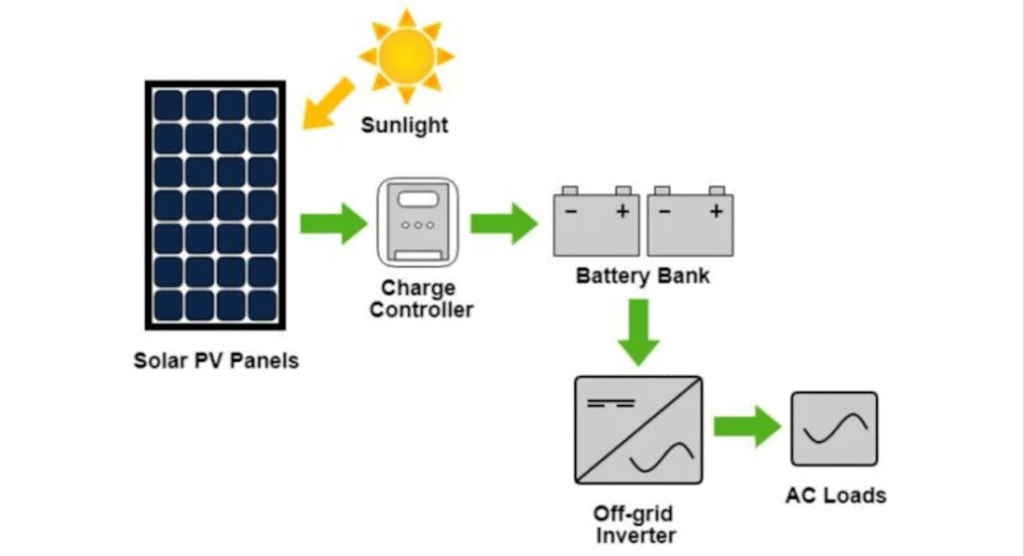
Meta Description
Learn how to size a lead acid battery bank for solar systems. Step-by-step guide with formulas and examples.
Keywords
solar battery bank size, battery sizing solar, lead acid battery bank calculation
Introduction
Correct battery sizing is essential for a solar energy storage system. Undersized batteries lead to power shortages, while oversized systems increase unnecessary costs.
This guide explains how to properly size a lead acid battery bank.
Step 1: Calculate Daily Energy Consumption
List all electrical loads:
| Device | Power (W) | Hours | Energy (Wh) |
|---|---|---|---|
| Lights | 100 | 5 | 500 |
| TV | 150 | 4 | 600 |
| Total | 1100 Wh |
Step 2: Determine Backup Days
Decide how many days the battery should supply power without sunlight.
Example:
- 2 days backup
Step 3: Calculate Total Energy Required
Formula:
Total Energy = Daily Consumption × Backup Days
Example:
1100 Wh × 2 = 2200 Wh
Step 4: Adjust for Depth of Discharge
For lead acid batteries:
- Recommended DOD = 50%
Formula:
Required Capacity = Total Energy ÷ DOD
2200 ÷ 0.5 = 4400 Wh
Step 5: Convert to Ampere-Hours (Ah)
Formula:
Ah = Wh ÷ Voltage
For 48V system:
4400 ÷ 48 ≈ 92Ah
Step 6: Add Safety Margin
Add 10–20% extra capacity:
👉 Final capacity ≈ 110Ah
Step 7: Choose Battery Configuration
Example:
- 4 × 12V batteries in series → 48V system
Common Mistakes
- Ignoring DOD
- Not considering backup days
- Underestimating load
Conclusion
Proper battery sizing ensures:
- Stable system operation
- Longer battery lifespan
- Better cost efficiency
FAQ
Q1: What happens if battery is too small?
System will run out of power.
Q2: Can I oversize battery?
Yes, but cost increases.