
Introduction
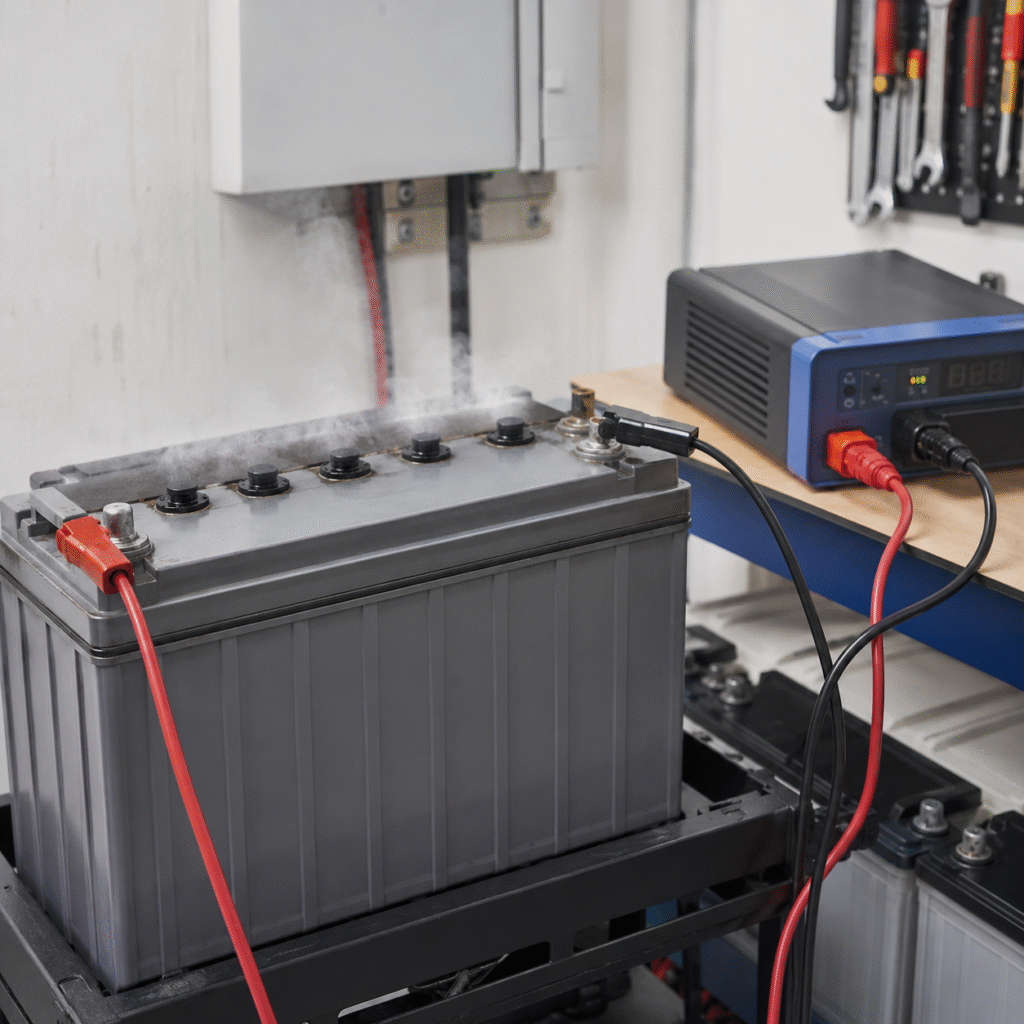
A strong rotten-egg or sulfur-like smell coming from a lead-acid battery room is not a normal condition that should simply be ignored.
It may appear during:
- Battery charging
- Generator operation
- Equalization
- High-temperature operation
- UPS recovery after an outage
- Solar battery recharging after deep discharge
A slight change in odor around some flooded battery installations can occur during charging, but a strong rotten-egg smell can indicate abnormal battery conditions and potentially the presence of hydrogen sulfide.
This is very different from hydrogen gas.
Hydrogen itself is colorless and odorless. Hydrogen sulfide, by contrast, has the characteristic rotten-egg odor at low concentrations and is hazardous.
Stationary-battery inspection guidance from Vertiv specifically warns that a rotten-egg smell can indicate hydrogen sulfide and recommends leaving the battery area rather than remaining inside to investigate the source by smell.
Therefore, if there is a strong or unusual sulfur smell:
Do not continue normal operation and do not rely on smell as a gas detector.
The area should be handled according to the site’s battery-room and emergency safety procedures.
What Causes the Rotten-Egg Smell?
In a properly operating lead-acid battery, charging reactions are controlled within the battery’s designed voltage and temperature limits.
However, abnormal operating conditions can result in excessive electrochemical reactions, gassing, overheating, or decomposition products.
Possible causes include:
- Severe overcharging
- Excessive charging voltage
- Battery overheating
- Thermal runaway
- An internally damaged battery
- Incorrect equalization
- Charger failure
- One abnormal cell in a long series string
- Extended deep discharge followed by aggressive charging
The odor is therefore a symptom, not the root cause.
Hydrogen and Hydrogen Sulfide Are Not the Same Thing
This distinction is important.
Hydrogen
Lead-acid batteries can produce hydrogen during charging, particularly near full charge and during equalization.
Hydrogen:
- Has no smell
- Is highly flammable
- Can accumulate in poorly ventilated spaces
- Can create an explosion hazard
Hydrogen Sulfide
Hydrogen sulfide has a recognizable sulfur or rotten-egg odor at low concentrations.
It can be:
- Toxic
- Irritating
- Corrosive to certain metals
At higher concentrations, odor is not a reliable warning because a person may no longer perceive the smell effectively.
This is one reason technicians should never use their sense of smell as a method for determining whether a battery room is safe.
Reason 1: Charging Voltage Is Too High
Overcharging is one of the first conditions to investigate.
When charging voltage is above the battery manufacturer’s specified range, excess energy can produce:
- Increased electrolysis
- More gas generation
- Battery heating
- Water loss in flooded batteries
- Increased internal pressure in VRLA batteries
- Accelerated plate corrosion
The problem may affect:
- The complete bank
- Only one series string
- One individual battery
Check:
- Absorption voltage
- Boost voltage
- Float voltage
- Equalization voltage
- Number of battery cells configured in the charger
Do not use one generic charging profile for every lead-acid battery.
AGM, GEL, flooded, OPzV, and OPzS batteries may require different settings.
Reason 2: The Battery Is Overheating
Battery temperature has a major influence on charging behavior.
As temperature increases:
- Electrochemical activity increases.
- Battery charging current may increase.
- Gas generation may increase.
- Internal reactions accelerate.
In VRLA systems, excessive temperature can create a dangerous feedback mechanism:
Temperature rises → charging current rises → more heat is produced → temperature rises further.
This can develop into thermal runaway.
Abnormal odor together with a battery that is significantly hotter than nearby units should therefore be treated as a serious warning.
Check for:
- Failed battery-room air conditioning
- Poor ventilation
- Blocked airflow
- Direct sunlight
- Hot inverter exhaust
- Generator heat
- Battery spacing that restricts cooling
Do not judge battery temperature simply by touching the case if there is concern about an abnormal battery condition. Use appropriate temperature-monitoring equipment following site procedures.
Reason 3: One Battery Is Being Overcharged in a Series String
Consider four 12V batteries connected in series in a 48V bank.
The charger controls the total battery-bank voltage.
It may not know the voltage of each individual battery.
For example:
- Battery 1: 13.7V
- Battery 2: 13.8V
- Battery 3: 13.8V
- Battery 4: 15.2V
Total:
56.5V
The total charging voltage may look acceptable to the charger, while Battery 4 is operating at an abnormally high voltage.
That battery may:
- Gas excessively
- Become hotter
- Lose water
- Vent
- Develop abnormal odor
Always compare individual battery voltages when troubleshooting a series-connected battery bank.
Reason 4: Incorrect Equalization Charging
Certain flooded batteries may require controlled equalization under specified conditions.
However, equalization normally involves a higher voltage than routine charging and produces more gassing.
Problems arise when:
- Equalization voltage is too high.
- Equalization lasts too long.
- It is performed too frequently.
- Battery temperature is not monitored.
- The charger uses the wrong battery profile.
- Equalization is applied to a battery that does not permit it.
Automatic reconditioning or equalization should not be enabled casually.
Victron, for example, states that reconditioning is an optional stage for lead-acid batteries and that unnecessary or excessive use can reduce battery life because of increased gassing.
For GEL, AGM, and other VRLA batteries, do not apply flooded-battery equalization procedures unless specifically approved by the battery manufacturer.
Reason 5: The Charger Has Failed or Lost Calibration
A charger display may show the expected value while actual voltage is different.
Possible charger problems include:
- Voltage calibration drift
- Failed control board
- Incorrect voltage sensing
- Faulty temperature sensor
- Incorrect firmware settings
- Failed remote-sense connection
Always verify actual battery-terminal voltage using an independent calibrated meter.
Measure:
- Charger output voltage
- Battery-bank voltage
- Individual battery voltages
Do this according to the appropriate electrical safety procedure.
Reason 6: Incorrect Temperature Compensation
Lead-acid charging voltage is normally specified at a reference temperature.
If battery temperature rises, the charger may need to reduce the charging voltage according to the battery manufacturer’s temperature-compensation recommendation.
If the temperature sensor is:
- Disconnected
- Damaged
- Installed on the wrong battery
- Measuring room air rather than battery temperature
- Programmed with the wrong coefficient
the batteries may receive excessive charging voltage when hot.
This can increase:
- Gassing
- Water consumption
- Battery temperature
- Corrosion
- Venting
Reason 7: A Battery Has an Internal Fault
One battery may develop an internal problem that causes abnormal charging behavior.
Possible causes include:
- Partial internal short
- Separator damage
- Severe sulfation
- Grid corrosion
- Internal connection damage
- Loss of electrolyte
The abnormal battery may show:
- Higher temperature
- Unusual voltage
- Increased self-discharge
- Rapid voltage rise during charging
- Low voltage under load
- Stronger odor than nearby batteries
If one battery is clearly behaving differently from the others, it should be isolated and evaluated according to manufacturer and site safety procedures.
Reason 8: A Deeply Discharged Battery Is Being Recharged Aggressively
A badly discharged lead-acid battery may not accept charging normally.
If it is:
- Severely sulfated
- Internally damaged
- Left discharged for months
- Repeatedly over-discharged
applying high charging current or an aggressive recovery mode may result in abnormal voltage, heating, or gas production.
A battery that has been deeply discharged should first be inspected before attempting recovery charging.
Do not automatically use a high-voltage “repair” or desulfation mode.
What If the Smell Comes from an AGM or GEL Battery?
AGM and GEL batteries are VRLA batteries.
Under normal operation, much of the gas generated internally is recombined.
However, they contain pressure-relief valves.
If internal pressure becomes excessive because of:
- Overcharging
- High temperature
- Charger malfunction
- Battery failure
the valve can open and release gas.
An AGM or GEL battery that repeatedly vents should not be treated as a normal maintenance condition.
Unlike flooded batteries:
Do not open the case or add water to a sealed VRLA battery.
What If the Smell Appears Only During Equalization?
Flooded batteries can generate considerably more gas during equalization than during normal float charging.
However, a strong sulfur odor still requires investigation.
Check:
- Battery voltage
- Individual cell voltage
- Battery temperature
- Electrolyte level
- Equalization current
- Ventilation
Do not assume the smell is acceptable simply because equalization is active.
What If the Battery Is Also Making a Hissing Sound?
Hissing may indicate gas escaping through a vent.
Possible causes include:
- Overcharging
- High internal pressure
- Battery overheating
- VRLA valve operation
If hissing is accompanied by:
- Strong odor
- Swelling
- Increasing temperature
- Case deformation
- Leakage
stop treating it as routine charging behavior and follow the site’s abnormal-battery procedure.
Battery Room Ventilation Matters
Lead-acid battery installations require appropriate ventilation because charging can generate hydrogen.
The ventilation system should be designed according to:
- Battery type
- Battery quantity
- Charging current
- Charging method
- Room volume
- Applicable electrical and safety standards
Do not try to solve a charging fault simply by increasing ventilation.
Ventilation addresses gas accumulation.
It does not correct:
- Excessive charge voltage
- Thermal runaway
- Internal battery damage
- Charger malfunction
The root cause must still be identified.
Practical Troubleshooting Checklist
Step 1: Do Not Remain in an Area with a Strong Rotten-Egg Odor
Follow the site’s battery-room and gas-response procedures.
Vertiv’s stationary-battery inspection guidance recommends leaving the area when a rotten-egg odor indicating possible hydrogen sulfide is detected.
Step 2: Identify Whether the Problem Occurs During Charging
Record:
- Bulk charging
- Absorption
- Float
- Equalization
- Generator charging
Step 3: Check Battery Temperature
Compare all batteries.
One hot battery is especially important.
Step 4: Verify Charging Voltage
Measure actual voltage rather than relying only on the charger display.
Step 5: Measure Individual Batteries
Identify units with abnormal high or low voltage.
Step 6: Check Charger Settings
Verify:
- Battery type
- Absorption voltage
- Float voltage
- Equalization settings
- Temperature compensation
Step 7: Inspect the Battery
Look for:
- Swelling
- Leakage
- Case deformation
- Wet areas
- Corrosion
- Abnormal venting
Step 8: Review Recent Changes
Ask:
- Was the charger replaced?
- Was firmware changed?
- Was equalization enabled?
- Did air conditioning fail?
- Was a battery recently replaced?
- Was the bank deeply discharged?
Should You Continue Charging to See If the Smell Goes Away?
No.
A strong abnormal odor should not be treated as something to “test” by continuing charging.
Continuing to charge an overheating or defective battery can increase:
- Gas generation
- Temperature
- Pressure
- Battery damage
Determine the cause first.
When Should the Battery Be Replaced?
Replacement may be necessary when a battery:
- Repeatedly vents
- Becomes abnormally hot
- Swells
- Leaks
- Has substantially reduced capacity
- Has abnormal individual voltage
- Shows evidence of internal shorting
- Cannot be charged normally
For an aged series bank, the condition of the remaining batteries should also be evaluated before replacing only one unit.
Frequently Asked Questions
Does every lead-acid battery produce a smell while charging?
No. Normal battery operation should not produce a strong rotten-egg odor that is obvious throughout the battery area.
Is the rotten-egg smell hydrogen?
No. Hydrogen itself has no odor. A rotten-egg odor can indicate hydrogen sulfide.
Can overcharging cause the smell?
Yes. Abnormal charging and overheating are important causes to investigate.
Can an AGM battery produce a sulfur smell?
A VRLA battery can vent under abnormal internal pressure or charging conditions. Repeated venting requires investigation.
Can I simply open the windows and continue charging?
Ventilation does not correct the underlying charger or battery fault.
Should I smell close to each battery to find the bad one?
No. Do not use your nose as a gas detector.
Why does only one battery smell?
That unit may be overcharging, overheating, venting, or internally damaged.
Conclusion
A rotten-egg smell near a lead-acid battery bank should be treated as an abnormal condition rather than a normal feature of charging.
Possible causes include:
- Excessive charging voltage
- High battery temperature
- Thermal runaway
- Incorrect equalization
- One overcharged battery in the series string
- Charger malfunction
- Incorrect temperature compensation
- Internal battery damage
For solar, UPS, telecom, substation, and industrial battery projects, provide the battery model, battery age, charging voltage, float voltage, equalization settings, battery temperatures, individual battery voltages, charger model, and the exact operating condition when the odor appears.