
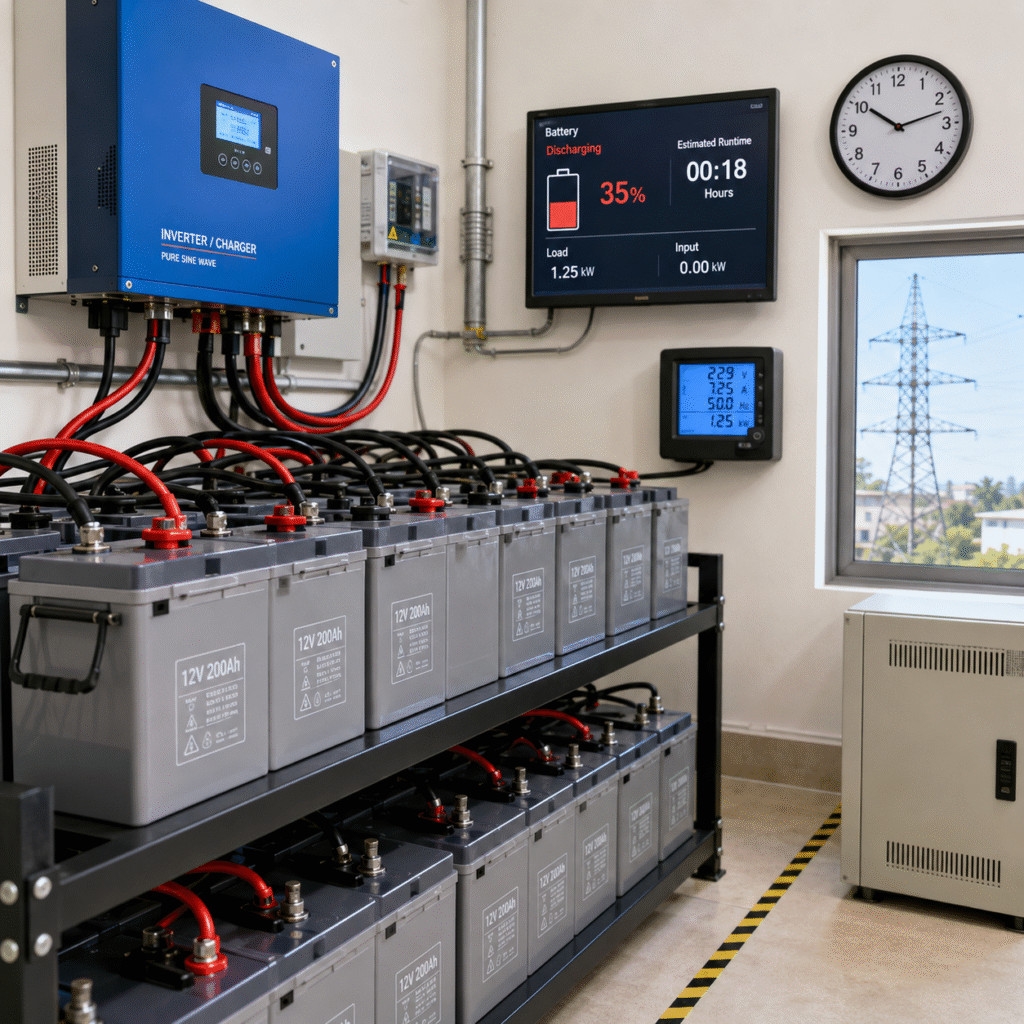
Introduction
A newly installed lead-acid battery bank is expected to provide full backup performance.
But sometimes the first discharge creates an immediate complaint:
“These are new batteries. Why did they last only four hours when we calculated six hours?”
The natural assumption is that the batteries are defective or that their Ah capacity is insufficient.
Sometimes that is true.
But a new battery bank can deliver shorter-than-expected runtime for many other reasons, including:
- Batteries were not fully charged before service.
- Commissioning charge was skipped.
- The Ah rating was misunderstood.
- The real discharge rate is much higher than the rated test rate.
- Temperature is below the rating temperature.
- Inverter losses were ignored.
- Connected loads are larger than the design calculation.
- Low-voltage cutoff is reached early.
- Cable voltage drop is excessive.
- One battery in the new string is abnormal.
A new battery should therefore be evaluated against its specified rating conditions, not simply the number printed on its label.
For example, EnerSys lists some stationary OPzS capacities at the C10 rate to 1.8V per cell at 20°C. This illustrates that an Ah rating is tied to a specific discharge duration, end voltage, and temperature—not every possible operating condition.
First Understand What “200Ah” Actually Means
Suppose a battery is labeled:
12V 200Ah
This does not mean it will deliver exactly 200Ah:
- At every current
- At every temperature
- To every cutoff voltage
- Through every inverter
Capacity is measured under specified conditions.
Typical battery data may define:
- C10 capacity
- C20 capacity
- 8-hour capacity
- Final voltage
- Test temperature
For instance, EnerSys lists certain stationary battery products at C10 to a specified end voltage and temperature, while US ratings may use an 8-hour rate and a different end voltage.
This means two batteries both labeled with an Ah figure may not have been rated under identical conditions.
Reason 1: The Battery Bank Was Not Fully Charged Before First Use
New does not mean fully charged.
Lead-acid batteries lose some charge during:
- Factory storage
- Sea transportation
- Warehouse storage
- Customs clearance
- Project installation
Storage temperature also influences the amount of charge lost.
Proper commissioning guidance emphasizes that the purpose of the commissioning charge is to ensure a new battery is fully charged before entering service or undergoing an acceptance capacity test. An improperly charged new battery may fail to deliver rated capacity.
Therefore, connecting new batteries and immediately performing a long discharge test can produce misleading results.
Reason 2: The Commissioning Charge Was Skipped
A common installation procedure is:
- Batteries arrive.
- Technicians install the cables.
- Charger is switched on.
- The system is immediately put into service.
This is not always adequate.
Proper commissioning may require:
- Physical inspection
- Voltage measurement
- Correct torque
- Initial charging
- Voltage stabilization
- Individual battery recording
The correct procedure depends on the battery model.
There is no universal commissioning voltage suitable for every AGM, GEL, OPzV, OPzS, or flooded battery.
The battery installation and operation manual should be followed.
Reason 3: The Battery Capacity Rating Was Misinterpreted
Consider a battery specified at:
200Ah C20
The 20-hour test current is approximately:
200Ah ÷ 20h = 10A
If the actual system discharges the battery at:
50A
the usable capacity will generally be lower.
This is a basic characteristic of lead-acid chemistry.
Therefore, a battery rated for long-duration discharge cannot be expected to deliver the same Ah capacity when discharged rapidly.
For storage systems using:
- Large inverters
- Pumps
- Air conditioners
- Heating equipment
the discharge rate should be checked against the manufacturer’s actual discharge table.
Reason 4: C10 and C20 Ratings Were Confused
This is especially important in international battery procurement.
Some stationary batteries are commonly specified at:
- C10
- C20
- 8-hour rate
These are not automatically equivalent.
If one quotation states:
200Ah at C10
and another states:
200Ah at C20
the performance conditions are different.
For B2B projects, purchasers should compare:
- Ah rating
- Discharge duration
- Final voltage
- Test temperature
rather than Ah alone.
Reason 5: Inverter Efficiency Was Ignored
Battery nominal energy may be calculated as:
Voltage × Ah
For example:
48V × 200Ah = 9.6kWh nominal DC energy
But AC appliances do not receive all 9.6kWh.
Energy is lost through:
- Inverter conversion
- DC cables
- Battery internal resistance
- Standby power
If the runtime calculation assumes 100% inverter efficiency, expected runtime will be too high.
Reason 6: The Complete Nominal Capacity Was Assumed to Be Usable
A lead-acid battery system should not normally be sized on the assumption that every nominal Ah will be used on every cycle.
The practical allowable depth of discharge depends on:
- Battery type
- Required cycle life
- Application
- Manufacturer data
If the project calculation assumes 100% discharge while the inverter is configured to stop at a more conservative voltage, actual runtime will be shorter.
This is not necessarily a battery defect.
Reason 7: Low-Voltage Cutoff Is Set Too High
The inverter may disconnect while the battery still has some available energy.
Suppose a battery manufacturer’s discharge table specifies performance to a certain final voltage under a defined current.
If the inverter stops significantly above that point, the system cannot use the complete rated test capacity.
This may be intentional to increase battery life.
When comparing measured runtime with a data sheet, check whether both tests use the same:
- Load current
- Final voltage
- Temperature
Otherwise the comparison is invalid.
Reason 8: Low-Voltage Cutoff Is Reached Because of High Load Current
Even when the cutoff setting itself is correct, a high load can create voltage sag.
The battery may be at a reasonable SOC, but high current causes loaded voltage to fall below the inverter cutoff.
When the inverter stops:
- Battery voltage recovers.
- Customer sees “normal” voltage again.
- Battery is accused of shutting down early.
This may be a power-delivery issue rather than insufficient stored energy.
Reason 9: Cable Voltage Drop Causes Early Shutdown
The inverter monitors voltage at its DC input.
For example:
Battery terminals: 46.8V
Inverter terminals: 44.5V
If inverter cutoff is 45V, it shuts down.
The battery has not reached 45V—the cable and connections have lost 2.3V.
Check:
- Cable cross-section
- Cable length
- Cable-lug quality
- Breaker
- Fuse
- Busbars
A new battery cannot compensate for badly designed DC wiring.
Reason 10: Actual Load Is Higher Than the Customer Calculated
Project calculations often use only the main appliances.
Hidden consumption may include:
- Inverter standby
- Cooling fans
- Routers
- CCTV
- Lights
- Control systems
- Pumps
- Chargers
- Transformers
Example:
Estimated load:
1,000W
Measured actual load:
1,350W
That 35% increase can significantly reduce backup time.
Use a power meter or battery shunt to measure real operation.
Reason 11: Motor Loads Have Startup Surges
The battery may support a 1kW running load but experience several-kilowatt peaks when a compressor or motor starts.
These surges can cause:
- Voltage sag
- Inverter shutdown
- High DC current
- Apparent “short battery runtime”
Applications include:
- Air conditioning
- Refrigeration
- Pumps
- Compressors
Battery and inverter sizing must consider peak power as well as average energy.
Reason 12: The Battery Is Operating Below Its Rated Temperature
Battery capacity is temperature-dependent.
EnerSys battery documentation explicitly shows discharge performance varying with temperature and discharge rate.
A battery rated under approximately room-temperature conditions may provide less capacity in:
- Outdoor winter cabinets
- Unheated warehouses
- Cold telecom sites
The battery may be perfectly new and healthy while still delivering shorter runtime than the room-temperature data sheet.
Reason 13: One Battery in the New String Is Abnormal
New battery banks can still contain an installation or individual-unit problem.
Possible causes include:
- Transportation damage
- One battery stored differently
- Poor terminal connection
- One battery at lower SOC
- Manufacturing defect
Measure individual battery voltage under load.
A weak unit may fall significantly faster than the others.
The total bank can only perform as well as its weakest series battery.
Reason 14: Batteries Were Installed with Different States of Charge
Even identical new batteries can arrive at slightly different SOC.
If the difference is large and the batteries are immediately connected in series, charging can become uneven.
One battery may reach high voltage early while another remains undercharged.
A proper commissioning charge helps reduce this risk.
Reason 15: One Parallel String Is Not Connected Correctly
A bank may appear to contain:
600Ah
but one of three 200Ah parallel strings may be:
- Disconnected
- Behind a blown fuse
- Open at a breaker
- Poorly connected
The system is then operating at only:
400Ah
Total voltage still appears normal.
This is why initial commissioning should include current-sharing checks where multiple strings are installed.
Reason 16: Battery Monitor Capacity Is Programmed Incorrectly
Battery monitoring configuration errors can make a new system appear defective.
Remember:
Series Connection
Four 12V 200Ah batteries:
48V 200Ah
not:
48V 800Ah
Parallel Connection
Three 48V 200Ah strings:
48V 600Ah
If the monitor or commissioning technician incorrectly adds the Ah values of series-connected batteries, expected runtime can be exaggerated dramatically.
Reason 17: The Customer Compared Nominal Energy with AC Energy
A common calculation is:
48V × 200Ah = 9.6kWh
then:
9.6kWh ÷ 1kW = 9.6 hours
This ignores:
- Depth of discharge
- Inverter efficiency
- High-rate capacity reduction
- Cable losses
- Cutoff voltage
- Temperature
Real runtime will therefore be lower.
A More Realistic Preliminary Runtime Formula
A simple preliminary estimate is:
Runtime ≈ Battery Nominal Energy × Usable DoD × Inverter Efficiency ÷ Load
Example:
- Battery: 48V 300Ah
- Nominal energy: 14.4kWh
- Planned usable DoD: 50%
- Inverter efficiency: 90%
- Load: 1.2kW
Estimated:
14.4 × 0.50 × 0.90 ÷ 1.2
= approximately 5.4 hours
Even this does not yet include:
- High discharge-rate reduction
- Temperature
- Battery aging
- Cable losses
For accurate engineering, use the manufacturer’s constant-current or constant-power discharge tables.
How to Test Whether a New Battery Really Meets Capacity
The correct approach is an acceptance or capacity test.
EnerSys provides capacity-test procedures based on a controlled discharge to the specified final voltage, with measured test time compared against the rated discharge time.
A formal test generally requires:
- Correct initial charging
- Appropriate stabilization
- Known discharge current
- Defined final voltage
- Battery temperature measurement
- Individual cell or battery monitoring
- Accurate timing
The test conditions must match the manufacturer’s specification.
Acceptance Test vs. Real-World Backup Test
These are not necessarily the same.
Acceptance Test
Used to verify whether the battery meets specified capacity under controlled conditions.
Real-World Backup Test
Includes:
- Actual inverter
- Real loads
- Real cables
- Site temperature
- System settings
A battery can pass an acceptance test while the installed system still provides insufficient backup because of:
- Inverter losses
- Cable voltage drop
- Incorrect sizing
Conversely, a poorly commissioned battery can fail an initial field test even though the battery itself is not defective.
Vertiv emphasizes that proper initial charging is necessary before an acceptance capacity test because an improperly charged new battery cannot be expected to deliver rated capacity.
Practical Troubleshooting Procedure
Step 1: Check the Battery Data Sheet
Confirm:
- Ah capacity
- C-rate
- Final voltage
- Rating temperature
Step 2: Verify Battery Configuration
Confirm:
- Batteries in series
- Parallel strings
- Actual total Ah
Step 3: Confirm Commissioning Charge
Was the manufacturer’s initial charging procedure completed?
Step 4: Fully Recharge
Use the correct charging profile.
Step 5: Measure Individual Battery Voltages
Check before and during discharge.
Step 6: Measure Actual Load
Do not rely only on appliance labels.
Step 7: Measure DC Battery Current
Compare with the expected discharge rate.
Step 8: Measure Battery and Inverter Voltage
Identify cable voltage loss.
Step 9: Check Temperature
Compare with the data-sheet rating condition.
Step 10: Conduct a Controlled Capacity Test
If the battery is still suspected of being under capacity, perform a proper acceptance test.
Common Buyer Mistakes
Comparing Price Per Ah Only
Two “200Ah” batteries may use different rating conditions.
Ignoring C10 vs. C20
Always compare capacity at the same discharge rate.
Requesting a Larger Battery Without Reviewing the Charger
A larger bank may not recharge fully.
Testing Immediately After Installation
Complete commissioning first.
Judging Capacity from Voltage
Voltage does not directly prove Ah capacity.
Ignoring End Voltage
The data-sheet capacity is tied to a specified final voltage.
Ignoring Temperature
A cold battery can provide less available energy.
Questions B2B Buyers Should Ask a Battery Supplier
Before purchasing batteries for a solar, UPS, telecom, or industrial project, ask:
- What is the battery’s rated Ah capacity?
- Is the rating C10, C20, or another rate?
- What is the final discharge voltage?
- At what temperature is capacity rated?
- Is constant-power discharge data available?
- What charging voltage is recommended?
- What charging current is recommended?
- Is a commissioning charge required?
- What acceptance-test procedure is recommended?
- What warranty conditions apply to capacity?
These questions make quotations much easier to compare.
Frequently Asked Questions
Should a new lead-acid battery provide 100% capacity immediately?
It should be correctly commissioned and fully charged before capacity is evaluated. Storage and transport can reduce SOC before installation.
Why is a 200Ah battery not delivering 200Ah?
The rating applies under specified current, temperature, and final-voltage conditions.
Is C20 capacity higher than C10 capacity?
For the same lead-acid battery, available Ah capacity is generally greater at a slower discharge rate, so rating conditions must be compared carefully.
Can a new battery have normal voltage but low runtime?
Yes. Incomplete charging, high load, cable loss, low temperature, or an individual battery issue can produce that symptom.
Should I immediately request replacement batteries?
First verify commissioning, test conditions, actual load, wiring, and individual battery behavior.
How can a buyer confirm capacity?
A controlled acceptance/capacity test using the battery manufacturer’s specified discharge conditions is the most reliable method.
Conclusion
A new lead-acid battery bank providing shorter backup time than expected does not automatically mean the batteries are defective.
Common causes include:
- Incomplete commissioning
- Battery not fully charged
- C10/C20 misunderstanding
- High discharge rate
- Incorrect depth-of-discharge assumptions
- Inverter losses
- High load
- Low temperature
- Early inverter cutoff
- Cable voltage drop
- Individual battery problems
- Incorrect series/parallel calculations
For battery procurement or project sizing, provide the system voltage, inverter power, load profile, required backup time, battery rating rate, installation temperature, charger specifications, and intended end-of-discharge voltage. These details allow the battery bank to be selected and evaluated on the correct basis.