
Introduction
One of the major advantages of OPzS batteries is that technicians can inspect the electrolyte directly.
Unlike sealed OPzV batteries, an OPzS battery allows maintenance personnel to monitor:
- Electrolyte level
- Electrolyte temperature
- Specific gravity
- Cell voltage
This provides valuable information about battery condition.
However, a common maintenance problem is:
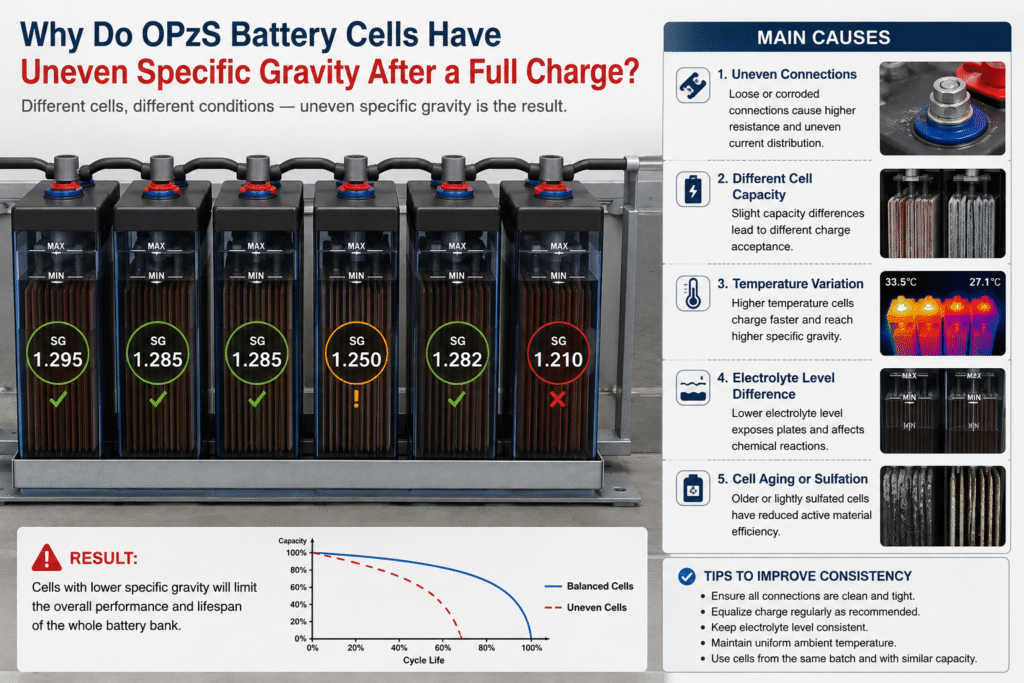
The battery bank has been charged, but several OPzS cells still show noticeably different specific-gravity readings.
For example:
- Most cells show similar electrolyte density.
- One or two cells remain lower.
- The total bank voltage looks normal.
- The charger has already entered float.
- Backup time may or may not be affected.
Does this mean the low-specific-gravity cells are defective?
Not necessarily.
Specific-gravity differences can be caused by:
- Temperature
- Electrolyte level
- Recently added water
- Electrolyte stratification
- Incomplete charging
- Cell imbalance
- Sulfation
- Internal cell problems
- Incorrect hydrometer technique
OPzS manuals specifically require technicians to evaluate electrolyte density together with temperature and electrolyte level because both conditions influence the measured value.
What Does Specific Gravity Tell Us?
OPzS batteries use a liquid sulfuric-acid electrolyte.
During discharge:
- Sulfuric acid participates in the electrochemical reaction.
- Electrolyte density decreases.
During charging:
- Acid concentration rises again.
- Specific gravity increases.
Therefore, specific gravity can provide valuable information about state of charge and cell condition.
However, the correct fully charged value is battery-model specific.
For example, some OPzS manufacturers specify approximately 1.240 kg/L at the reference temperature and maximum electrolyte level, but this should not be treated as a universal value for every OPzS product.
Always use the manufacturer’s data sheet.
Reason 1: Temperature Correction Was Not Applied
Specific gravity changes with electrolyte temperature.
Suppose two OPzS cells contain electrolyte at different temperatures.
Their raw hydrometer readings cannot automatically be compared as if both were measured at the same reference temperature.
Some OPzS instructions specify a temperature-correction factor and require readings to be converted to the manufacturer’s reference temperature.
Therefore, always record:
- Raw SG reading
- Electrolyte temperature
- Temperature-corrected SG
before concluding that one cell is abnormal.
Reason 2: Electrolyte Levels Are Different
Specific gravity also depends on electrolyte level.
When water is lost:
- Electrolyte volume decreases.
- Acid concentration can increase.
- Specific gravity may appear higher.
After water is added:
- Electrolyte near the top may temporarily become more diluted.
- Specific gravity may appear lower.
BAE OPzS guidance specifically notes that electrolyte level and recent water addition can influence SG readings.
For meaningful comparison, cells should be measured under consistent conditions.
Reason 3: Water Was Added Recently
This is one of the most common causes of misleading OPzS hydrometer readings.
After adding demineralized water, the new water does not instantly mix uniformly throughout a tall 2V cell.
The upper electrolyte may temporarily have a lower density.
If a technician measures immediately afterward, the result may suggest that the cell is undercharged.
The cell may actually need sufficient charging and time for the electrolyte to mix.
Do not immediately add acid because the top-layer SG looks low after watering.
Reason 4: Electrolyte Stratification Has Developed
Electrolyte stratification is particularly important in tall flooded cells such as OPzS.
Stratification occurs when:
- Denser acid settles toward the bottom.
- Lighter electrolyte remains toward the top.
A hydrometer normally samples electrolyte from the upper part of the cell.
Therefore, the measured SG can be lower than the average electrolyte concentration deeper inside the battery.
OPzS operating instructions specifically warn that stratification can create a lower density in the upper electrolyte layer than deeper inside the cell and may reduce available capacity if charging conditions do not provide adequate electrolyte mixing.
What Causes OPzS Electrolyte Stratification?
Common causes include:
- Repeated partial charging
- Low charging current
- Insufficient gassing
- Short boost-charge duration
- Solar system never completing charging
- Chronic partial state of charge
- Frequent shallow cycling without adequate mixing
Stratification is particularly relevant for:
- Off-grid solar systems
- Telecom sites
- Renewable-energy installations
- Long-duration backup applications
where batteries may repeatedly operate without receiving a complete recharge.
Why Stratification Is Harmful
Stratification is not merely a measurement inconvenience.
Uneven acid concentration can produce uneven electrochemical conditions within the plates.
Possible consequences include:
- Reduced usable capacity
- Increased sulfation in part of the plate
- Accelerated corrosion
- Uneven plate utilization
- Misleading SOC measurements
This can gradually reduce the performance of an otherwise robust tubular battery.
Reason 5: The OPzS Bank Has Not Been Fully Charged
A charger showing float does not automatically prove that every cell is fully charged.
Possible causes of incomplete charging include:
- Charging voltage too low
- Charging time too short
- Charging current too small
- Solar array undersized
- Generator stopped too early
- Significant daytime loads
- Incorrect charger profile
Narada’s OPzS manual, for example, shows that full recharge time depends significantly on previous depth of discharge, charging voltage, and charging-current limit.
A deeply discharged OPzS battery can require substantially longer recharge time than customers expect.
Reason 6: One Cell Is Chronically Undercharged
If one OPzS cell consistently shows:
- Lower SG
- Lower discharge voltage
- Lower float voltage
it may be receiving or retaining less charge than the rest of the string.
Possible causes include:
- Higher self-discharge
- Internal leakage
- Severe sulfation
- Internal cell damage
One weak cell can be hidden by the total string voltage because other cells compensate.
Measure voltage and SG for every suspect cell.
Reason 7: The Cell Has Become Sulfated
Sulfation can occur when OPzS batteries remain:
- Discharged
- Partially charged
- Undercharged over repeated cycles
A sulfated cell may:
- Accept charge poorly
- Reach voltage abnormally
- Show low SG after charging
- Deliver reduced capacity
A low SG reading that remains abnormal after a proper full-charge procedure is therefore more significant than one taken after an incomplete solar-charge day.
Reason 8: One Cell Has Lost Electrolyte
Electrolyte loss can occur through:
- Leakage
- Overflow
- Excessive gassing
- Improper maintenance
Normal water loss should generally be replaced with the specified purified/demineralized water.
If acid-containing electrolyte has physically leaked or overflowed, however, the situation is different.
Do not routinely add sulfuric acid simply because SG is low.
Electrolyte adjustment should only be performed according to the specific manufacturer’s procedure and after confirming that the battery is fully charged and properly mixed.
Reason 9: The Battery Has Been Over-Watered
Over-watering can temporarily or persistently reduce measured SG.
It can also cause electrolyte overflow during charging.
Possible consequences include:
- Acid loss
- Rack corrosion
- Dirty battery surfaces
- Greater leakage current
- Incorrect SG readings
Electrolyte level should remain between the manufacturer’s marked limits.
Reason 10: Hydrometer Technique Is Inconsistent
Hydrometer testing appears simple, but small technique differences can produce inconsistent results.
Common errors include:
- Air bubbles around the float
- Float touching the tube
- Reading at an angle
- Insufficient sample
- Measuring different cells at very different times
- Not correcting temperature
- Contaminated equipment
Use the same procedure and preferably the same calibrated instrument for all cells.
A Useful Diagnostic Pattern
Pattern A: All Cells Show Uniformly Low SG
Possible causes:
- Battery not fully charged
- Charging voltage too low
- Insufficient charge time
- Incorrect temperature correction
Pattern B: One Cell Is Much Lower Than the Others
Possible causes:
- Weak cell
- High self-discharge
- Internal fault
- Sulfation
- Electrolyte loss
Pattern C: SG Is Low at the Top but Capacity Seems Normal
Possible cause:
- Electrolyte stratification
- Recent water addition
Pattern D: SG Is High and Electrolyte Level Is Low
Likely cause:
- Water loss
Pattern E: Several Cells Become More Different Over Time
Investigate:
- Charging regime
- Battery age
- Temperature distribution
- Maintenance quality
Should an OPzS Battery Be Equalized?
Equalizing charge can be appropriate for certain flooded OPzS batteries when permitted by the manufacturer.
Its purpose may include:
- Correcting charging imbalance
- Improving electrolyte mixing
- Reducing certain forms of stratification
However, equalization also produces additional:
- Gassing
- Water loss
- Heat
Therefore, it should not be performed blindly.
Use the OPzS manufacturer’s specified:
- Equalization voltage
- Current limit
- Duration
- Temperature limit
The site’s existing OPzS charging article can provide general background, but actual field settings should always come from the selected battery model.
Electrolyte Circulation Systems
Certain large flooded battery installations may use electrolyte circulation systems.
These systems improve electrolyte mixing and can reduce stratification under suitable operating conditions.
They may be useful in applications with:
- Frequent cycling
- Limited overcharge
- Large tall cells
Whether such a system is appropriate depends on the battery design and project requirements.
Practical OPzS Troubleshooting Procedure
Step 1: Fully Charge the Battery
Use the manufacturer’s approved charging procedure.
Step 2: Check Electrolyte Level
Ensure all cells are within the specified range.
Step 3: Record Electrolyte Temperature
Do not compare raw SG values without temperature data.
Step 4: Measure Every Cell
Record:
- Cell number
- Voltage
- Specific gravity
- Temperature
- Electrolyte level
Step 5: Allow for Mixing
If water was recently added, allow adequate charging and mixing before final evaluation.
Step 6: Compare Cell-to-Cell Deviation
Look for individual outliers.
Step 7: Check Charging Settings
Review:
- Float voltage
- Boost voltage
- Charging current
- Charging time
Step 8: Perform a Controlled Discharge
A truly weak cell usually becomes easier to identify under load.
Step 9: Perform a Capacity Test if Required
Capacity—not SG alone—is ultimately what determines whether the battery can support the project load.
Why Maintenance Records Matter
For large OPzS systems, create a cell-by-cell table.
| Cell | Float Voltage | SG | Temperature | Electrolyte Level | Remarks |
|---|---|---|---|---|---|
| 01 | — | — | — | Normal | |
| 02 | — | — | — | Normal | |
| 03 | — | — | — | Normal |
Narada OPzS guidance recommends periodic recording of total voltage, individual cell voltage, specific gravity, temperature, connection condition, and ventilation.
The trend is often more valuable than a single inspection.
Frequently Asked Questions
What is the normal specific gravity of an OPzS battery?
It depends on the manufacturer and model. Many stationary OPzS designs use approximately 1.240 kg/L at a specified reference temperature and electrolyte level, but always use the selected battery’s specification.
Why is SG low immediately after adding water?
The water may not yet be fully mixed with the electrolyte.
Can OPzS electrolyte stratify?
Yes. Tall flooded cells can develop denser electrolyte near the bottom and lighter electrolyte near the top.
Does low SG always mean the cell is bad?
No. Temperature, water level, incomplete charging, and stratification can all affect the reading.
Should I add acid if SG is low?
Not as routine maintenance. First confirm correct full charging, temperature correction, electrolyte level, and battery condition.
Can equalization correct uneven SG?
It may help in certain OPzS systems when the manufacturer permits it, especially when incomplete charging or stratification is involved.
Why should SG and voltage both be measured?
Together they provide more information than either measurement alone.
Conclusion
Uneven specific gravity in an OPzS battery bank is not automatically proof that cells are defective.
Common causes include:
- Temperature differences
- Electrolyte-level differences
- Recent water addition
- Electrolyte stratification
- Incomplete charging
- Chronic undercharging
- Sulfation
- Weak individual cells
- Incorrect hydrometer measurement
A reliable OPzS diagnosis should combine:
specific gravity + individual cell voltage + temperature + electrolyte level + discharge performance.
For solar, telecom, UPS, utility, substation, and industrial OPzS projects, provide the battery model, battery age, number of cells, charging settings, individual SG values, electrolyte temperatures, individual voltages, water-maintenance history, and discharge performance for a more accurate assessment.
Suggested Internal Links:
- Proper Charging and Discharging Practices for OPzS Batteries
- Common Challenges in OPzS Battery Installation and How to Overcome Them
- How to Choose Between OPzV and OPzS Batteries for Energy Storage Systems?