
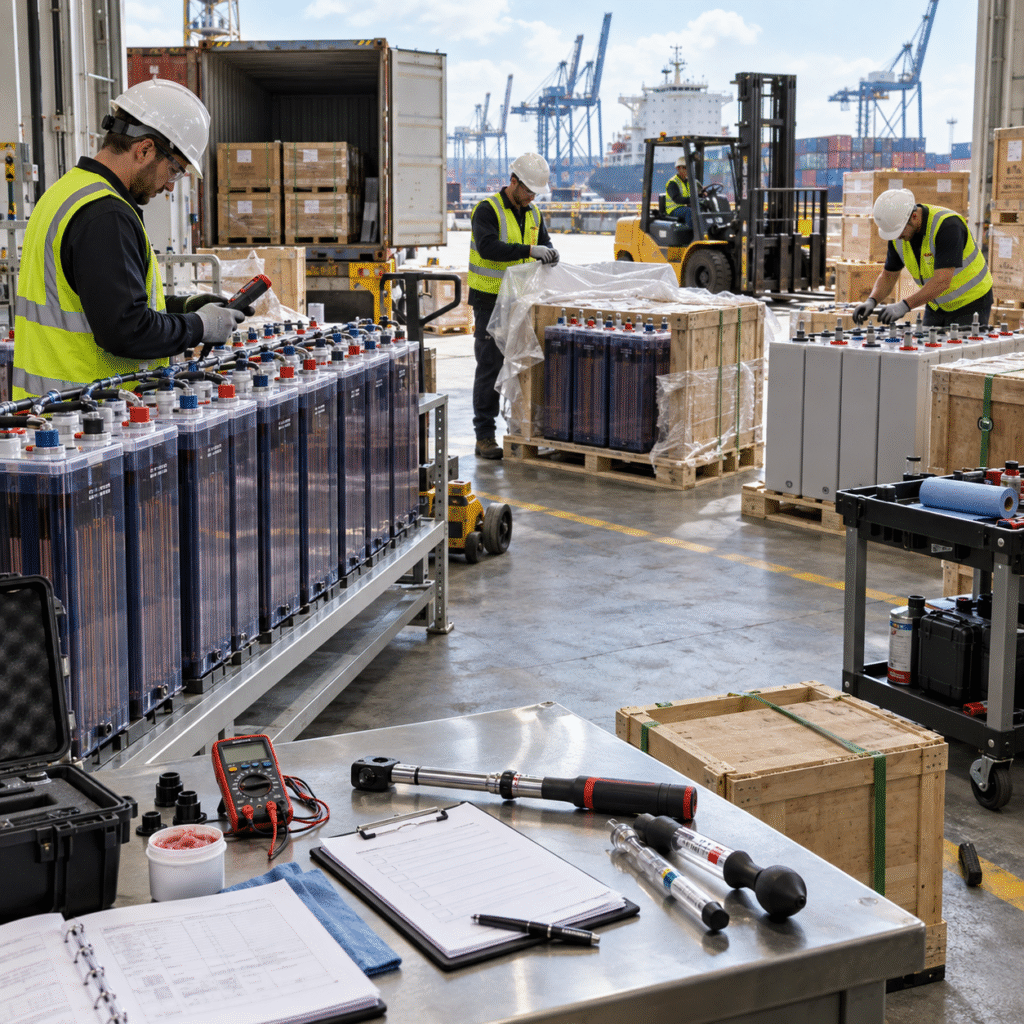
Introduction
Large OPzV and OPzS battery projects are often shipped internationally by sea.
A typical supply chain may include:
- Factory production
- Export warehouse storage
- Dangerous-goods or sea-freight booking
- Port waiting time
- 30–60 days at sea
- Destination customs clearance
- Local warehouse storage
- Project-site transportation
By the time the batteries are installed, several months may have passed since production.
This raises an important practical question for importers and EPC contractors:
Can the batteries be installed and used immediately after the container arrives?
Not always.
Lead-acid batteries continue to self-discharge during storage. Their condition on arrival depends on:
- Battery type
- Shipment condition
- Storage temperature
- Time since manufacture
- Time since last charging
- Transport damage
- Whether the battery is OPzV or OPzS
For example, EnerSys specifies model-specific storage limits for one OPzV range: up to 12 months at 20°C, 6 months at 30°C, and 3 months at 40°C before a refreshing charge is required, or earlier if OCV approaches 2.07V/cell. These figures are manufacturer-specific, but they demonstrate how strongly temperature affects allowable storage time.
OPzV and OPzS Should Not Be Treated the Same After Shipment
The first step is identifying the shipment condition.
OPzV
OPzV is a valve-regulated tubular GEL battery.
It is generally shipped:
- Charged
- Sealed
- Ready for electrical commissioning
It does not require electrolyte filling.
OPzS
OPzS is a flooded tubular battery.
Depending on the commercial arrangement, it may be supplied:
- Filled and charged
- Moist charged
- Dry charged
These conditions require different receiving procedures.
A dry or moist-charged OPzS battery may require electrolyte filling and an initial charging process before service.
This distinction should be confirmed before shipment—not after the container reaches the customer.
Step 1: Check the Packing List Before Opening the Container
Before unloading, verify:
- Battery model
- Capacity
- Quantity
- Cell configuration
- Accessories
- Battery racks
- Intercell connectors
- Terminal covers
- Electrolyte drums, if included
- Installation tools or spare parts
For large orders, discrepancies are much easier to document before materials are distributed across several installation sites.
Step 2: Photograph the Shipment Condition
Take photographs of:
- Container interior
- Pallets
- Wooden cases
- Battery racks
- Damaged cartons
- Tilted batteries
- Broken straps
These records can help distinguish:
transport damage
from
installation damage
during a later warranty discussion.
Step 3: Inspect Every Battery for Transit Damage
Look for:
OPzV
- Cracked containers
- Damaged lids
- Bent terminals
- Swelling
- Valve-area residue
- Broken terminal covers
- Impact marks
OPzS
In addition to the above, inspect:
- Electrolyte leakage
- Wet surfaces
- Damaged vent plugs
- Low electrolyte level if shipped filled
- Cracked transparent containers
EnerSys instructs users to examine OPzV shipments on arrival for transit damage and confirm the shipment against the packing documentation.
Do not install visibly damaged cells simply because total order quantity must be completed.
Step 4: Record Production Date and Shipment Timeline
For each project, establish:
Production Date → Shipment Date → Arrival Date → Installation Date
A battery that arrives after 45 days at sea but sits for another four months in a tropical warehouse may require very different handling from one installed immediately.
A useful receiving report should contain:
| Item | Record |
|---|---|
| Production date | |
| Shipment date | |
| Arrival date | |
| Warehouse temperature | |
| Installation date | |
| Last known charge date |
This information can later become essential in capacity or warranty discussions.
Step 5: Measure OPzV Open-Circuit Voltage
Before connecting the cells into a complete string, measure the OCV of every OPzV cell.
Record:
- Cell number
- OCV
- Battery temperature
Do not check only a few random cells on a large project.
A 108-cell order can contain one abnormal unit that would be difficult to identify after the entire system is assembled.
Manufacturer-specific OCV guidance can help determine whether a refreshing charge is needed. For the EnerSys OPzV range cited above, a refresh is required if OCV approaches 2.07V/cell or the specified storage-time limit is reached.
Do not apply that exact 2.07V/cell threshold automatically to every OPzV brand.
Use the supplied battery manual.
Step 6: Look at OCV Distribution, Not Only the Average
Suppose 100 OPzV cells measure:
2.12–2.14V
and one cell measures:
2.04V
The average string OCV may still look acceptable.
The outlier is more important.
Investigate cells with:
- Much lower voltage
- Much higher voltage
- Abnormal temperature
- Visible damage
before assembling the string.
Step 7: Determine Whether Refresh Charging Is Required
Refresh or freshening charging is used to restore batteries that have lost charge during storage.
Whether it is required depends on:
- OCV
- Storage duration
- Average storage temperature
- Battery manufacturer
For the current EnerSys OPzV instructions, storage at higher temperatures shortens the interval before refresh charging.
This is especially important for shipments to:
- Saudi Arabia
- UAE
- Iraq
- Kuwait
- Africa
- Southeast Asia
- Tropical Latin America
A container may experience high internal temperatures even when the destination’s average air temperature seems acceptable.
Step 8: Do Not Assume Sea Transit Is “Cold Storage”
Container temperature can vary widely.
Battery condition may be affected by:
- Direct solar heating
- Port storage
- Container position on the vessel
- Tropical transit routes
For this reason, importers should consider total elapsed time and likely temperature exposure—not just sailing time.
Step 9: OPzV Commissioning Charge After Arrival
If the battery requires recommissioning or a first charge, follow the specific battery manual.
EnerSys’ current OPzV instructions, for example, provide manufacturer-specific boost and float commissioning methods and require the first charge to be monitored for temperature and charging limits.
The important lesson is not the exact numerical setting.
The important lesson is:
Do not use an arbitrary “2V GEL charging profile” taken from another brand.
Confirm:
- Float voltage
- Boost voltage
- Current limit
- Temperature compensation
- Charging duration
for the selected product.
Step 10: OPzS Shipment Condition Must Be Identified Before Filling
An OPzS cell may arrive moist charged and without final operating electrolyte.
In that case, the customer should not improvise with locally available automotive acid.
EnerSys’ OPzS activation instructions, for example, specify:
- Filling electrolyte density
- Rest time after filling
- Temperature requirements
- Maximum delay before initial charge
for that particular product.
The filling specification is manufacturer-specific.
Step 11: Check Whether Electrolyte Was Included in the Shipment
This should be confirmed before import.
There are three common commercial scenarios.
Scenario A: Electrolyte Ships with the Battery
Advantages:
- Correct specification can be controlled by supplier.
Challenges:
- Dangerous-goods logistics
- Additional shipping weight
- Local import restrictions
Scenario B: Electrolyte Is Purchased Locally
Advantages:
- Lower international freight complexity.
Risks:
- Wrong density
- Poor purity
- Incorrect preparation
Scenario C: Batteries Arrive Filled and Charged
Simpler at installation, but shipment weight and regulatory handling may be greater.
The quotation should clearly state which arrangement applies.
Step 12: Inspect Filled OPzS Electrolyte Level
If OPzS batteries arrive filled, check:
- Minimum level
- Maximum level
- Signs of leakage
- Unequal levels
Do not immediately add acid because one battery’s level appears low.
Determine whether liquid was lost during transport.
Normal future water loss is generally replenished with the manufacturer’s specified purified water—not routine sulfuric acid addition.
Step 13: Allow Batteries to Reach a Reasonable Installation Temperature
A battery unloaded from a very hot container should not automatically be subjected to maximum charging current immediately.
Measure battery temperature first.
Charging voltage and capacity behavior are temperature-dependent.
For OPzV, current manufacturer guidance explicitly uses temperature compensation for float charging.
For flooded OPzS batteries, charging limits also depend on battery temperature.
Step 14: Check Accessories Before Installation
Large 2V battery systems require more than the cells.
Confirm availability of:
- Intercell connectors
- Bolts
- Washers
- Terminal covers
- Flexible links
- Racks
- Labels
A missing connector can delay an entire substation commissioning.
Importers should perform an accessory count immediately after receipt rather than waiting until the installation team arrives.
Step 15: Inspect Battery Racks
Sea freight can damage:
- Coating
- Fasteners
- Frames
- Pallets
Look for:
- Bent rack parts
- Paint damage
- Corrosion
- Missing hardware
Do not place heavy 1000Ah–3000Ah cells on an unstable or incorrectly assembled rack.
Step 16: Do Not Lift Large Cells by Their Terminals
Large OPzV and OPzS cells can be extremely heavy.
Use:
- Approved lifting straps
- Cell lifting devices
- Mechanical lifting equipment
EnerSys specifically warns not to use OPzV terminal posts for lifting.
Terminal damage can cause:
- Leakage
- High resistance
- Future heating
- Mechanical failure
Step 17: Create an Incoming Inspection Report
For each cell record:
| Cell No. | OCV | Visual Condition | Temperature | Electrolyte Level | Remark |
|---|---|---|---|---|---|
| 001 | |||||
| 002 | |||||
| 003 |
For OPzS, also consider:
- Specific gravity
- Shipment condition
This document creates a clear boundary between:
factory shipment condition
and
site installation condition.
Step 18: Perform Commissioning Before the First Capacity Test
Do not unload a battery container and immediately perform a capacity test.
First confirm:
- Correct charging
- Correct installation
- Stable cell condition
A battery that has spent weeks in shipment may not be at full SOC.
Testing it without proper commissioning can produce a falsely low capacity result.
The Distributor’s Biggest Mistake: Waiting for the End Customer to Find the Problem
A distributor should not deliver unopened batteries directly from the port to the end user without establishing condition records.
A better workflow is:
Receive → inspect → record → recharge if required → deliver/install → commission
This greatly reduces future disputes.
Frequently Asked Questions
Do OPzV batteries need charging after sea shipment?
It depends on storage duration, temperature, OCV and manufacturer requirements. Check them before installation.
Can OPzV batteries be stored for six months?
Possibly, but allowable storage time is temperature- and product-specific. Some manufacturers permit much longer storage at 20°C than at 40°C.
Should OPzS acid be added immediately after arrival?
Only if the product was supplied in a condition requiring field activation and the installation/charger are ready.
Can the customer use locally available sulfuric acid?
Only if it meets the exact battery manufacturer’s density and purity requirements.
Should every 2V cell be measured?
For large B2B projects, individual incoming voltage recording is strongly recommended.
Conclusion
Receiving OPzV or OPzS batteries after overseas shipment should be treated as a technical handover process, not simply a logistics event.
The correct workflow includes:
shipment inspection → storage-history review → individual voltage checks → electrolyte assessment → refresh charging where required → commissioning → baseline records.
For distributors and EPC contractors, this process can prevent many future disputes involving:
- Low capacity
- Weak cells
- Storage damage
- Transport damage
- Incorrect electrolyte
- Incomplete commissioning
For an overseas project evaluation, provide the battery model, production date, shipping date, arrival date, storage temperature, shipment condition, individual cell OCV and intended installation date.