
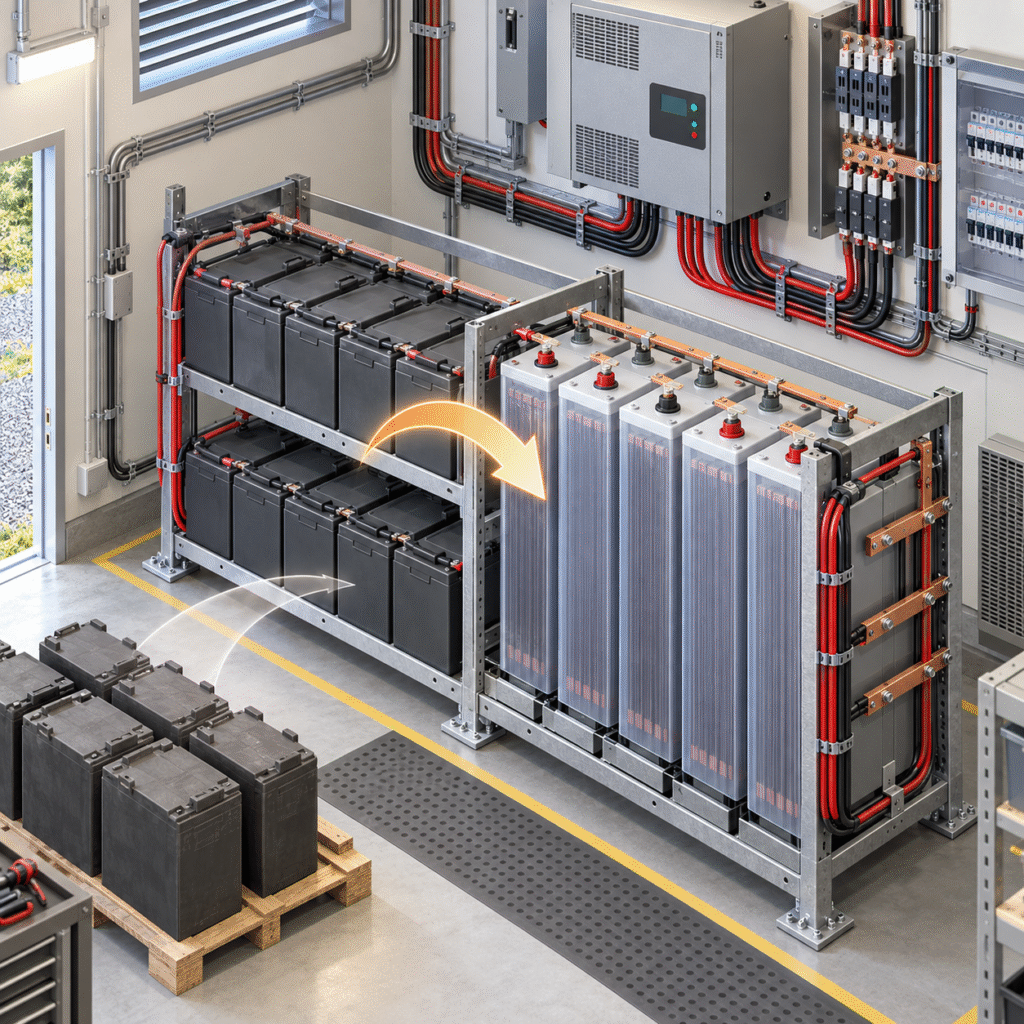
Introduction
An aging AGM battery bank reaches the end of its useful service life.
The end user decides:
“This time we want OPzV batteries because the project requires long-life 2V tubular GEL cells.”
The next question is usually:
“Can we just remove the old batteries and connect the new OPzV bank to the existing charger?”
Sometimes yes.
Sometimes no.
A battery retrofit must confirm compatibility between the new OPzV bank and the existing:
- Charger
- Inverter
- DC bus
- Battery rack
- Cables
- Breakers
- Monitoring system
- Room layout
OPzV batteries are stationary VRLA batteries, but that does not mean every AGM charger and OPzV product use identical charging parameters.
A retrofit should therefore begin with the complete DC system, not only the battery dimensions.
Start with the Existing Battery Data
Before requesting an OPzV quotation, collect:
- Existing battery model
- Nominal voltage
- Battery quantity
- Ah capacity
- C-rate
- Installation date
- Charger model
- Float voltage
- Boost voltage
- Required backup time
Also collect photographs of:
- Rack
- Charger nameplate
- Battery terminals
- DC breaker
- Room
This often reveals compatibility issues before a new battery is ordered.
Question 1: Will the OPzV Cell Count Match the Existing DC Voltage Window?
An existing AGM system may use:
- 12V monoblocs
while the OPzV replacement uses:
- 2V cells
For example:
4 × 12V AGM = nominal 48V
may be replaced with approximately:
24 × 2V OPzV = nominal 48V
But nominal voltage is only the starting point.
The final cell count must work at:
- Float voltage
- Boost voltage
- End-of-discharge voltage
The inverter or DC equipment must tolerate the entire voltage range.
Question 2: Can the Existing Charger Provide the Correct Float Voltage?
Do not assume yes simply because both batteries are lead-acid.
Check the OPzV manufacturer’s required:
- Float voltage per cell
- Temperature compensation
- Voltage tolerance
For example, EnerSys specifies 2.25V/cell at 20°C for one current OPzV product, with temperature compensation at temperatures significantly different from the reference condition.
That value is specific to that product.
Your selected OPzV battery may use a different setting.
The existing charger must be adjustable to the new battery specification.
Question 3: Is the Existing Boost Voltage Suitable?
Older AGM systems may have been configured with:
- Fixed boost voltage
- Automatic equalization
- Periodic high-voltage charging
Do not assume those functions should remain enabled after installing OPzV.
For the cited EnerSys OPzV range, higher-voltage boost charging is permitted under defined current and time limits, while equalizing charging is reserved for exceptional conditions such as deep discharge or repeated inadequate recharge.
The retrofit engineer should review:
- Boost voltage
- Boost duration
- Equalization schedule
- Current limit
before connecting the new bank.
Question 4: Does the Charger Support Temperature Compensation?
This becomes especially important in:
- Outdoor telecom cabinets
- Tropical countries
- Hot substations
- Generator rooms
A charger originally used with small AGM batteries may have:
- No battery-temperature sensor
- An air-temperature sensor
- Fixed charging voltage
A large OPzV bank may require better temperature management.
Higher temperature accelerates battery aging, while lower temperature reduces available capacity. Current EnerSys OPzV instructions explicitly specify temperature-adjusted float voltage.
Question 5: Is Charger Current Large Enough?
Increasing battery capacity during retrofit may create a recharge-time problem.
Example:
Old system:
48V 200Ah AGM
New system:
48V 600Ah OPzV
If the existing charger remains unchanged, recharge time can become much longer.
The charger must support:
- Continuous DC loads
- Battery recharge
- Required recovery time
A larger battery does not automatically improve the system if it cannot be fully recharged between outages.
Question 6: Is Charger Current Too High?
The opposite problem can also occur.
A charger designed for a large previous bank may exceed the selected OPzV manufacturer’s charging-current limit when operating at higher boost voltages.
Check:
- Maximum charger output
- Configurable current limit
- OPzV manufacturer requirement
Do not size charging current only from charger capability.
Question 7: Will the Existing Rack Fit 2V OPzV Cells?
Replacing 12V monoblocs with 2V cells usually changes the physical layout substantially.
Compare:
- Cell width
- Depth
- Height
- Weight
- Terminal location
- Maintenance clearance
A 2V 1000Ah OPzV cell may be:
- Taller
- Much heavier
- Narrower
than the 12V AGM battery it replaces.
The old rack may therefore be unsuitable.
Rack Load Capacity Matters
Large OPzV banks can weigh several tonnes.
Do not evaluate the rack using dimensions alone.
Confirm:
- Maximum rack loading
- Floor loading
- Seismic requirement
- Anchoring
- Cell support
An old rack designed for smaller AGM monoblocs should not automatically be reused.
Question 8: Are the Existing Interconnect Cables Suitable?
A 12V monobloc system may use short flexible cables between batteries.
A 2V OPzV system may use:
- Rigid copper connectors
- More intercell connections
This changes:
- Connection count
- Voltage-drop locations
- Maintenance requirements
OPzV manufacturers commonly supply purpose-designed intercell connectors and specify installation torque. EnerSys, for example, warns that loose connectors can cause erratic performance and battery damage.
Question 9: Can Existing Main DC Cables Be Reused?
If system voltage and maximum current remain similar, reuse may be possible.
But verify:
- Cable cross-section
- Cable length
- Insulation condition
- Terminal compatibility
- Voltage drop
If battery capacity is increased but inverter power remains unchanged, main discharge current may not increase.
If inverter size is also upgraded, cable requirements may change substantially.
Question 10: Is the Existing DC Breaker Still Correct?
Check:
- DC voltage rating
- Continuous current
- Breaking capacity
- Cable protection
Do not change battery technology while ignoring the protection system.
A new high-capacity OPzV bank may have substantial short-circuit capability.
Question 11: Will the Old Monitoring System Work?
The old installation may monitor only:
- Total bank voltage
For a large 2V OPzV system, it may be valuable to monitor:
- Individual cell voltage
- Cell temperature
- Internal resistance
- Float current
A retrofit is an excellent opportunity to improve battery monitoring.
12V AGM vs. 2V OPzV: Maintenance Changes
A 12V AGM bank may contain relatively few units.
A 2V OPzV bank contains many more individual cells.
For example:
48V AGM system: 4 × 12V batteries
versus:
48V OPzV system: 24 × 2V cells
This increases:
- Individual voltage measurements
- Connector count
- Maintenance records
But it also makes individual cell condition easier to isolate.
Can the Same Low-Voltage Cutoff Be Used?
Not automatically.
Check the OPzV manufacturer’s discharge tables.
End-of-discharge voltage varies with discharge duration.
For one current OPzV product, EnerSys publishes different end voltages for different discharge-time ranges rather than one universal cutoff.
Therefore:
old AGM inverter cutoff ≠ automatically correct OPzV cutoff.
Backup-Time Requirements Should Be Recalculated
Do not simply replace:
200Ah AGM
with:
200Ah OPzV
and assume identical runtime.
Check:
- Capacity rating basis
- C10/C20 rating
- Final voltage
- Temperature
- Load current
EnerSys currently lists its PowerSafe OPzV European capacity based on C10 to 1.8V/cell at 20°C, illustrating why the test basis matters.
Can OPzV and Existing AGM Batteries Operate in Parallel?
This should generally not be treated as a normal expansion strategy.
The battery strings can differ in:
- Internal resistance
- Charging characteristics
- Capacity
- Age
For new parallel OPzV strings, EnerSys’ current instructions specify matching capacity, design and age, and equal string cable resistance for its product.
A mixed AGM/OPzV parallel arrangement should only be considered with specific engineering/manufacturer approval.
Retrofit Scenario: Telecom Site
Existing:
- 48V AGM bank
- Frequent grid outages
- Batteries replaced every few years
- Limited maintenance staff
New proposal:
- 24 × 2V OPzV
Before quoting, evaluate:
- Existing rectifier voltage range
- Temperature sensor
- Charging current
- Cabinet dimensions
- Floor loading
- Low-voltage disconnect
- Communication monitoring
The correct question is not:
“Can OPzV replace AGM?”
It is:
“Can this specific DC system correctly charge, discharge, house and protect this OPzV bank?”
Retrofit Scenario: Substation
Old battery:
- Stationary VRLA bank
New OPzV requirement:
- Higher Ah capacity
The existing charger may support the voltage but not the required recovery time.
If the system must recover full autonomy within a defined number of hours after an outage, the charger may also need replacement.
A Practical Retrofit Checklist
Before confirming the OPzV order, collect:
Battery
- OPzV model
- Ah rating
- Capacity rate
- Quantity
- Dimensions
- Weight
Charger
- Manufacturer
- Model
- Max DC voltage
- Float setting
- Boost setting
- Max current
- Temperature compensation
Load
- Continuous DC power
- Peak current
- Backup duration
Mechanical
- Rack dimensions
- Floor loading
- Ventilation
- Maintenance access
Protection
- Main fuse
- Breaker
- Cable size
Control
- LVD
- Monitoring
- Alarm system
When Can the Existing Charger Usually Be Retained?
Reuse becomes more realistic when:
- Voltage range is adjustable
- Correct OPzV float voltage can be set
- Current limit is suitable
- Temperature compensation is available
- Boost/equalization behavior can be configured
- Charger is in good condition
When Is Charger Replacement Worth Considering?
Consider a new charger when:
- Fixed voltage cannot match OPzV requirements
- Charger has no temperature compensation in a demanding environment
- Charging current is inadequate
- Ripple is excessive
- Existing equipment is obsolete
- Reliability requirement is high
Frequently Asked Questions
Can I replace AGM batteries with OPzV?
Yes, in many stationary applications, but the charger, rack, protection, voltage window and battery sizing must be checked.
Can I use the old AGM charger?
Possibly. It must be adjustable to the selected OPzV battery’s charging requirements.
Is OPzV charging voltage the same as AGM?
Do not assume so. Use the battery manufacturer’s data.
Can I keep the old 12V AGM rack?
Often not without modification because 2V OPzV cells have different dimensions, weight and terminal layouts.
Can AGM and OPzV batteries be mixed?
Mixing different battery designs in one series or parallel bank is generally poor practice unless specifically engineered and approved.
Should inverter cutoff settings be changed?
They should be checked against the new OPzV manufacturer’s discharge data.
Conclusion
Replacing an existing AGM battery bank with OPzV can be a very good upgrade for a stationary telecom, UPS, substation or industrial project—but it should be handled as a system retrofit, not simply a battery substitution.
Check:
charger voltage + charging current + cell count + LVD + rack + cables + protection + monitoring + temperature.
For a retrofit quotation, sending the battery supplier the existing charger nameplate, old battery data sheet, DC load, rack dimensions and required backup time will usually prevent most compatibility problems.