
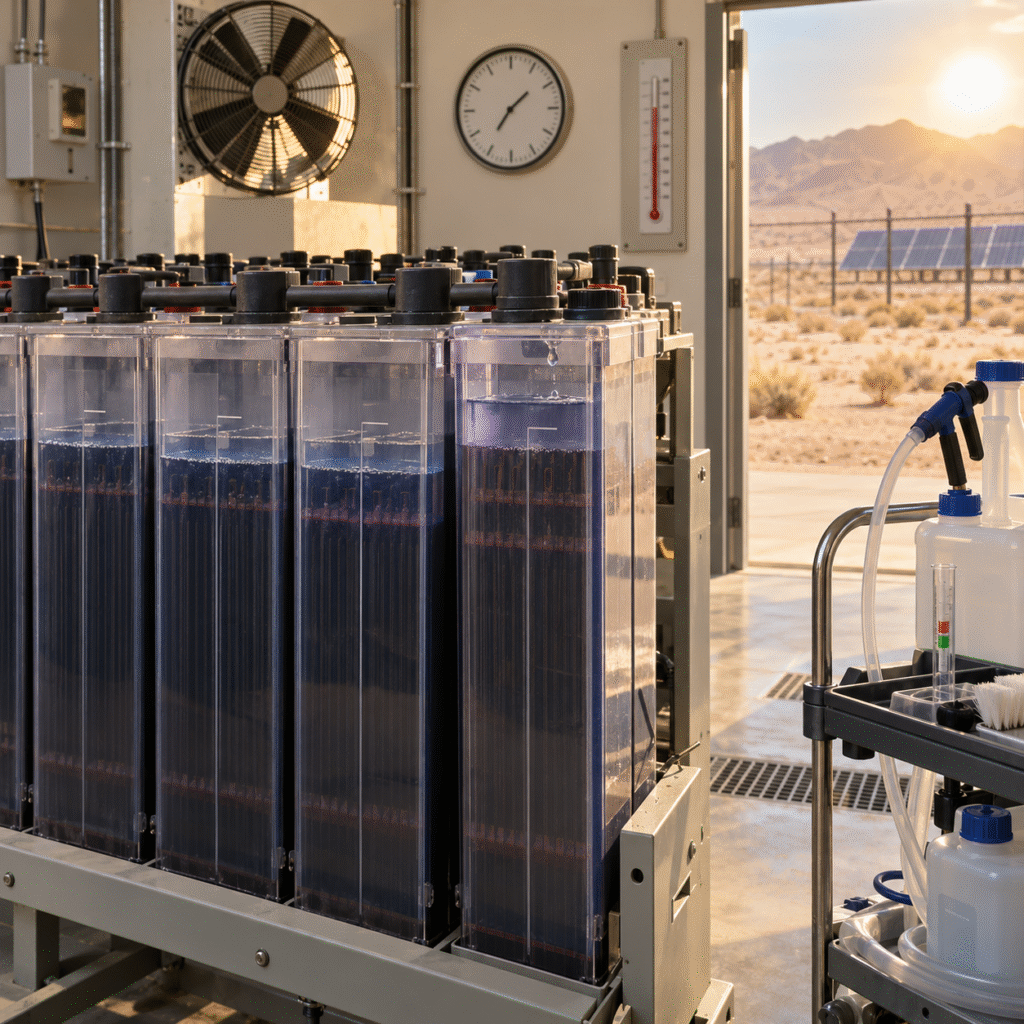
Introduction
OPzS batteries are well suited to long-life stationary applications, but unlike OPzV GEL batteries, they require electrolyte-level maintenance.
For projects in:
- Middle East
- Africa
- Southeast Asia
- Tropical regions
one common question is:
“How often should we add water to the OPzS batteries?”
There is no reliable universal answer such as:
every three months or once per year.
The correct interval depends on:
- Battery design
- Electrolyte reserve
- Operating temperature
- Float voltage
- Cycling frequency
- Boost/equalization frequency
- Battery age
Some modern OPzS products have a large electrolyte reserve and can achieve very long topping-up intervals under standby conditions. For example, EnerSys states approximately three years for its PowerSafe OPzS range in standby operation. That is a product-specific design feature—not a universal rule for every OPzS battery or solar cycling application.
A better maintenance strategy is therefore:
Inspect regularly, record water use, and establish the actual interval for the site.
OPzS Loses Water During Normal Operation
OPzS is a vented flooded lead-acid battery.
During charging, especially near full charge and during higher-voltage charging, electrolysis can produce:
- Hydrogen
- Oxygen
These gases leave through the vent system.
Over time, electrolyte water content decreases.
The sulfuric acid itself is not normally “consumed” in the same way.
This is why normal routine topping-up generally uses:
demineralized or distilled water
rather than additional sulfuric acid.
EnerSys’ flooded stationary battery instructions specify topping to the nominal level without exceeding the MAX mark, using demineralized or distilled water meeting the stated purity requirement.
Hot Climate Does Not Mean “Add Water Every Month”
Temperature increases the need for closer monitoring, but calendar-based watering can create overfilling.
Instead use two different concepts:
Inspection Interval
How often you check electrolyte level.
Topping-Up Interval
How often water is actually required.
These should not be confused.
In a new installation in a hot climate, the inspection interval should initially be relatively frequent until a stable pattern is established.
After enough historical data are available, the site can optimize the schedule.
Start with a Baseline
At commissioning, record:
- Electrolyte level
- Cell specific gravity
- Cell voltage
- Battery temperature
- Charger float voltage
For each cell.
Then inspect again under the same operating conditions.
The objective is to answer:
How fast is the level actually falling at this site?
Temperature Is One of the Main Variables
Hot batteries generally experience faster electrochemical reactions.
High temperature can also increase the impact of excessive charging voltage.
If a battery bank previously needed infrequent topping-up but water consumption suddenly increases during summer, investigate:
- Battery temperature
- Charger temperature compensation
- Air conditioning
- Ventilation
- Float voltage
Do not assume that increased water consumption is simply “normal because it is hot.”
Check Float Voltage Before Blaming the Climate
Excessive float voltage can dramatically increase gassing.
For one current EnerSys flooded stationary battery manual, float voltage is product-specific and temperature compensation is required outside the recommended operating-temperature range.
This illustrates an important maintenance principle:
If OPzS water consumption increases, verify the charger before simply increasing the watering frequency.
Possible charging issues include:
- Wrong battery profile
- Charger calibration drift
- Incorrect cell count
- Failed temperature sensor
Equalization Can Increase Water Consumption
Equalization or higher-voltage charging increases gas production.
It may be useful for certain flooded-battery conditions, but excessive frequency increases:
- Water loss
- Gassing
- Temperature
- Corrosion
If a site reports unusually frequent OPzS watering, review how often the charger performs:
- Boost charging
- Equalization
- Recovery charging
Do not schedule equalization simply because the charger offers the function.
Solar OPzS Systems May Need a Different Maintenance Pattern
A substation OPzS bank may remain on float for most of its life.
A solar OPzS bank may:
- Cycle every day
- Reach boost voltage regularly
- Experience inconsistent charging
- Operate at partial SOC
The resulting water-consumption pattern can be different.
This is one reason a standby product’s advertised topping interval should not automatically be used for a daily-cycling solar application.
Check All Cells—Not Just One Representative Cell
Large OPzS banks can have:
- 24 cells
- 55 cells
- 108 cells
- 110 cells
Water loss may not be identical.
One cell may consume more water because of:
- Higher charging voltage
- Higher local temperature
- Leakage
- Internal problem
Record individual cell behavior.
What Does One Cell Needing Much More Water Mean?
This is more concerning than all cells gradually consuming water.
Possible causes include:
- Cell overcharging
- High local temperature
- Electrolyte leakage
- Internal fault
- Unequal cell voltage
Compare the suspect cell’s:
- Float voltage
- Specific gravity
- Temperature
- Water addition history
If one cell consistently needs two or three times more water than neighboring cells, investigate the cause rather than simply topping it up.
Overfilling Is a Major Maintenance Mistake
Adding too much water can cause electrolyte to overflow when the battery charges.
Remember:
- Electrolyte volume changes with charge condition.
- Gas bubbles can raise apparent level.
If the cell is filled above the maximum mark, charging can push acid-containing electrolyte out of the battery.
This can cause:
- Rack corrosion
- Terminal corrosion
- Conductive contamination
- Acid damage
- Lower electrolyte acid content
Follow the marked MAX/MIN level and battery manual.
Do Not Use the Top of the Container as the Fill Line
Transparent OPzS containers make level inspection easier.
Use the manufacturer’s designated:
- Minimum mark
- Maximum mark
not a visually convenient level.
EnerSys describes transparent OPzS containers specifically so electrolyte level and cell condition can be monitored visually.
Use the Correct Water
Normal OPzS topping-up should use water of suitable purity.
Avoid:
- Tap water
- Mineral water
- Bottled drinking water
- Unknown industrial water
Impurities may include:
- Iron
- Copper
- Chloride
- Minerals
These contaminants can negatively affect battery chemistry.
EnerSys’ flooded-battery guidance specifies demineralized or distilled water for routine topping-up.
Should Sulfuric Acid Be Added?
Not during normal routine watering.
Normal water loss is primarily the result of electrolysis and evaporation of water.
Adding acid every time the electrolyte level falls can gradually make the electrolyte too concentrated.
Additional acid should only be considered under a manufacturer-controlled procedure when actual acid-containing electrolyte has been lost, for example through:
- Significant leakage
- Spill
Do not correct low specific gravity automatically by adding acid.
Low SG may instead indicate:
- Undercharging
- Recent water addition
- Stratification
Water First or Charge First?
For routine maintenance, follow the battery manufacturer’s instructions.
If electrolyte is below the minimum safe level, immediate action may be necessary before charging.
Otherwise, final level adjustment is often best evaluated at the appropriate charged condition because electrolyte level can rise during charging.
Do not blindly fill a discharged cell to MAX.
Record How Much Water Is Added
For large OPzS projects, quantity is valuable diagnostic information.
Instead of writing:
“Water added.”
record:
| Cell | Previous Date | Water Added | SG | Voltage | Temperature |
|---|---|---|---|---|---|
| 01 | |||||
| 02 | |||||
| 03 |
After a year, this can reveal:
- One abnormal cell
- Seasonal trends
- Excessive charging
- Increasing maintenance demand
Water Consumption Can Be an Early Warning Signal
Suppose a substation OPzS bank has operated for years with stable maintenance.
Then annual water use suddenly doubles.
Possible reasons include:
- Charger setting changed
- Room temperature increased
- Equalization frequency increased
- Battery aging
- Individual cells are becoming abnormal
The maintenance log helps identify when the change began.
Do Not Ignore Ventilation
OPzS charging releases gas.
Battery-room ventilation must comply with applicable battery installation requirements.
EnerSys’ stationary flooded-battery guidance specifically references IEC 62485-2 for battery accommodation and ventilation.
This is particularly important during:
- Boost charging
- Equalization
- Commissioning
when gas generation may increase.
Hot-Climate Maintenance Strategy
Instead of fixing one universal watering interval, use this approach:
Initial Period
Inspect frequently enough to establish actual site consumption.
Stable Operation
Extend inspection intervals only after data show stable behavior.
Hot Season
Increase monitoring if battery temperature rises significantly.
After Charger Changes
Recheck water-consumption pattern.
After Equalization
Inspect electrolyte level according to the battery procedure.
Aging Bank
Shorten monitoring intervals if water consumption becomes less predictable.
This is more reliable than using a generic calendar.
Signs That Water Consumption Is Abnormal
Investigate if:
- One cell level drops much faster
- All cells suddenly use more water
- Battery temperature rises
- Strong gassing continues on float
- Electrolyte overflows
- Corrosion appears around vents
- Specific gravity becomes increasingly inconsistent
Example: Solar OPzS Site in West Africa
A customer installs a large OPzS bank at an off-grid site.
During the first year:
- Daily cycling
- High ambient temperature
- Regular generator charging
The maintenance contractor assumes a “three-year watering interval” found in a product brochure.
This would be poor practice.
The three-year figure for the cited EnerSys product applies to its standby operating design.
A cycling solar project has different:
- Charging frequency
- Temperature
- Gassing behavior
The site should establish its own inspection schedule.
Example: Substation with Air Conditioning
A properly controlled OPzS standby installation may require much less frequent topping-up.
If:
- Temperature remains stable
- Float voltage is correct
- Equalization is limited
- Battery design has a large electrolyte reserve
maintenance intervals can be relatively long.
This illustrates why identical OPzS cells can require different maintenance frequencies in different applications.
Common Maintenance Errors
Topping Every Cell on a Fixed Date
Some cells may not need water.
Filling Above MAX “So It Lasts Longer”
This increases overflow risk.
Adding Acid Instead of Water
Can alter electrolyte concentration.
Using Tap Water
Introduces contaminants.
Ignoring Charger Settings
Excessive voltage may be the real cause of water loss.
Recording Only Total String Voltage
One abnormal cell can remain hidden.
Frequently Asked Questions
How often should OPzS batteries be topped up?
There is no universal interval. It depends on battery design, duty, temperature and charger settings.
Is three years a normal OPzS topping interval?
Some OPzS products advertise approximately three-year intervals in standby service, but this is product- and application-specific.
Can I use tap water?
Use only the water quality specified by the battery manufacturer; distilled or demineralized water is commonly required.
Why does only one OPzS cell need frequent water?
Check for high cell voltage, local heating, leakage or internal problems.
Should I add acid when SG is low?
Not as normal maintenance. First confirm charging, temperature, water addition and stratification.
Does hot weather shorten the watering interval?
It can increase the need for monitoring, especially if charging voltage is not properly temperature-compensated.
Conclusion
A professional OPzS watering program should not be based on a fixed sentence such as:
“Add water every six months.”
The correct approach is:
inspect → record → compare → identify the site’s actual water-consumption pattern.
For hot-climate solar, telecom, substation and industrial projects, monitor:
- Electrolyte level
- Water added per cell
- Specific gravity
- Individual voltage
- Battery temperature
- Float/boost settings
This turns routine watering into a useful battery-condition monitoring tool rather than simply a maintenance chore.