
Introduction
A high-quality OPzV or OPzS battery can still deliver disappointing service life if it is installed in a poorly designed battery room.
This is especially important in projects located in:
- Middle East
- Africa
- Southeast Asia
- Tropical Latin America
where battery rooms may experience high temperature for much of the year.
A battery-room design must consider much more than:
“Do the batteries physically fit?”
The complete installation should address:
- Temperature
- Temperature uniformity
- Ventilation
- Hydrogen management
- Maintenance access
- Floor loading
- Rack arrangement
- Electrical protection
- Electrolyte hazards
- Emergency access
IEC 62485-2 applies to stationary secondary battery installations up to 1500V DC and covers hazards including electricity, gas emissions and electrolyte.
OPzV and OPzS Have Different Room Requirements
Both batteries use lead-acid chemistry and tubular positive plates, but their electrolyte systems differ.
OPzV
- GEL electrolyte
- Valve-regulated
- No routine water addition
- Lower routine gas release than flooded batteries
OPzS
- Liquid electrolyte
- Vented/flooded design
- Requires electrolyte-level maintenance
- Generates gas during charging
HOPPECKE classifies OPzS as a vented stationary lead-acid cell with liquid electrolyte.
The room design must reflect these differences.
“Sealed OPzV” Does Not Mean No Ventilation
OPzV is often described commercially as sealed or maintenance-free.
Technically, it is valve-regulated, not hermetically sealed.
Under normal conditions, most internal gas is recombined.
However, gas can still be released during:
- Overcharging
- Abnormal temperature
- Valve operation
- Charger failure
Therefore, ventilation requirements should not simply be eliminated because OPzV batteries are installed.
Battery-room safety should be evaluated according to:
- Battery quantity
- Charging conditions
- Room volume
- Applicable standard
- Manufacturer instructions
OPzS Ventilation Is Especially Important
OPzS batteries can generate hydrogen during charging.
Hydrogen is:
- Colorless
- Odorless
- Highly flammable
The purpose of ventilation is to prevent dangerous gas accumulation.
IEC 62485-2 specifically includes gas-emission hazards within stationary battery installation safety requirements.
Do not use one generic “air changes per hour” figure for every project.
Required airflow depends on:
- Cell quantity
- Charging current
- Battery type
- Charging mode
Final ventilation calculations should follow applicable standards and local regulations.
Equalization and Commissioning Can Increase Ventilation Demand
Normal float operation may produce relatively little gas.
But higher-voltage charging can change the situation.
Examples include:
- Initial commissioning
- Equalizing charging
- Recovery charging
Battery-room ventilation should therefore be capable of supporting abnormal or special charging modes where required.
This is particularly relevant for large OPzS banks.
Temperature Is Often the Biggest Life-Cycle Issue
Many battery rooms focus heavily on hydrogen while underestimating temperature.
A battery manufacturer may publish:
20-year design life at 20°C
but this does not mean:
20 years under any ambient condition.
High temperature accelerates lead-acid aging.
In a hot climate, battery-room cooling may have greater economic value than purchasing a slightly larger battery.
Uniform Temperature Matters
Average room temperature is not enough.
Consider this installation:
- Room thermostat: 25°C
- Bottom rack: 24°C
- Middle rack: 27°C
- Top rack near charger exhaust: 34°C
The batteries are not experiencing the same operating conditions.
Cells running consistently hotter may age faster.
Avoid placing battery racks:
- Beside hot inverters
- Beside rectifier exhaust
- Under direct sunlight
- Directly beside HVAC hot-air discharge
Do Not Blow Very Cold Air Directly onto One Battery Row
The opposite problem can also occur.
An air-conditioning outlet may blow directly onto one row while the rest of the room remains warmer.
This creates temperature differences within a series string.
Temperature differences can affect:
- Float voltage behavior
- Charge acceptance
- Available capacity
- Aging
The objective should be:
stable and reasonably uniform battery temperature
rather than simply maximum air-conditioning power.
Battery Temperature Is More Important Than Wall Thermostat Temperature
The HVAC display may show:
24°C
while battery cases remain:
30°C
because of:
- Charger heat
- Poor airflow
- Dense rack arrangement
- Thermal inertia
Critical projects should periodically measure actual cell or battery temperature.
Leave Maintenance Access Around OPzS Cells
OPzS maintenance may require technicians to:
- Inspect electrolyte level
- Add water
- Measure cell voltage
- Measure specific gravity
- Clean batteries
- Replace cells
A rack design that maximizes battery density but prevents access creates future maintenance problems.
The transparent container and accessible flooded design are advantages only if technicians can actually reach the cells.
OPzV Also Needs Maintenance Access
OPzV does not require watering, but technicians still need access for:
- Cell voltage testing
- Resistance/impedance testing
- Temperature measurement
- Connector inspection
- Battery replacement
Do not install OPzV batteries so tightly that a single failed 1000Ah or 2000Ah cell cannot be removed.
Floor Loading Must Be Checked
Large 2V cells are heavy.
A battery room containing:
- 55 cells
- 108 cells
- 110 cells
can impose several tonnes of concentrated load.
Check:
- Rack weight
- Battery weight
- Floor load capacity
- Local structural requirements
This is particularly important when battery rooms are located:
- Above ground floor
- In containerized systems
- On raised floors
Rack Loading and Cell Removal
Rack design should account for:
- Static weight
- Cell dimensions
- Safe installation
- Future removal
A replacement cell must be removable without dismantling half the battery bank.
For very large cells, consider:
- Lifting access
- Service trolley access
- Ceiling clearance
during the original design.
OPzS Requires Electrolyte Spill Planning
Because OPzS contains liquid sulfuric acid, the installation should consider:
- Spill containment
- Acid-resistant surfaces
- Neutralization procedure
- PPE
- Eye-wash arrangements
IEC 62485-2 includes electrolyte hazards within stationary battery safety requirements.
The exact required equipment depends on local safety regulations.
Keep the Battery Room Clean and Dry
Battery rooms should not become storage areas for:
- Tools
- Paint
- Cardboard
- Spare metal parts
- Cleaning chemicals
Contamination increases maintenance risk.
Dust and moisture can also accumulate on battery surfaces and around terminals.
For OPzS, acid mist can further contribute to:
- Corrosion
- Surface contamination
A dedicated battery environment simplifies inspection and maintenance.
Do Not Install Unrelated Heat-Producing Equipment in the Room
Battery rooms are sometimes used to house:
- Chargers
- Inverters
- Transformers
- Communication cabinets
because all equipment belongs to the same DC system.
But every piece of equipment adds heat.
Where practical, consider separating major heat sources or managing their airflow so that hot exhaust does not pass directly across the batteries.
Ventilation and Air Conditioning Serve Different Purposes
This distinction is important.
Ventilation
Primarily manages:
- Gas concentration
- Battery-room air safety
Air Conditioning / Thermal Management
Primarily manages:
- Temperature
- Battery life
- Capacity consistency
A room can have excellent ventilation but still be too hot.
Likewise, a tightly air-conditioned room can still require adequate gas management.
Hydrogen Detectors Are Not a Substitute for Ventilation
A gas detector can provide:
- Alarm
- Monitoring
- Fault warning
but it does not remove hydrogen.
The ventilation strategy should remain the primary engineered control where required.
Gas detection can be an additional layer.
Electrical Ignition Sources Matter
Because lead-acid charging can produce hydrogen, battery-room design should control ignition risk.
Consider:
- Switching equipment
- Sparks
- Open flame
- Maintenance tools
Local electrical codes and IEC requirements should guide the final equipment classification and installation.
Do not make a battery room “safe” merely by adding a warning sticker.
Include Emergency Isolation
Large battery banks can deliver extremely high short-circuit current.
The installation should provide appropriate:
- Disconnects
- Fuses
- Breakers
- Safe isolation procedure
Technicians should be able to isolate the battery before:
- Cell replacement
- Major connector work
- Rack maintenance
without improvising temporary disconnections.
Cable Routing Should Not Block Battery Maintenance
A common layout mistake is running large DC cables directly across:
- Battery lids
- Watering access
- Terminal inspection points
Design cables so technicians can still:
- Check cells
- Torque terminals
- Remove one battery
without moving major system cabling.
Hot-Climate Design Priorities
For projects in consistently hot regions, give particular attention to:
- Battery-room temperature
- Temperature uniformity
- Charger temperature compensation
- HVAC redundancy
- Solar heat gain
- Ventilation
- Remote temperature alarms
A highly reliable battery installed in a continuously hot room can still suffer accelerated aging.
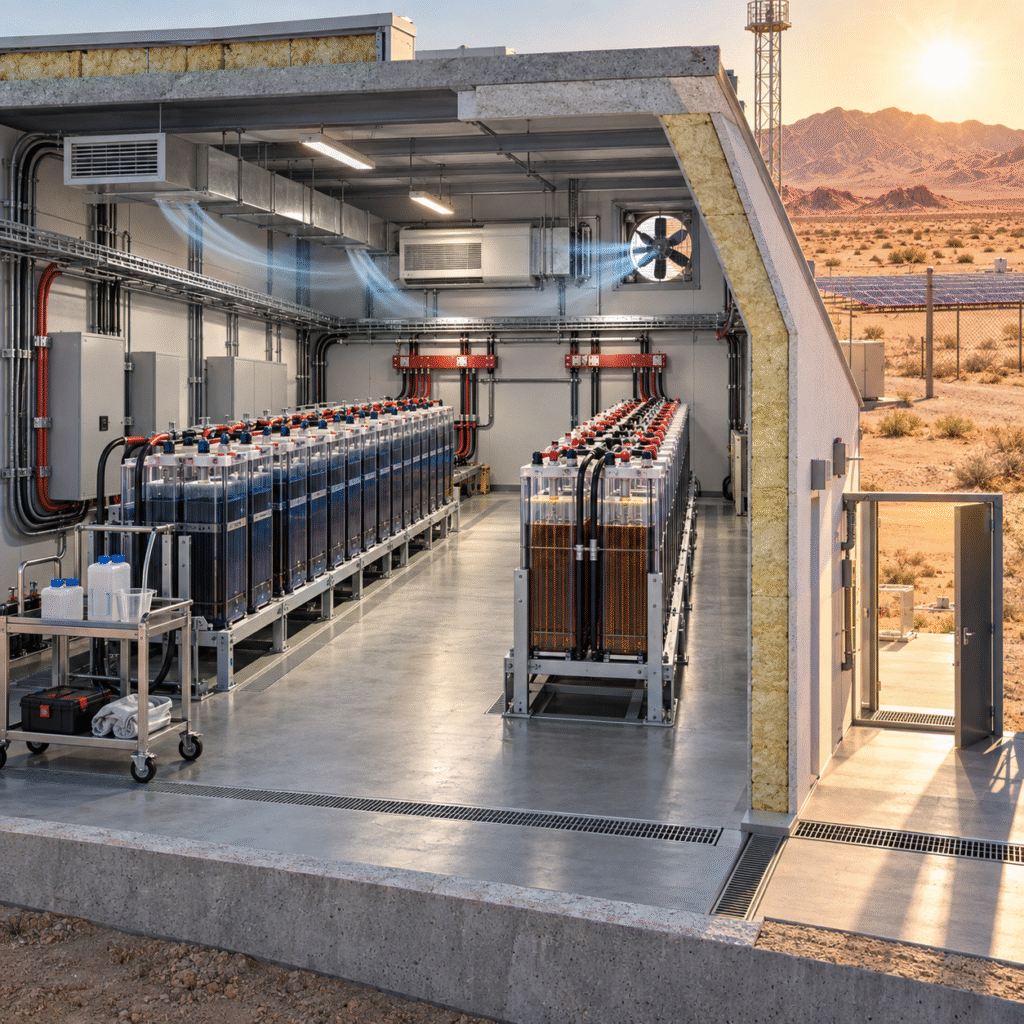
Outdoor Containerized Battery Rooms
Container systems can experience significant solar heating.
Consider:
- Roof insulation
- Wall insulation
- External shading
- HVAC redundancy
- Alarm monitoring
Metal container temperature can rise rapidly if cooling fails.
For remote telecom or solar installations, a high-temperature alarm can provide an early warning before battery damage becomes severe.
OPzV vs. OPzS in Remote Hot Sites
OPzV may be attractive where:
- Maintenance visits are difficult
- Water supply is limited
- Acid handling is undesirable
OPzS may still be attractive where:
- Skilled maintenance is available
- Long flooded-battery experience exists
- Electrolyte condition monitoring is valuable
The battery-room maintenance capability should therefore be part of battery selection.
Battery Room Inspection Checklist
Record:
Environment
- Ambient temperature
- Battery temperature
- HVAC condition
- Ventilation operation
Batteries
- Individual voltage
- Temperature
- Physical condition
Connections
- Corrosion
- Heating
- Torque condition
OPzS Additional Checks
- Electrolyte level
- Specific gravity
- Spill evidence
Safety
- Access
- PPE
- Warning signs
- Emergency equipment
HOPPECKE’s battery-room inspection service similarly includes checks of ventilation, floor condition, warning signs, safety equipment, disconnects and cables, illustrating that battery-room reliability goes well beyond the battery cells themselves.
Frequently Asked Questions
Does OPzV need battery-room ventilation?
Yes, ventilation requirements still need to be evaluated. OPzV is valve-regulated, not a completely gas-impermeable battery.
Does OPzS require more ventilation than OPzV?
Flooded OPzS normally has greater routine gas-generation considerations, particularly during charging, but final ventilation must be calculated for the actual system.
What is the ideal battery-room temperature?
Use the selected battery manufacturer’s recommended operating conditions. More important than one generic number is maintaining a stable, uniform temperature appropriate for the design-life assumptions.
Can I install the charger directly above the batteries?
Avoid exposing batteries to unnecessary heat or hot exhaust. Maintenance access and electrical safety must also be considered.
Is air conditioning enough for hydrogen safety?
No. Temperature control and gas ventilation are different engineering functions.
Does an OPzS room need acid-spill protection?
Flooded batteries contain liquid electrolyte, so spill and electrolyte safety should be included according to applicable standards and local regulations.
Conclusion
A good OPzV or OPzS battery room should be designed around battery life, maintenance access and safety, not simply around fitting the maximum number of cells into the available space.
The main design priorities are:
ventilation + temperature uniformity + maintenance clearance + structural loading + electrical isolation + electrolyte safety.
For projects in hot climates, controlling battery temperature can be just as important as selecting the battery itself.