
Introduction
A project needs more battery capacity.
The first solution often appears simple:
Add another battery string in parallel.
For example:
One string: 48V 1000Ah
Two strings in parallel: 48V 2000Ah
Three strings: 48V 3000Ah
Electrically, this is correct.
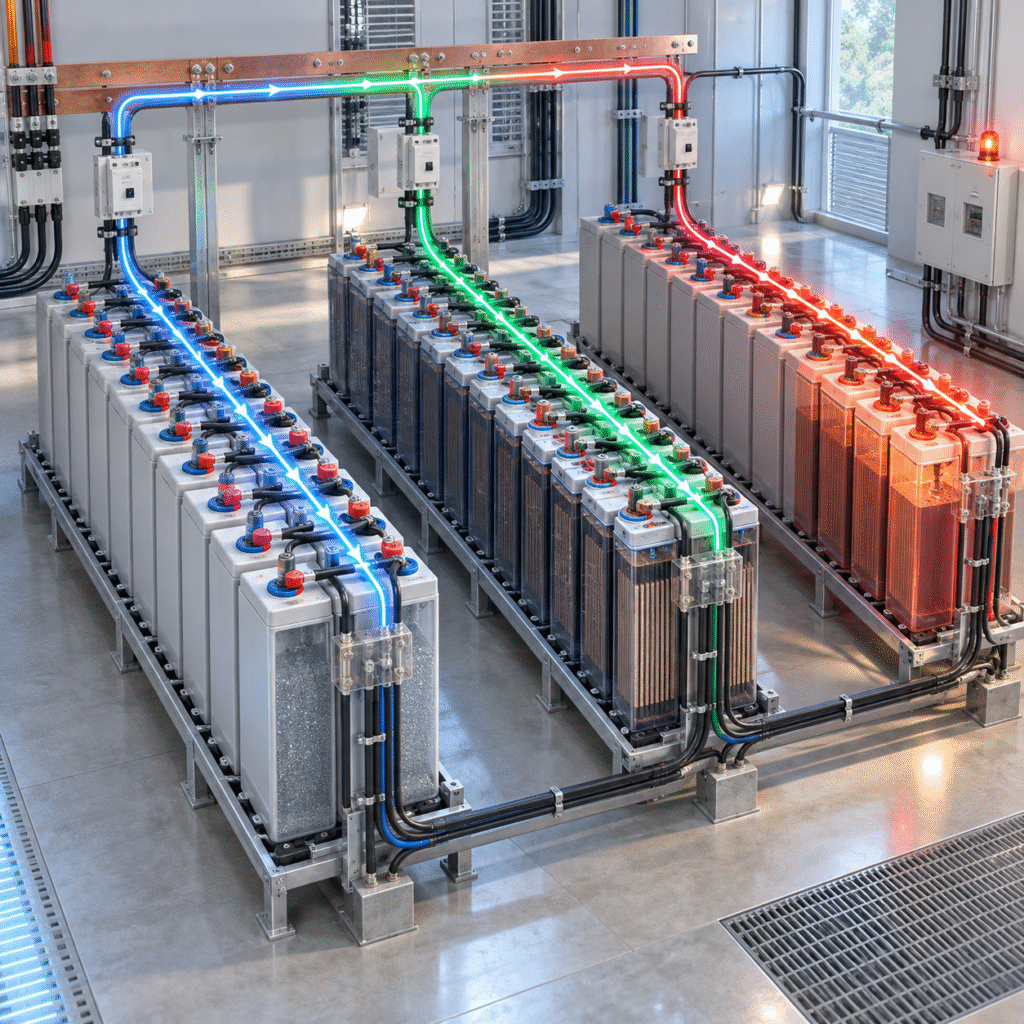
But a large OPzV or OPzS parallel battery bank is not simply an Ah calculation.
Each additional string creates more questions about:
- Current sharing
- Cable resistance
- Battery matching
- Protection
- Charger capacity
- Maintenance
- Fault current
- Future expansion
EnerSys OPzV instructions reproduced in current online manuals specify that parallel strings should use batteries of the same capacity, design and age, with equal cable resistance; the cited instructions also recommend a maximum of four parallel strings for that particular product arrangement.
This should not be treated as a universal four-string limit for every brand.
It illustrates an important engineering principle:
The number of parallel battery strings should remain controlled and manufacturer-approved.
Series and Parallel Serve Different Purposes
Series Connection
Increases voltage.
Example:
24 × 2V 1000Ah cells: 48V 1000Ah
The Ah capacity remains 1000Ah.
Parallel Connection
Increases Ah/current capability.
Two identical 48V 1000Ah strings: 48V 2000Ah
Three strings: 48V 3000Ah
The voltage remains the same.
The Main Parallel-Bank Problem: Current Does Not Automatically Split Equally
Suppose three battery strings supply: 300A total
The ideal distribution is:
- String A: 100A
- String B: 100A
- String C: 100A
But real battery systems have resistance.
If one string has lower total resistance, it may carry:
- 130A
while another carries:
- 75A
and another:
- 95A.
The heavily loaded string then:
- Discharges faster
- Heats more
- Cycles deeper
- Ages faster
Eventually the imbalance becomes even worse.
Where Does String Resistance Come From?
Total branch resistance includes:
- Battery internal resistance
- Intercell connectors
- Main string cables
- Fuses
- Breakers
- Busbar connections
Even small differences matter in high-current DC systems.
This is why parallel-string engineering focuses so heavily on symmetry.
Equal Cable Length Matters
If String A uses:
1.5m positive + 1.5m negative
and String B uses:
4m positive + 4m negative
the two strings do not have the same external resistance.
The shorter string may carry more current.
Good practice is to engineer each string with:
- Same conductor material
- Same cross-section
- Same approximate length
- Same number/type of connections
For the current EnerSys instructions cited above, equal cable cross-section and equal length are specifically required for parallel strings.
Use a Common Busbar Correctly
Large multi-string banks should normally use a properly designed common connection point.
Each string should connect to the common DC system in a way that minimizes resistance differences.
Avoid:
- Connecting String B through String A
- Daisy-chaining parallel strings
- Giving one string a substantially shorter route to the inverter
The objective is:
electrically symmetrical current paths.
String Protection Is Important
Each parallel string can supply current into a fault in another string.
This is very different from a single series battery bank.
Consider three large OPzV strings.
If String 2 develops a cable short, fault current may come from:
- String 1
- String 2
- String 3
The protection scheme should therefore consider:
- Individual string fuse/breaker
- Main battery protection
- DC interrupting capability
The exact fuse or breaker design must be engineered for the actual:
- Battery short-circuit current
- Cable rating
- DC voltage
Do not size protection only from normal operating current.
Install a Disconnect for Each String
Individual string isolation makes maintenance much easier.
It allows technicians to:
- Remove one string
- Test one string
- Replace cells
- Service connectors
without necessarily shutting down the complete bank.
One OPzV installation manual also recommends individual string disconnect capability for maintenance and safety when parallel strings are used.
Final protection architecture should follow the battery manufacturer and project electrical design.
Measure Current in Every String
A total battery-current measurement is not enough.
Suppose the inverter draws: 240A
The system reports 240A and appears normal.
But:
- String A: 115A
- String B: 120A
- String C: 5A
The battery bank has a serious hidden problem.
Install or periodically use:
- DC clamp meter
- Individual shunt
- Battery monitoring system
to verify current sharing.
An Open String Can Remain Hidden
If one fuse opens, the other strings may continue supplying the DC bus.
Total voltage still looks normal.
The system may not generate an obvious alarm.
But:
- Available capacity decreases.
- Remaining strings work harder.
- Backup time falls.
Individual string-current monitoring helps detect this condition early.
Battery Age Must Match
Parallel strings should ideally contain batteries with similar:
- Capacity
- Internal resistance
- Charge acceptance
A five-year-old OPzV string and a new OPzV string can behave very differently even if both are labeled:
2V 1000Ah.
The new string may carry a disproportionately high current.
The aged string may contribute less.
For this reason, simply adding a new parallel string years later can be technically problematic.
Expanding an Existing Bank Is Not the Same as Building It Larger from Day One
Consider this project:
Year 0
2 × 48V 1000Ah strings
Year 6
Customer wants:
3 × 48V 1000Ah strings
The new string is not electrically identical to the six-year-old strings.
Before expansion, test the existing strings for:
- Capacity
- Internal resistance
- Individual cell condition
If the old strings have already lost significant capacity, the project may be better served by a different expansion or replacement strategy.
Same Capacity Does Not Guarantee Matching
Two 1000Ah OPzV models may have different:
- Plate construction
- Internal resistance
- Float behavior
Therefore, avoid mixing different models in parallel solely because the labels say:
2V 1000Ah.
Manufacturer approval should be obtained if exact replacement products are unavailable.
Do Not Mix OPzV and OPzS Strings in Parallel Casually
OPzV and OPzS may both use:
- 2V cells
- Tubular positive plates
but one uses:
- GEL VRLA construction
and the other:
- Flooded liquid electrolyte.
Their charging and maintenance behavior differ.
They should not be treated as interchangeable parallel strings.
Charger Capacity Must Increase with Battery Capacity
Suppose a system originally has: 48V 1000Ah
and the charger is appropriately sized.
The bank is expanded to: 48V 3000Ah.
If charger capacity remains unchanged:
- Recharge takes much longer.
- Battery may remain partially charged.
- Generator runtime may increase.
The complete design should recalculate:
charger output = operating load + desired battery recharge current
within the battery manufacturer’s charge-current limits.
More Strings Mean Higher Short-Circuit Capability
Parallel strings increase available fault current.
This affects:
- Busbars
- Fuses
- Breakers
- Disconnect switches
- Cable fault withstand
Do not expand battery capacity without reviewing the DC protection design.
Charging Current Sharing Matters Too
Most discussions focus on discharge.
But the same current-sharing issue exists during recharge.
One lower-resistance string may accept more charging current.
This can result in:
- Uneven SOC
- Uneven temperature
- Different aging rates
Measure string currents during:
- Bulk/boost charging
- Discharge
for a complete assessment.
Temperature Differences Create Additional Imbalance
Suppose one string is:
- Next to an HVAC outlet at 20°C
and another operates at:
- 30°C.
Their electrical characteristics and charging behavior will differ.
Parallel strings should ideally operate under reasonably uniform environmental conditions.
Do not install one string in a separate hot cabinet and assume it will share current identically.
OPzS Electrolyte Condition Can Affect String Behavior
For OPzS, differences in:
- Specific gravity
- Electrolyte level
- Charging history
can further affect string performance.
When troubleshooting uneven OPzS string current, inspect more than cables.
Also compare:
- SG
- Temperature
- Individual cell voltage
How Many Parallel Strings Are Too Many?
There is no universal answer applicable to every OPzV and OPzS product.
However, increasing the number of strings increases:
- Wiring complexity
- Imbalance risk
- Protection devices
- Monitoring requirements
As one manufacturer example, EnerSys instructions for certain OPzV/OPzS products recommend no more than four parallel strings in the stated installation arrangement.
For another product or project, follow its own documentation.
If many parallel strings are required, consider whether using:
higher-capacity individual cells
would create a simpler system.
Example: 48V 3000Ah Requirement
Option A:
3 × 48V 1000Ah strings
Option B:
1 × 48V 3000Ah string
Option B may offer:
- Fewer parallel branches
- Simpler current sharing
- Fewer protection devices
but may also involve:
- Larger/heavier cells
- More difficult handling
The best design depends on:
- Available product range
- Rack layout
- Maintenance strategy
- Redundancy requirements
Redundancy Can Justify Parallel Strings
Parallel strings are not inherently bad.
They can provide valuable operational flexibility.
If one string is isolated, other strings may continue supporting critical loads.
This is useful in:
- Telecom
- Data centers
- Utility systems
But redundancy only works properly when:
- Each string is protected.
- Each string is monitored.
- Remaining capacity is sufficient after one string is removed.
Recommended Commissioning Measurements
At commissioning, record:
Each String
- Total string voltage
- Charge current
- Discharge current
Each Cell
- Float voltage
- Internal resistance
- Temperature
Connections
- Terminal resistance
- Torque confirmation
These become baseline values.
Practical Current-Sharing Test
Apply a stable DC load.
Example:
Total load: 300A
Measure:
- String A current
- String B current
- String C current
Calculate the percentage of total current carried by each branch.
Do not define one universal allowable imbalance percentage unless supported by the battery manufacturer/project design.
Instead investigate meaningful deviations and compare them with:
- Cable resistance
- Battery resistance
- SOC
- Temperature
Troubleshooting One Underloaded String
If one branch carries much less current:
- Verify measurement accuracy.
- Check fuse/breaker.
- Check disconnect.
- Measure cable voltage drop.
- Inspect connectors.
- Compare battery resistance.
- Check SOC.
- Perform string capacity testing.
Do not immediately assume all cells in that string are defective.
Troubleshooting One Overloaded String
If one string carries much more current:
- Compare cable lengths.
- Compare cable cross-sections.
- Check busbar geometry.
- Compare age and resistance.
- Measure temperature.
The problem may be caused by the other strings being weak—not because the overloaded string itself is faulty.
Common Design Mistakes
Adding a New String Without Testing Old Strings
Creates age and resistance mismatch.
Unequal Cable Lengths
Creates predictable current-sharing differences.
One Fuse for the Entire Bank Only
May provide inadequate individual string fault isolation.
Monitoring Only Total Current
Can hide a disconnected string.
Unlimited Parallel Expansion
Creates increasing complexity.
Different Battery Models in Each String
Makes current sharing difficult to predict.
Frequently Asked Questions
Can OPzV batteries be connected in parallel?
Yes, if permitted by the manufacturer and correctly engineered.
Does Ah simply add in parallel?
Yes nominally. Two identical 1000Ah strings provide approximately 2000Ah nominal capacity at the same voltage.
Should each string have the same cable length?
Equal branch resistance is strongly recommended for predictable current sharing.
Can I add a new OPzV string to a five-year-old bank?
It should not be done automatically. Test the existing strings and evaluate age, capacity and resistance differences first.
Can OPzV and OPzS be connected in parallel?
They should not normally be mixed casually because the battery constructions and charging behavior differ.
Is four parallel strings the universal maximum?
No. Some manufacturers recommend four for specific products, but the applicable manufacturer’s instructions determine the project limit.
Conclusion
Parallel OPzV and OPzS strings can provide:
- More Ah capacity
- More current capability
- Redundancy
but they also create:
- Current-sharing risk
- Higher fault current
- More protection requirements
- More complex maintenance
A reliable design should coordinate:
matched strings + equal cable resistance + individual protection + string-current monitoring + charger capacity + temperature uniformity.
Before adding another string to an existing project, test the old bank first.
Sometimes the correct solution is not:
“Add another 1000Ah string.”
It may be:
Use larger-capacity cells or replace the aging bank with a properly redesigned system.