
Introduction
Industrial nickel-cadmium batteries are designed to provide reliable power under demanding operating conditions. However, even a high-quality battery can experience serious problems if its electrical connections are not properly installed or maintained.
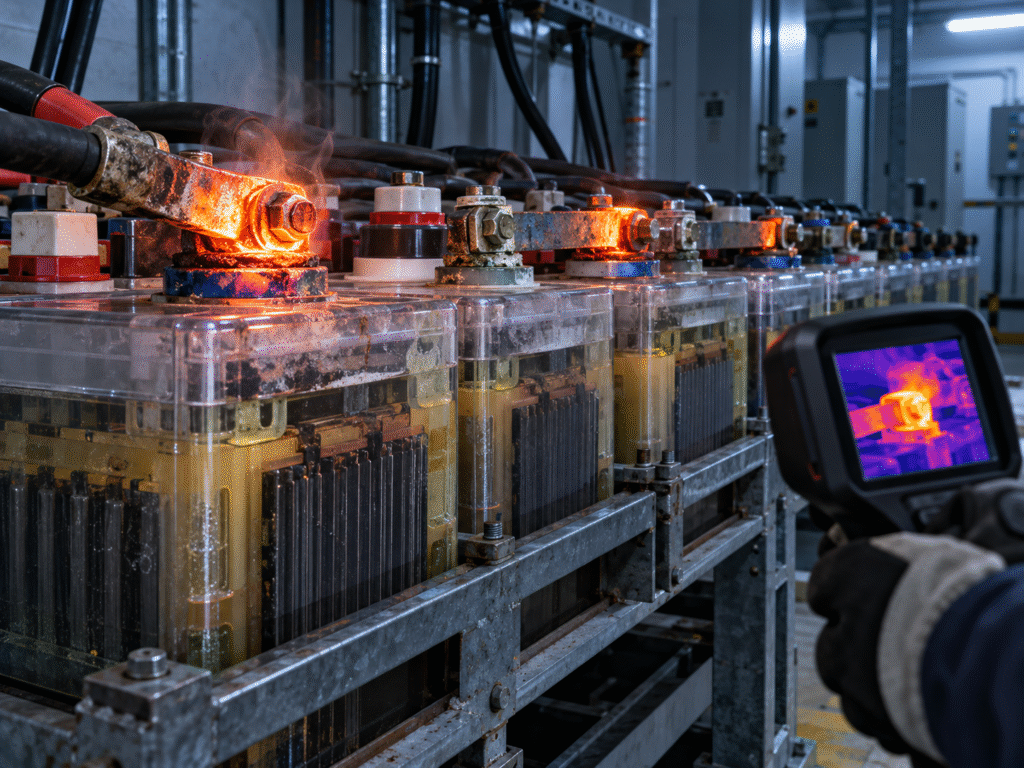
One warning sign is abnormal heating around battery terminals or intercell connectors. Maintenance engineers may discover that one connection is noticeably warmer than the others, that a terminal has become discolored, or that insulation materials near the connection show signs of heat exposure.
These problems are sometimes mistaken for internal battery defects. In reality, terminal overheating is frequently associated with increased electrical resistance at connection points.
If ignored, a high-resistance connection can lead to additional heating, voltage losses, damaged terminals, and potentially an interruption of the DC supply.
For power substations, railway systems, and industrial emergency power installations, understanding the causes of NiCd battery terminal overheating is essential for reliable operation.
1. Why Do Battery Terminals Become Hot?
Every electrical connection has some resistance. When current flows through the connection, part of the electrical energy is converted into heat.
The relationship between current, resistance, and heat generation can be expressed as:
P=I^2R
Where:
- P = power dissipated as heat, in watts
- I = current flowing through the connection, in amperes
- R = electrical resistance of the connection, in ohms
This relationship explains why a seemingly small increase in connection resistance can become significant when a battery supplies high current.
Example: A High-Resistance Connection
Consider a NiCd battery connection with a resistance of 1 milliohm (0.001 Ω).
At a current of 100A: P=100^2*0.001=10W
If the current increases to 300A: P=300^2*0.001=90W
At higher current, a relatively small resistance can generate substantial localized heating.
This is particularly important for industrial NiCd batteries designed to support high discharge currents or short-duration emergency loads.
2. Loose Terminal Connections
One of the most common causes of battery terminal overheating is an improperly tightened connection.
When a terminal bolt is not tightened to the manufacturer’s specified torque, the effective contact area between conductive surfaces may be reduced. This increases contact resistance and can create localized heating during charging or discharging.
Over time, mechanical vibration, thermal cycling, improper assembly, or maintenance activities may contribute to connection problems.
Why Is Correct Tightening Torque Important?
Applying insufficient torque can result in unreliable electrical contact. However, excessive tightening can also damage terminal components, threads, or sealing structures. Therefore, more torque is not necessarily better.
The correct tightening torque depends on the battery terminal design, bolt dimensions, materials, and manufacturer specifications. Maintenance personnel should use suitable tools and follow the approved installation instructions.
3. Corrosion and Contamination Around Terminals
Corrosion or contamination around NiCd battery terminals can increase electrical resistance and contribute to overheating. In industrial environments, terminal surfaces may be exposed to humidity, dust, chemical contamination, or electrolyte residue.
Vented nickel-cadmium batteries use an alkaline electrolyte, and contamination around the terminal area should be handled using appropriate procedures.
Common Warning Signs
Maintenance engineers should look for visible changes such as surface discoloration, deposits around terminal connections, damaged protective coatings, and irregular temperature patterns. However, visual inspection alone cannot determine the electrical resistance of a connection.
A connection may appear clean while still having poor electrical contact because of installation errors or deterioration beneath the contact surface. When corrosion is identified, technicians should investigate the underlying cause rather than repeatedly cleaning the terminal without addressing the source of contamination.
4. Incorrect or Incompatible Intercell Connectors
Industrial NiCd battery banks typically consist of multiple individual cells connected in series. The intercell connectors must be designed to carry the expected charging, continuous discharge, and short-duration peak currents.
If connectors are undersized, incorrectly installed, or made from unsuitable materials, they may exhibit excessive voltage drop and heating. The use of incompatible terminal hardware can also create unreliable contact.
For battery replacement projects, it is important to verify connector compatibility rather than assuming that components from different battery models are interchangeable.
Example: Replacement Battery Installation
A maintenance contractor replaces several cells in an existing industrial battery bank. Although the replacement cells have the same nominal voltage and capacity, the terminal dimensions differ from the original battery model.
The contractor modifies the existing connectors to fit the new terminals. During a later high-current discharge, one modified connection develops abnormal heating.
In this situation, the problem may be caused by insufficient contact area, inappropriate connector geometry, or improper hardware rather than the electrochemical performance of the replacement cell. Correct connector design and installation should be verified before the battery is returned to service.
5. Can High Charging Current Cause Terminal Overheating?
High current increases the heating associated with connection resistance. During normal float charging, the current flowing into a fully charged standby battery may be relatively low. Under these conditions, a connection defect might produce little noticeable heat.
After a deep discharge, however, the battery may receive a substantially higher charging current. The increased current can expose an existing high-resistance connection.
Similarly, a short-duration emergency discharge may produce a temperature rise that does not appear during ordinary standby operation. This explains why some battery connection problems become visible only during a capacity test or actual DC power interruption.
A connection that remains cool at low current should not automatically be considered suitable for the full design load.
6. How to Diagnose Terminal Overheating
Thermal inspection and electrical measurements can help identify abnormal connections.
Infrared Thermal Inspection
An infrared camera can help maintenance personnel identify unusual temperature differences between similar connections operating under comparable loads.
For example, if one intercell connector is significantly hotter than other connectors carrying the same current, that location deserves further investigation.
However, infrared measurements can be affected by surface emissivity, reflections, viewing angle, and other factors. Temperature differences should therefore be interpreted carefully rather than treated as definitive proof of a particular defect.
Voltage Drop Measurement
Under a known current, technicians can measure the voltage drop across an individual connection using suitable instruments and approved test points.
The resistance can then be estimated using: R=V/I
For example, a 50mV voltage drop at 100A corresponds to an estimated resistance of: R=0.05/100=0.0005Ω=0.5mΩ
This calculation is useful for comparison, but the result must be evaluated against the manufacturer’s specifications, measurement conditions, and the type of connection being tested.
Physical Inspection
After the equipment has been safely isolated according to the approved procedure, technicians can inspect the terminal hardware, contact surfaces, and connector condition.
Any corrective work must follow site electrical safety requirements. Live tightening, disassembly, or improvised repairs can cause short circuits, arc hazards, or loss of essential DC power.
7. Common Terminal Overheating Problems and Corrective Actions
| Observed Condition | Possible Cause | Recommended Action |
|---|---|---|
| One connector hotter than neighboring connectors | Increased contact resistance | Investigate voltage drop and connection condition |
| Heating after high-current discharge | Existing resistance exposed by high current | Inspect the connection and verify suitability |
| Corrosion around terminal | Contamination or electrolyte-related issue | Identify cause and use approved cleaning procedures |
| Damaged terminal hardware | Improper installation or excessive torque | Evaluate and replace damaged components as required |
| Repeated heating after maintenance | Incorrect connector or hardware | Verify design and installation compatibility |
| Multiple hot connections | Excess current, unsuitable connectors, or systematic installation problem | Review load current and installation design |
8. How Distributors Can Reduce Connection-Related Complaints
Industrial battery distributors sometimes receive complaints about overheated terminals shortly after a battery bank is installed. Before concluding that the battery cells are defective, the distributor should request clear photographs, installation records, measured current, temperature observations, and information about the connector hardware.
For replacement battery projects, the supplier and contractor should verify terminal dimensions, connector compatibility, rack layout, and installation requirements before shipment. Providing installation drawings and correct tightening instructions can reduce problems caused by field assembly.
For overseas projects where technical support may be difficult to arrange immediately, clear documentation is particularly valuable.
Frequently Asked Questions
Is it normal for NiCd battery terminals to become warm?
Some temperature rise may occur when current flows through a connection. However, unusual heating compared with similar connections under the same conditions should be investigated.
Can a loose connector damage a nickel-cadmium battery?
Yes. A high-resistance connection can generate localized heat, damage terminal components, and reduce the reliability of the battery circuit.
Should I tighten a hot battery terminal immediately?
No. Corrective work should follow the approved electrical safety and isolation procedure. Attempting to tighten an energized connection can be hazardous.
Can an infrared camera detect every connection problem?
No. Infrared inspection is useful, but certain defects may not produce detectable heating under low-current conditions. Electrical measurements and physical inspections may also be required.
Conclusion
Terminal overheating in industrial NiCd battery systems is often associated with connection resistance rather than internal battery failure. Loose hardware, contaminated contact surfaces, unsuitable connectors, and high operating currents can all contribute to excessive heating.
For industrial DC backup applications, regular inspection and correct installation practices are essential to prevent connection-related failures.
Industrial Nickel-Cadmium Batteries for Reliable DC Power Systems
WUXI HUIZHONG POWER CO., LTD. supplies industrial NiCd batteries for substations, railway facilities, power generation plants, and emergency backup power systems.
Visit www.huizhongpower.com for product information, battery selection assistance, and technical discussions concerning replacement projects and new installations.