

Introduction
A failed battery capacity test can create serious concerns for industrial facilities that depend on reliable DC backup power. When a nickel-cadmium (NiCd) battery bank delivers less capacity than expected, maintenance teams may immediately suspect that the battery has reached the end of its service life.
However, the situation is not always that straightforward. The measured capacity of an industrial NiCd battery depends on several factors, including its charging condition, discharge current, temperature, test procedure, and the performance of individual cells.
A battery that fails a capacity test may genuinely be deteriorating, but an incorrect test setup or unsuitable preparation can also produce misleading results.
For power utilities, railway operators, EPC contractors, and industrial battery distributors, understanding the reasons behind capacity test failure is essential before deciding whether to repair, retest, or replace a battery bank.
1. What Does a NiCd Battery Capacity Test Measure?
A capacity test determines how much electrical charge a battery can deliver under specified discharge conditions. For industrial nickel-cadmium batteries, capacity is commonly expressed in ampere-hours (Ah).
Under a constant-current discharge test, the delivered capacity can be calculated using: C=I*t
Where:
- C = delivered capacity in Ah
- I = constant discharge current in amperes
- t = discharge duration in hours
For example, if a battery delivers 20A for five hours before reaching the specified discharge endpoint, the delivered capacity is: C=20*5=100Ah
However, this calculation does not automatically mean the battery has achieved 100% of its rated capacity. The measured result must be compared with the manufacturer’s published performance data at the specified discharge rate, temperature, and final voltage.
This distinction is particularly important because industrial NiCd batteries may be designed for different discharge characteristics, including long-duration, medium-duration, and high-rate applications.
2. The Battery Was Not Fully Charged Before Testing
One of the first factors to investigate after an unexpectedly low capacity result is the battery’s charging condition before the test. A NiCd battery may have been connected to a charger for an extended period without necessarily completing the charging procedure required before an acceptance or capacity test.
For example, the charger may have operated at an unsuitable voltage, reached its current limit, or been disconnected before the battery had recovered from a previous discharge. The overall battery voltage may appear normal even though the battery has not achieved the required charged condition.
Example: A Newly Installed NiCd Battery Bank
An EPC contractor installs a new industrial NiCd battery bank for a substation project. After installation, the battery is connected to the charger and left charging overnight. The following morning, a discharge test is performed.
The result is below the contractual acceptance requirement. Before rejecting the battery, the contractor should check whether the initial charging procedure was completed correctly.
Certain industrial NiCd battery designs require specific commissioning or initial charging procedures. Simply leaving the battery on normal float charging may not satisfy those requirements. A correctly prepared retest may produce a different result.
3. The Discharge Current Does Not Match the Battery Rating
Industrial NiCd batteries are available in different constructions optimized for different discharge requirements. A battery designed for relatively long discharge durations may behave differently from a high-rate battery intended to supply substantial current for a short period.
This is one reason why comparing only nominal ampere-hour ratings can be misleading.
Example: Different Discharge Conditions
Consider two industrial battery models with the same nominal 100Ah capacity. One battery may be optimized for a relatively long discharge, while another may be designed for higher discharge currents.
Although their nominal capacities are identical, their available capacities at a particular high discharge current may differ. If the test technician uses the same discharge current and performance expectation for both batteries without checking the manufacturer’s discharge tables, the assessment may be incorrect.
What Should Be Verified?
The discharge current, required duration, final voltage, and temperature conditions should match the applicable battery specification.
For projects involving KPL, KPM, KPH, or similar industrial NiCd battery series, model-specific performance data should always be used. The model designation alone is not sufficient to establish the exact test current or capacity acceptance limit.
4. Battery Temperature Affects the Measured Capacity
Temperature can have a significant influence on the discharge performance of nickel-cadmium batteries. At lower temperatures, electrochemical reaction rates and discharge performance can be reduced, depending on the cell design and discharge current.
This means that a battery tested in a cold environment may deliver less capacity than the same battery tested under the manufacturer’s reference conditions. High temperatures also require careful consideration because they can influence battery behavior, safety, and long-term service life.
Example: Outdoor Industrial Installation
A telecommunications facility uses an industrial NiCd battery bank in an outdoor equipment shelter. During the winter, a maintenance team performs a capacity test when the battery temperature is substantially below the reference temperature used in the manufacturer’s performance data.
The battery delivers less capacity than expected. In this situation, the technician should review whether the test result requires a temperature correction or comparison with the manufacturer’s performance data for the actual test temperature.
The correct approach depends on the battery design and applicable test standard. A lower result at reduced temperature does not automatically demonstrate permanent battery deterioration.
5. Incorrect End-of-Discharge Voltage
Another common source of capacity test error is selecting an inappropriate final discharge voltage. During a controlled capacity test, discharge must be terminated according to the specified endpoint.
If the test is stopped at a voltage higher than the applicable final voltage, the recorded discharge duration may be shorter than expected. Conversely, continuing the discharge beyond the approved endpoint can expose individual cells to excessive discharge and possible damage.
Nickel-cadmium batteries have different discharge characteristics from lead-acid batteries. Therefore, a lead-acid battery discharge endpoint should not be applied automatically to a NiCd battery system. For industrial applications, the correct final voltage must be obtained from the battery manufacturer’s discharge performance information and the approved test procedure.
6. One Weak Cell Can Limit the Entire Battery Bank
A series-connected NiCd battery bank may contain many individual cells. Even if most cells retain acceptable capacity, one deteriorated cell can reach its discharge endpoint earlier than the others. This can cause the battery bank to terminate its discharge test before reaching the expected duration. A maintenance technician who measures only the total battery voltage may overlook this problem.
Individual cell voltage monitoring during an approved discharge test can provide valuable diagnostic information. If one cell repeatedly reaches an abnormal voltage earlier than neighboring cells, the battery maintenance team should investigate its condition, charging history, and possible need for replacement. However, an individual low voltage reading should not be used as the sole basis for condemning a cell.
7. Understanding Capacity Test Results
Consider a hypothetical industrial NiCd battery with a rated capacity of 200Ah under a specified five-hour discharge condition. The corresponding constant test current would be 40A.
The following table illustrates how discharge duration affects delivered capacity.
| Discharge Duration | Delivered Capacity | Percentage of 200Ah |
|---|---|---|
| 5.0 hours | 200Ah | 100% |
| 4.5 hours | 180Ah | 90% |
| 4.0 hours | 160Ah | 80% |
| 3.5 hours | 140Ah | 70% |
| 3.0 hours | 120Ah | 60% |
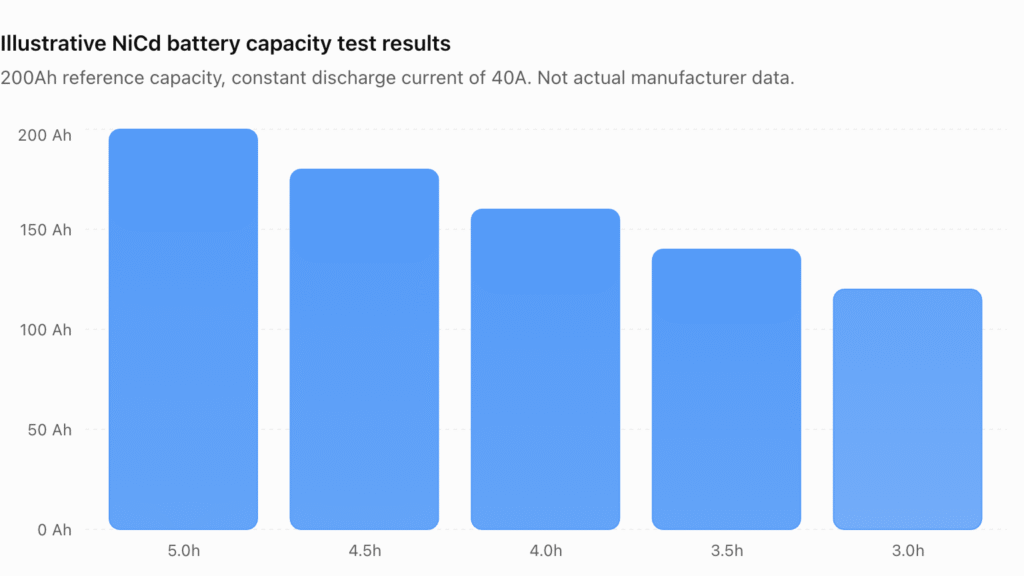
These figures are simplified examples based on constant-current discharge.
In actual testing, the result may require additional interpretation based on temperature, final voltage, battery condition, and the relevant manufacturer’s performance specification.
A battery delivering 80% of a reference capacity is not automatically classified as failed in every application. The pass/fail threshold must be established by the applicable standard, project specification, maintenance policy, or battery manufacturer’s recommendations.
8. Acceptance Testing vs. Maintenance Capacity Testing
Not all battery capacity tests serve the same purpose.
Factory Acceptance Testing
Factory tests are performed to verify that batteries meet applicable manufacturing and performance requirements. The test conditions and acceptance criteria should follow the agreed product specification and relevant standards.
For industrial vented NiCd cells, IEC 60623 is an important reference covering performance and testing requirements.
Site Acceptance Testing
Site acceptance testing is generally performed after installation to verify that the battery system meets the project requirements. The test should follow the approved commissioning procedure and take into account the charging preparation, installation condition, and required discharge performance.
Periodic Maintenance Testing
Maintenance capacity tests are used to assess battery condition after the equipment has been operating for a period of time. The measured capacity can be compared with previous test results to identify performance trends.
For older battery systems, this historical comparison can be particularly valuable. An isolated low result should be evaluated together with maintenance records and operating conditions before reaching a final replacement decision.
9. Troubleshooting Checklist After a Failed Capacity Test
| Potential Problem | Verification Method | Possible Next Step |
|---|---|---|
| Incomplete charging | Review charging parameters and duration | Perform approved recharge procedure |
| Incorrect discharge current | Compare test setup with discharge tables | Correct the test current |
| Low test temperature | Check recorded battery temperature | Apply approved correction or performance comparison |
| Incorrect endpoint voltage | Verify test configuration | Review and correct test procedure |
| Weak individual cell | Review cell voltage records | Investigate the abnormal cell |
| Test equipment error | Check calibration and recorded values | Correct equipment issue and reassess |
| Genuine battery deterioration | Review valid test results and history | Assess replacement requirements |
Any retest should be performed only after the cause of the initial result has been evaluated and the battery has been appropriately recharged. Repeated deep discharge testing without a justified procedure can create unnecessary stress and may temporarily reduce the availability of critical backup power.
10. What Information Should an Overseas Distributor Send to the Manufacturer?
When a customer reports that an industrial NiCd battery has failed its discharge capacity test, supplying complete information can significantly improve the technical investigation.
A useful report should include the battery model and serial information, installation date, discharge current, starting and ending voltage, discharge duration, battery temperature, charger settings, and charging preparation.
Individual cell voltage records, photographs, and previous maintenance reports are also valuable. If the installation supports critical equipment, the manufacturer should be informed about operational restrictions and whether a replacement battery bank or temporary backup supply is required.
Clear technical records help distinguish between genuine battery defects, installation problems, and incorrect test conditions.
Frequently Asked Questions
Why does my NiCd battery show normal voltage but fail the discharge test?
Normal terminal voltage does not guarantee full usable capacity. The battery may be incompletely charged, deteriorated, or affected by weak cells or unsuitable test conditions.
Can a NiCd battery recover after failing a capacity test?
In some cases, an incorrectly prepared or incompletely charged battery may achieve a better result after following the manufacturer’s approved procedure. However, permanent deterioration cannot necessarily be reversed.
Can I test a NiCd battery using a lead-acid battery capacity tester?
A programmable battery discharge tester may be suitable if it supports the required NiCd test current, voltage range, endpoint, and monitoring requirements. Lead-acid-specific presets should not be assumed compatible.
When should an industrial NiCd battery be replaced?
Replacement decisions should consider the validated capacity test result, required backup duty, applicable acceptance criteria, battery age, individual cell condition, and installation criticality.
Conclusion
A failed capacity test does not always mean that an industrial nickel-cadmium battery has reached the end of its useful life. Charging preparation, discharge current, battery temperature, endpoint voltage, individual cell performance, and measurement accuracy can all affect the result.
Before replacing an expensive battery bank, engineers should verify the test procedure and investigate whether the observed capacity reduction reflects the actual condition of the battery. For industrial facilities, correct testing and interpretation help avoid unnecessary replacement while ensuring that critical DC backup systems remain reliable.
Looking for Industrial NiCd Batteries for Substation or Power Plant Projects?
WUXI HUIZHONG POWER CO., LTD. supplies nickel-cadmium battery solutions for power generation, electrical substations, railway signaling, and industrial backup power systems.
Visit www.huizhongpower.com to discuss battery replacement, project specifications, capacity requirements, and technical product information.