
Introduction
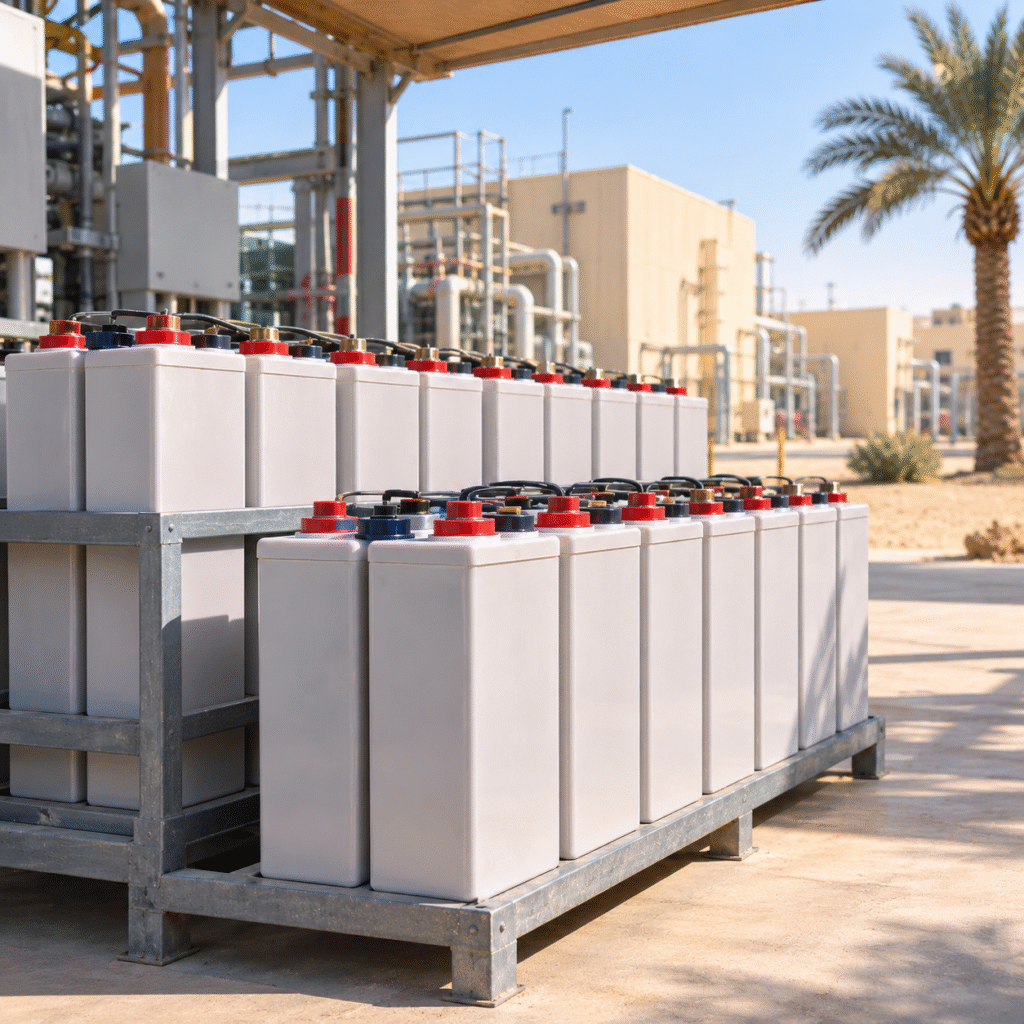
Industrial battery selection becomes particularly challenging when equipment must operate in high-temperature environments. For power utilities, oil and gas facilities, railway networks, and telecommunications infrastructure in the Middle East and Africa, battery rooms may experience elevated temperatures, dust exposure, limited maintenance access, and unstable electrical grid conditions.
Nickel-cadmium (NiCd) batteries are frequently considered for these projects because of their operating characteristics, mechanical durability, and ability to support demanding industrial applications. However, the statement that nickel-cadmium batteries are suitable for hot climates should not be interpreted as meaning that temperature has no effect on their performance or service life.
High temperatures can influence charging behavior, electrolyte water consumption, maintenance requirements, and overall battery reliability. For overseas importers, EPC contractors, and local industrial battery distributors, selecting the right NiCd battery requires more than checking the maximum operating temperature listed in a catalog.
This article explains the most important technical and purchasing considerations for industrial NiCd battery projects in hot climates, with particular attention to installations in Saudi Arabia, the United Arab Emirates, Nigeria, Kenya, and other markets facing demanding environmental conditions.
1. Why Are NiCd Batteries Considered for Hot Climate Applications?
Industrial NiCd batteries are available in designs intended for demanding stationary and industrial applications. Their operating characteristics can make them suitable for projects where reliability, high discharge performance, and resilience to difficult environmental conditions are important.
Compared with certain other battery technologies, some industrial nickel-cadmium designs offer a relatively broad operating temperature range. However, the exact allowable temperature range depends on the manufacturer, battery construction, and operating conditions. A battery marketed as suitable for high-temperature operation may still require temperature-related charging adjustments, ventilation, and regular maintenance.
Common Applications in Hot Regions
Industrial NiCd batteries may be used in electrical substations, thermal power plants, industrial emergency shutdown systems, oil and gas facilities, remote signaling installations, and telecommunications infrastructure.
These applications often require dependable DC backup power for equipment that must continue operating during an AC supply interruption. For example, an electrical substation may rely on its battery bank to energize protection relays and operate circuit breakers even when the main power supply is unavailable. In such applications, failure of the backup battery system can have consequences far greater than the cost of replacing the battery itself.
2. Maximum Operating Temperature Is Not the Same as Recommended Operating Temperature
One of the most common mistakes when selecting industrial batteries for hot climates is focusing only on the maximum temperature stated in the data sheet. A manufacturer may specify that a particular battery can operate within a relatively wide temperature range.
However, this does not necessarily mean that continuous operation near the upper limit is recommended or that the battery will deliver identical long-term performance under all temperatures within that range. There is an important distinction between temporary temperature tolerance and continuous operating conditions.
Example: Battery Room at 40°C
Consider an industrial NiCd battery installed in a substation battery room where the air temperature frequently reaches 40°C. The battery may remain operational under those conditions if its technical specification permits them.
However, the elevated temperature may affect charging behavior, water consumption, and maintenance requirements. Over time, the battery’s operating condition may differ from that of an identical model installed in a controlled environment at a lower temperature. Therefore, project engineers should request manufacturer-specific information concerning the intended continuous operating temperature, not just the maximum allowable temperature.
3. High Temperature Can Increase Electrolyte Maintenance Requirements
Vented industrial nickel-cadmium batteries use an alkaline electrolyte, typically based on potassium hydroxide. During charging, water can be consumed through gas generation. The amount of water consumed depends on battery design, charger settings, temperature, and operating conditions.
In hot environments, inappropriate charging parameters can contribute to excessive water consumption. This issue becomes especially important in remote installations where regular maintenance visits are difficult or expensive.
Example: Remote Telecommunications Installation
A telecommunications operator installs industrial NiCd batteries at a remote facility in a hot region. The site is inspected only at scheduled maintenance intervals. If the charging settings are unsuitable or operating temperatures remain elevated, the battery may require more frequent water replenishment than originally anticipated.
Without appropriate inspection and maintenance, electrolyte levels may eventually fall outside the manufacturer’s specified limits. This can create reliability problems and increase the risk of unexpected maintenance work. For remote projects, the battery’s electrolyte reserve, maintenance instructions, charging arrangement, and service access should therefore be reviewed during the procurement stage.
4. Charging Voltage Must Match the Actual Operating Conditions
Industrial NiCd batteries require manufacturer-specific charging parameters. Different cell constructions may have different recommended float, boost, or commissioning charging settings. Using inappropriate settings can result in insufficient charging or excessive gas generation and water consumption.
In hot climates, battery temperature should be considered when configuring the charger. However, temperature compensation should not simply be copied from lead-acid battery charging practices. Whether compensation is required, and the appropriate adjustment method, depends on the specific NiCd battery and charger design.
What Should Buyers Ask?
Buyers should request the recommended charging voltage and current limits for the proposed battery model, including instructions for the expected temperature range. They should also verify that the charger can support those requirements while maintaining a suitable DC bus voltage for the connected equipment. This is particularly important when installing NiCd batteries in an existing power system originally designed for another battery type.
5. Battery Room Ventilation Is Essential
Some project buyers assume that selecting a high-temperature-tolerant battery eliminates the need for a carefully designed battery room. This is incorrect. Vented NiCd batteries can release hydrogen and oxygen during charging.
Hydrogen accumulation can create a fire or explosion hazard if the battery room or cabinet is inadequately ventilated. The ventilation system must therefore be designed according to the battery installation, expected gas generation, applicable standards, and local requirements. IEC 60623:2026 includes safety recommendations concerning the ventilation of industrial vented NiCd battery systems and refers to IEC 62485-2 for stationary battery installation safety.
Air Conditioning Is Not a Substitute for Ventilation
In hot regions, electrical equipment rooms may use air conditioning to maintain suitable operating temperatures. However, an air conditioning system that simply recirculates indoor air may not provide the fresh-air exchange required for hydrogen dilution.
Temperature control and gas ventilation must therefore be addressed separately and coordinated in the overall design. For enclosed battery cabinets, the airflow arrangement deserves particular attention.
6. Dust, Sand, and Humidity Can Affect Installation Reliability
Hot climate projects do not all experience the same environmental conditions. Desert installations may face airborne dust and sand, while coastal power plants or industrial facilities may experience elevated humidity and salt-laden air.
These factors can influence electrical connections, equipment enclosures, insulation surfaces, and maintenance practices. For example, contamination around battery terminals and supporting structures may increase maintenance requirements.
In coastal locations, corrosion protection for battery racks, connectors, and other installation components can be important. The battery’s environmental suitability should therefore be evaluated together with the complete installation.
Avoid Assuming Every African or Middle Eastern Site Has the Same Climate
A substation located in a desert environment has different installation challenges from a coastal industrial facility. Similarly, a telecommunications site in a hot and humid region may require different environmental protection measures from an inland power station.
Buyers should provide actual site temperature, humidity, dust, and installation conditions to the battery manufacturer. Regional location alone is not sufficient to define the operating environment.
7. Long-Term Storage Before Installation Can Become a Problem
Large industrial projects often involve extended periods between equipment delivery and commissioning. This can be particularly important where batteries are shipped internationally and stored at construction sites. High-temperature storage conditions may affect the battery’s condition, depending on the shipment status and manufacturer instructions.
For example, batteries stored inside unventilated metal containers may experience temperatures considerably higher than the surrounding ambient air. A battery capable of operating in a hot environment is not necessarily suitable for unlimited storage under those same conditions.
For overseas importers, the storage requirements should be confirmed before shipment. If project delays occur, the buyer should maintain storage records and consult the manufacturer regarding any additional inspections or commissioning procedures.
8. Selecting Between KPL, KPM, and KPH for Hot Climate Projects
Industrial NiCd batteries are often divided into low-rate, medium-rate, and high-rate discharge designs. The selection should reflect the actual DC load profile rather than the climate alone.
| Battery Type | General Discharge Focus | Typical Application Considerations |
|---|---|---|
| KPL | Longer-duration, relatively lower current | Telecommunications, monitoring and extended standby loads |
| KPM | Medium-rate discharge | Industrial control and mixed DC load profiles |
| KPH | Higher-rate, shorter-duration discharge | Certain circuit breaker and high-current industrial duties |
These categories describe general product positioning. Actual discharge rates and performance must be confirmed using the manufacturer’s data. A high-temperature site does not automatically require a KPH battery.
Likewise, a long-duration backup system should not be fitted with a low-rate battery solely on the basis of its Ah rating without checking the complete load profile. The correct selection depends on discharge current, duration, voltage limits, temperature, and the manufacturer’s performance tables.
9. What Should Buyers Check Before Ordering?
For projects in the Middle East and Africa, overseas importers and EPC contractors should obtain sufficient technical information before confirming the order.
| Procurement Item | Information to Verify | Why It Matters |
|---|---|---|
| Operating temperature | Continuous and maximum expected battery temperature | Supports performance and durability assessment |
| Battery construction | KPL, KPM, KPH or equivalent design | Matches discharge requirements |
| DC load profile | Continuous and short-duration currents | Ensures suitable sizing |
| Charging parameters | Manufacturer-approved settings | Prevents charging problems |
| Electrolyte maintenance | Inspection and water replenishment requirements | Supports maintenance planning |
| Ventilation | Battery-specific gas generation and installation requirements | Addresses safety |
| Rack protection | Materials and environmental suitability | Reduces installation problems |
| Storage conditions | Maximum storage duration and environmental limits | Protects batteries before commissioning |
| Test reports | Actual model and standard coverage | Supports technical verification |
| Warranty | Coverage and exclusions | Reduces commercial uncertainty |
These checks are especially valuable for projects where the batteries will be installed in remote locations and technical support visits are costly.
10. Evaluate the Supplier’s Technical Support, Not Just the Price
For a critical industrial installation, supplier capability extends beyond manufacturing batteries. A competent supplier should be able to provide accurate technical data, charging recommendations, discharge performance information, dimensional drawings, and appropriate installation instructions.
When evaluating suppliers, overseas buyers should consider whether the manufacturer can support technical questions during project design, installation, commissioning, and after-sales service. It is also important to establish how warranty claims and technical problems will be handled.
A low-cost battery may become expensive if the importer must arrange repeated site inspections, emergency replacements, or additional freight shipments. For large projects, clear communication and complete documentation can be as important as the battery’s initial purchase price.
11. A Practical Inquiry Example for a Hot Climate Project
Consider a utility contractor preparing to purchase an industrial NiCd battery bank for a substation in Saudi Arabia. The contractor knows that the DC system is nominally 110V, but the existing battery model is no longer available.
A useful technical inquiry should identify the number of existing battery cells, required discharge load profile, charger voltage range, battery capacity, rack dimensions, and expected battery room temperature. The buyer should also clarify whether the installation is air-conditioned, naturally ventilated, or mechanically ventilated.
With this information, the manufacturer can review the technical requirements and recommend a model for further engineering evaluation. Simply requesting “110V 200Ah high-temperature NiCd batteries” may not provide enough information for a technically reliable selection.
Frequently Asked Questions
Are nickel-cadmium batteries suitable for high-temperature environments?
Certain industrial NiCd battery designs are suitable for demanding temperature conditions. However, the allowable operating range and expected performance must be confirmed for the specific model.
Do NiCd batteries last longer than lead-acid batteries in hot climates?
Performance and service life depend on the specific products, operating temperatures, charging arrangements, and maintenance conditions. A universal lifespan advantage should not be assumed for every application.
Can NiCd batteries operate at 50°C?
Some industrial designs may permit operation at such temperatures under defined conditions, but this must be verified with the manufacturer. Continuous operation and short-term temperature tolerance are not equivalent.
Do NiCd batteries need air conditioning in Saudi Arabia or Africa?
Not necessarily in every installation. The need for temperature control depends on the battery design, site conditions, performance requirements, and project specifications. Adequate gas ventilation must still be provided.
Which NiCd battery is best for a hot climate substation?
The appropriate model depends on the electrical load profile, discharge duration, operating temperature, charger compatibility, and system voltage requirements. The climate alone does not determine the battery type.
What documents should an industrial NiCd battery importer request?
Important documents may include the product data sheet, discharge tables, charging instructions, installation guidelines, applicable test reports, and written warranty conditions.
Conclusion
Industrial nickel-cadmium batteries can be suitable for demanding environments in the Middle East and Africa, but reliable operation requires proper battery selection and system design. High operating temperatures, charging conditions, water consumption, ventilation, environmental contamination, and maintenance access should all be considered.
For overseas importers and engineering contractors, choosing a suitable battery involves more than selecting a nominal voltage, capacity, and temperature rating. By evaluating the complete operating environment and obtaining accurate technical information from the supplier, buyers can reduce installation risks and improve long-term reliability.
Industrial NiCd Battery Supplier for Middle East and Africa Projects
WUXI HUIZHONG POWER CO., LTD. supplies industrial nickel-cadmium batteries for power generation, substations, railways, telecommunications, oil and gas, and other critical DC backup applications.
For projects in Saudi Arabia, the UAE, Nigeria, Kenya, and other international markets, visit www.huizhongpower.com to discuss battery specifications, discharge requirements, operating conditions, and quotations.