
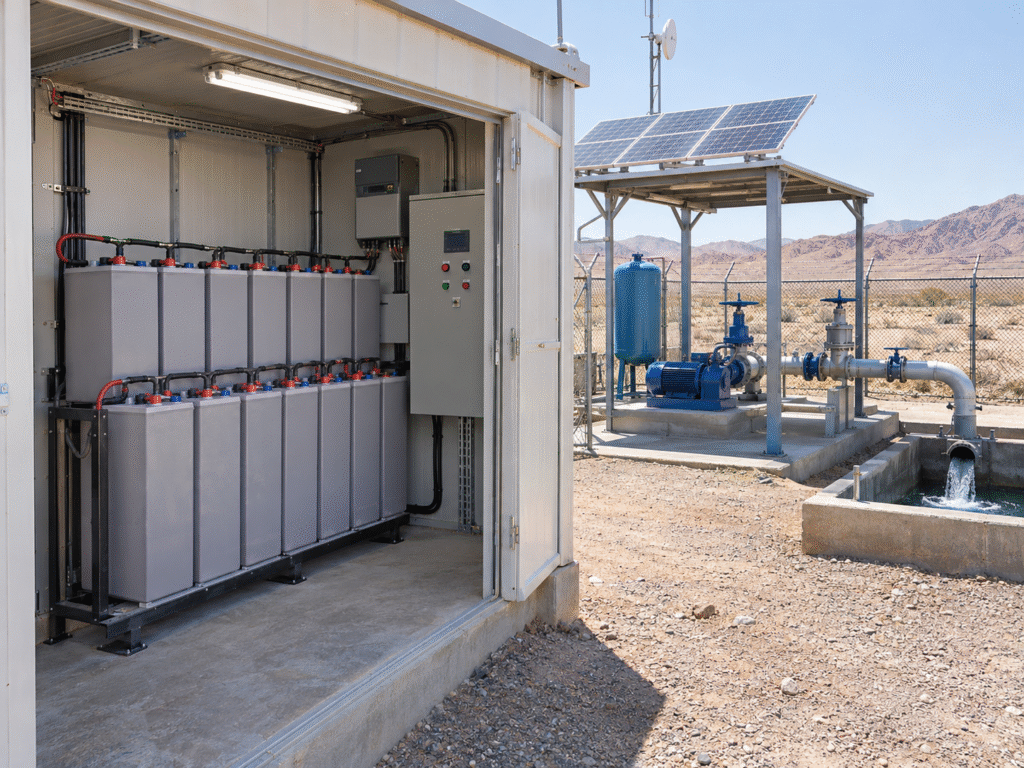
Reliable Water Supply Depends on More Than Pump Capacity
Remote water pumping stations play an important role in agricultural irrigation, municipal water distribution, rural drinking-water supply and industrial water infrastructure. Many of these installations operate in locations where the electrical grid is unreliable or unavailable. For project developers, selecting pumps and solar panels is only part of the challenge. Control systems, communications equipment, monitoring instruments and selected emergency functions may also require a dependable power source.
OPzV tubular GEL batteries can be considered for stationary backup systems at remote pumping stations, particularly where maintenance access is limited. However, an important distinction must be made between providing backup power to low-energy control equipment and operating a large electric water pump from batteries. These applications require very different battery capacities, inverters and system architectures.
Where Are Batteries Actually Used in Water Pumping Stations?
Pump Control and Automation Systems
Many pumping stations include programmable logic controllers, level sensors, pressure transmitters, communication equipment and remote monitoring devices. These components may need to remain operational when the main AC power supply fails.
A dedicated DC battery system can preserve monitoring and control functions, allow fault information to be transmitted and support appropriately designed shutdown procedures. For these relatively low-power applications, a stationary OPzV battery bank may be more practical than installing a large energy-storage system for the entire pump motor.
Solar-Powered Rural Water Infrastructure
In remote areas of Africa, the Middle East and Southeast Asia, solar pumping systems may be installed where utility electricity is unavailable. Some systems operate pumps primarily during daylight and store water in elevated tanks or reservoirs.
This approach uses stored water, rather than stored electricity, to maintain supply during nighttime. Battery storage may still be required for monitoring, communications, automatic valves or other critical loads. For distributors and solar EPC contractors, separating the pump’s energy demand from the auxiliary power demand is essential.
Emergency Water Supply Installations
Certain industrial and municipal installations require backup power for designated water-system functions. The required power architecture depends on the equipment and applicable engineering standards.
If the project requires an electric pump motor to operate during a power failure, the battery bank and inverter must be designed for motor starting current, operating power and required runtime. An ordinary small DC standby battery should not be assumed capable of starting or operating a large pump.
Why OPzV Batteries Are Considered for Unmanned Pump Stations
OPzV batteries combine tubular positive plates with an immobilized gel electrolyte and valve-regulated construction. Their reduced routine electrolyte maintenance requirements can be useful at locations where service personnel visit only periodically.
For a water utility operating many geographically dispersed stations, each maintenance visit may involve transportation, labor and temporary disruption to normal operations. Eliminating routine water topping-up can therefore reduce one part of the maintenance burden. Nevertheless, OPzV batteries still require suitable charging, inspection, temperature management and periodic performance evaluation. A reduced-maintenance design should not be confused with a completely maintenance-free installation.
Battery Sizing Begins with the Actual Equipment Load
Consider a hypothetical remote pump station with the following auxiliary electrical loads:
| Equipment | Average Power |
|---|---|
| Control unit and monitoring system | 35W |
| Communication equipment | 20W |
| Sensors and auxiliary devices | 15W |
| Total | 70W |
If the system must support these loads for 24 hours without external power, the theoretical energy demand is: 70W × 24h = 1,680Wh
For a nominal 24V DC battery system, this corresponds to approximately: 1,680Wh ÷ 24V = 70Ah
This value represents the theoretical energy requirement, not the final recommended battery capacity. The design must also consider permissible depth of discharge, aging, operating temperature, discharge-rate characteristics, DC conversion losses and a suitable reserve. For example, if a preliminary design assumes a maximum 50% depth of discharge and an 85% combined allowance for energy-delivery losses and design margin, the indicative capacity becomes: 70Ah ÷ (0.50 × 0.85) ≈ 165Ah
A final selection would require confirmation using the battery manufacturer’s discharge data. This calculation also excludes any large pump motor or intermittent equipment not included in the 70W load schedule.
What If the Customer Wants the Battery to Run the Water Pump?
This is a different engineering requirement. Suppose a project uses a 3kW pump that must operate for two hours during an outage. The pump alone requires approximately: 3kW × 2h = 6kWh
The battery must deliver more energy than this after inverter and electrical losses are included. The system must also handle motor starting current, which may be much higher than the normal operating current.
For such projects, the EPC contractor should evaluate the motor starter, inverter capability, allowable depth of discharge and suitable battery discharge performance together. Battery-supported pumping is technically possible, but it can be much more expensive than supplying control-system backup. In some applications, storing additional water or providing generator backup may be a more economical solution.
Solar Recharge Is Critical for Remote Pumping Infrastructure
At off-grid stations, the battery must recover energy between discharge periods. If the solar array is too small, the battery may remain partially discharged for extended periods. Repeated incomplete charging can accelerate deterioration in lead-acid batteries.
The designer should therefore evaluate daily consumption, available solar energy, charging efficiency and the expected number of consecutive low-sunlight days. A battery with a large nominal capacity cannot compensate for an inadequate long-term energy balance. For OPzV installations, the solar charge controller must also provide charging settings suitable for the selected gel battery.
Installation Conditions Can Affect Battery Performance
Remote pumping equipment may be installed inside small outdoor cabinets exposed to direct sunlight, dust and high temperatures. Battery-compartment temperature can differ significantly from ambient weather conditions. Elevated temperature accelerates lead-acid battery aging, while low temperature reduces available discharge capacity.
The enclosure should provide appropriate environmental protection, ventilation and safe access for inspection. Although OPzV batteries do not require routine water replenishment, gas release remains possible under abnormal or excessive charging conditions. Installation safety should therefore be assessed in accordance with the applicable stationary battery requirements.
OPzV or OPzS for Water Infrastructure Projects?
Both OPzV and OPzS can be considered for suitable stationary applications. OPzV is often attractive where service visits are expensive and reducing electrolyte-related maintenance is important. OPzS may be a practical option at staffed facilities with established flooded-battery maintenance procedures.
The decision should also consider expected cycling frequency, charging system compatibility, installation temperature and available space. Neither technology should be selected solely because a product catalogue describes it as suitable for solar energy storage.
What Should Water Infrastructure EPC Contractors Include in an RFQ?
A useful project inquiry should contain the DC voltage, equipment load schedule, required backup duration, solar or grid charging method, installation temperature and project quantity. If the batteries must operate a pump motor, the buyer should additionally provide motor power, starting method, inverter specifications and required pumping duration.
For replacement projects, the existing battery model, charger specifications and battery cabinet dimensions are particularly valuable. This information allows the manufacturer to recommend an appropriate battery configuration rather than simply quote a requested Ah rating.
OPzV Battery Supply for International Water Projects
Wuxi Huizhong Power manufactures stationary OPzV tubular GEL and OPzS flooded lead-acid batteries for industrial backup and renewable-energy applications. For overseas water infrastructure projects, we can evaluate battery capacity, nominal voltage, required autonomy, installation space and charging conditions when preparing a technical quotation. Project-specific battery racks, inter-cell connections and documentation requirements can also be discussed before the order is finalized.
Conclusion
A reliable remote pumping station requires an energy system that matches the actual application. For low-power monitoring and control equipment, OPzV batteries may provide a practical stationary backup solution.
Where the battery is expected to operate a large electric pump, motor starting requirements and total energy consumption must be assessed separately.
Planning a solar water pumping station, rural water supply project or municipal pump control backup system?
Contact Wuxi Huizhong Power with your DC system voltage, electrical load, required backup duration, solar charging details and project quantity.
Our team can evaluate a suitable OPzV battery configuration and prepare a project-based quotation.
Website: www.huizhongpower.com