
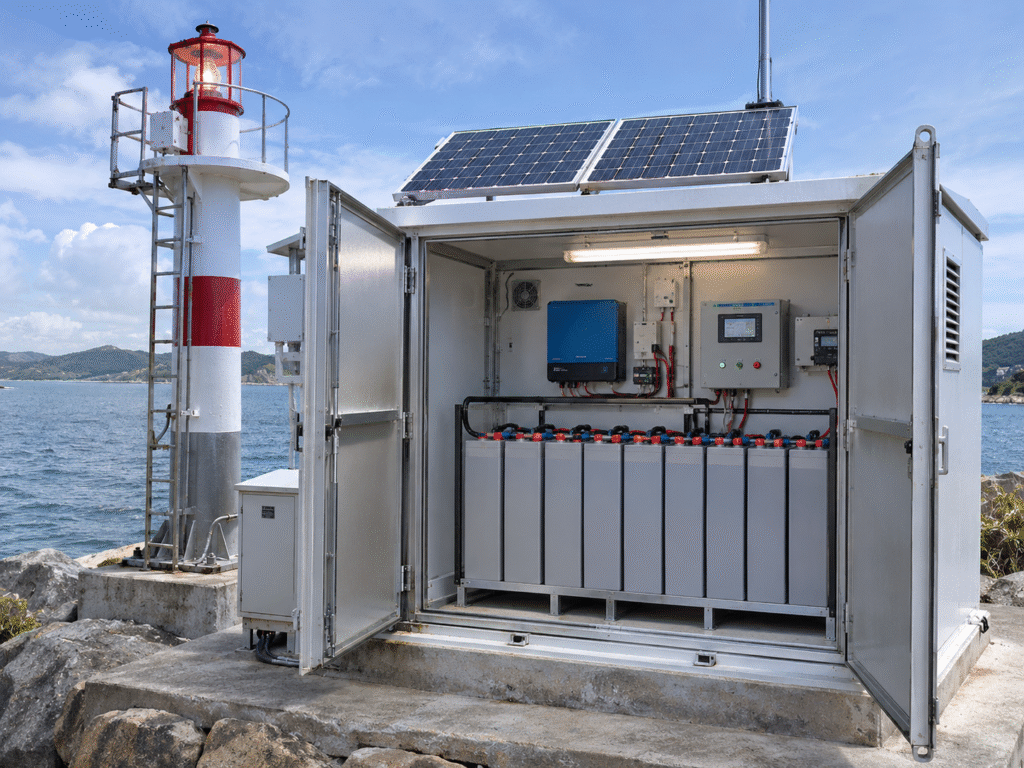
Why Navigation Equipment Needs Dependable Power
Marine navigation infrastructure operates in an environment where electrical reliability and maintenance accessibility can be challenging. Coastal monitoring stations, channel markers, navigation lights, remote beacons and port communication equipment may be located far from conventional utility connections.
Some installations rely on standalone solar power, while others use grid-connected backup systems. In either case, the energy-storage system must be designed to support the required equipment throughout periods of insufficient external power. OPzV tubular GEL batteries can be considered for suitable stationary marine infrastructure applications where reduced electrolyte maintenance, long-duration energy storage and reliable DC operation are priorities. However, marine applications vary significantly. A compact floating buoy and a large coastal navigation station may require entirely different battery technologies and enclosure designs.
Understanding Marine Navigation Battery Applications
Coastal Navigation Lights
Coastal navigation lights may operate every night, making their energy demand highly predictable. However, the energy available from solar panels can vary according to the season, weather and geographical location. The battery must store sufficient energy to maintain operation during periods with insufficient solar generation.
Remote Marine Beacons
Remote marine beacons may include lighting equipment, monitoring electronics and communications systems. Some installations are accessible only by boat, making routine maintenance expensive. A properly designed low-maintenance battery system can therefore help reduce service requirements.
Large 2V tubular GEL batteries may be considered for fixed installations with substantial energy requirements, while smaller compact battery products may be more appropriate for limited-space equipment.
Port Communication and Monitoring Infrastructure
Ports may operate monitoring stations, communications cabinets, security equipment and selected navigation-support systems. These installations can have different backup-duration requirements depending on their role.
For example, a monitoring station may require several hours of backup during a utility outage, while an off-grid coastal installation may require multiple days of energy autonomy. The battery system should be sized for the specific equipment and operating pattern rather than using one standard capacity across every site.
OPzV Battery Selection Starts with the Load Profile
Consider a hypothetical solar-powered coastal navigation installation. The equipment consists of a navigation light consuming 30W for 12 hours each night and a monitoring system consuming 10W continuously. The daily energy requirement is:
Navigation light: 30W × 12h = 360Wh / Monitoring equipment: 10W × 24h = 240Wh / Total daily consumption = 600Wh
If the project requires five days of autonomy without useful solar generation, the battery must deliver: 600Wh × 5 = 3,000Wh
For a nominal 24V DC battery system: 3,000Wh ÷ 24V = 125Ah
This is the theoretical energy requirement at nominal battery voltage. If the preliminary design assumes a maximum 50% depth of discharge and an 85% combined allowance for energy-delivery losses and reserve, the indicative capacity becomes: 125Ah ÷ (0.50 × 0.85) ≈ 294Ah
The final selection must still be confirmed using the battery’s rated discharge performance, installation temperature, end-voltage requirement and aging allowances. The actual navigation authority may also specify particular autonomy and reliability requirements that override these illustrative assumptions.
Why Solar Generation Is Especially Important at Coastal Sites
A marine navigation battery must not be sized independently of its solar charging system. During periods of good sunlight, the solar array must supply the daily load and restore energy removed from the battery. If the array cannot replace the consumed energy, the battery may operate in a prolonged partial state of charge.
For lead-acid batteries, repeated incomplete charging can accelerate deterioration. Coastal projects should therefore evaluate seasonal solar availability rather than relying only on average annual sunlight. A system that performs well during summer may have an insufficient energy balance during winter or an extended cloudy season.
Salt Air Is a Major Installation Challenge
Marine environments expose electrical equipment to moisture, salt deposits, condensation and corrosion. These conditions can affect battery terminals, connectors, cables and enclosures. A suitable battery housing should provide appropriate protection against environmental exposure while maintaining the ventilation and safety provisions required by the battery system.
Terminals and connections should be inspected for corrosion and abnormal resistance. The battery manufacturer’s ordinary product specifications do not automatically establish that a complete installation is approved for marine use. Any applicable environmental or equipment approvals must be verified for the finished system.
Are OPzV Batteries Suitable for Floating Navigation Buoys?
Not every marine navigation application is suitable for large 2V OPzV cells. Floating buoys may experience movement, vibration, impact and restricted installation space. OPzV tubular GEL batteries are primarily intended for stationary applications, and they should not automatically be recommended for continuously moving or heavily vibrating equipment.
For such installations, the equipment integrator must verify the battery’s mechanical suitability, mounting arrangement and environmental requirements. Compact batteries specifically qualified for the buoy system may be more appropriate. Large stationary OPzV battery banks are generally more relevant to fixed coastal stations, land-based navigation facilities and selected port infrastructure.
Reduced Maintenance Can Lower Remote Site Operating Costs
One of the challenges of maintaining coastal infrastructure is the cost of reaching the equipment. A routine inspection at an isolated navigation station may require a boat, maintenance personnel, suitable weather and coordination with port or coastal authorities. For operators maintaining many stations, these costs can accumulate.
Because OPzV batteries do not normally require routine water replenishment, they may reduce one category of scheduled maintenance. However, periodic electrical inspections, charger checks and battery-performance evaluations remain necessary. The correct comparison is therefore between the overall maintenance requirements of alternative battery technologies, rather than assuming any battery is entirely maintenance-free.
Battery Enclosures Need Proper Ventilation
OPzV batteries use a valve-regulated construction, but they can still release gas under certain operating conditions. This means a sealed environmental enclosure should not automatically be considered a safe battery enclosure. The design must address both protection against external moisture and the ventilation requirements of the installed battery system.
For coastal applications, the balance between weather protection and battery safety should be assessed during engineering. Applicable electrical and stationary battery safety standards should be incorporated into the project requirements.
Charging System Compatibility Is Essential
Navigation installations may use solar charge controllers, industrial DC chargers or hybrid power systems. The charging equipment must provide voltage settings appropriate for the selected OPzV battery. An unsuitable charging profile may result in undercharging, excessive charging stress or reduced battery life.
Temperature compensation may also be necessary according to the battery manufacturer’s charging recommendations. For replacement projects, the existing charge controller should be checked before installing a different battery model or capacity.
What Should Marine Infrastructure EPC Contractors Include in an RFQ?
A useful battery inquiry should identify the exact application, whether the installation is fixed or floating, system voltage, daily energy consumption, required autonomy, charging source and expected environmental conditions. Buyers should also provide the enclosure dimensions, temperature range, project quantity and required certifications or technical standards.
If the project uses solar charging, information about the panel capacity and charge controller is particularly valuable. For remote installations, the desired maintenance interval and accessibility of the site can influence the battery technology recommendation.
Evaluating an International Battery Supplier
For marine infrastructure projects, procurement should include more than the battery’s nominal capacity. Buyers should review discharge data, dimensions, weight, terminal arrangements, installation requirements, documentation and export packaging.
Where a project requires special marine or environmental qualifications, these should be identified before the order is placed. Wuxi Huizhong Power manufactures OPzV tubular GEL, OPzS flooded tubular and other stationary lead-acid batteries for industrial and renewable-energy applications. We can evaluate suitable OPzV configurations for fixed coastal facilities and port infrastructure based on the project’s electrical and environmental requirements.
Conclusion
Marine navigation and coastal monitoring systems depend on properly designed energy-storage solutions. Battery selection should consider daily energy demand, required autonomy, seasonal solar generation, temperature, salt-air exposure, maintenance accessibility and charging compatibility.
OPzV tubular GEL batteries may provide a useful solution for selected fixed marine infrastructure installations, particularly where long-duration stationary backup and reduced routine electrolyte maintenance are desirable.
Looking for OPzV batteries for coastal navigation facilities, remote beacons or port monitoring infrastructure?
Send Wuxi Huizhong Power your DC voltage, equipment load profile, required autonomy, solar charging details, installation environment and project quantity.
We can help evaluate a suitable battery configuration and prepare a project quotation.
Website: www.huizhongpower.com