
Keywords: OPzV battery, OPzS battery, tubular lead acid battery, energy storage battery selection
When designing a reliable energy storage system, selecting the right battery technology is one of the most critical decisions. Among industrial lead-acid batteries, OPzV (tubular gel batteries) and OPzS (flooded tubular batteries) are two of the most widely used options for stationary energy storage.
Although both belong to tubular plate lead-acid batteries, their performance, maintenance requirements, service life, and application suitability are quite different. This article provides a detailed comparison and selection guide to help system integrators, EPC contractors, and energy storage buyers choose the correct solution.
1. What Are OPzV and OPzS Batteries?
OPzS batteries are traditional flooded tubular lead-acid batteries. They use liquid electrolyte and tubular positive plates, offering long cycle life and excellent deep discharge performance.
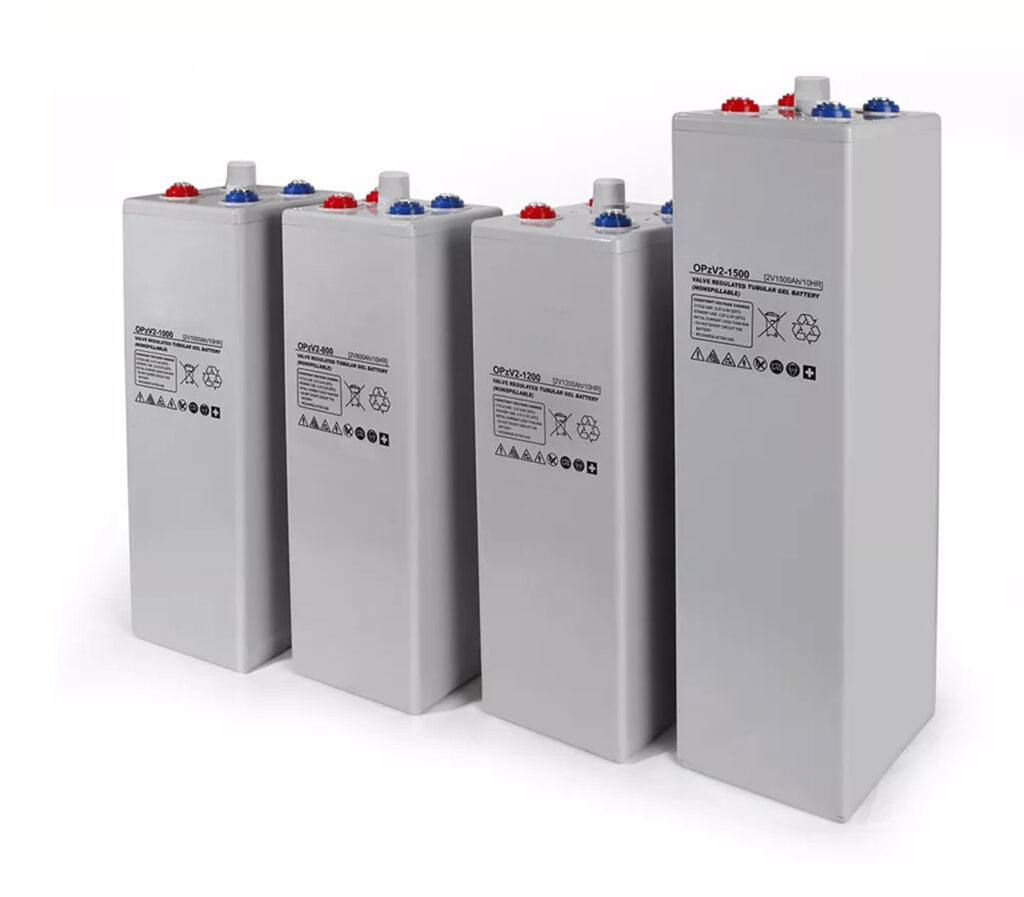
OPzV batteries are valve-regulated lead-acid (VRLA) tubular gel batteries. The electrolyte is immobilized in silica gel, making them maintenance-free and suitable for sealed installations.
Both types are designed for long-life stationary applications such as solar storage, telecom backup, substations, and off-grid power systems.
2. Key Technical Differences Between OPzV and OPzS
| Parameter | OPzS Battery | OPzV Battery |
|---|---|---|
| Electrolyte | Flooded (liquid) | Gel (immobilized) |
| Maintenance | Regular water topping required | Maintenance-free |
| Ventilation | Required | Minimal |
| Installation | Upright position only | Flexible positioning |
| Cycle Life | 1500–2000 cycles @ 80% DOD | 1800–2500 cycles @ 80% DOD |
| Service Life | 15–20 years | 18–25 years |
From a purely technical perspective, OPzV offers better convenience and safety, while OPzS provides lower initial cost and proven long-term stability.
3. Selection Based on Maintenance Conditions
One of the most important factors in choosing between OPzV and OPzS is maintenance capability.
If your project site has:
- Limited technical staff
- Difficult access (remote solar sites, telecom towers)
- Strict safety or cleanliness requirements
Then OPzV gel batteries are the preferred choice because they are:
- Sealed and spill-proof
- No water refilling required
- Lower gas emission
For sites with:
- Dedicated battery rooms
- Trained maintenance teams
- Regular inspection schedules
OPzS flooded batteries remain an economical and reliable solution.
4. Selection Based on Climate and Temperature
Temperature plays a critical role in battery lifespan.
- In hot climates (Middle East, Africa), OPzV batteries perform better due to lower water loss and reduced electrolyte evaporation.
- In moderate climates, both OPzS and OPzV perform well.
- In areas with poor ventilation, OPzV is safer due to low gas emission.
5. Selection Based on Project Budget and Total Cost of Ownership
Although OPzS batteries usually have a lower initial purchase cost, they require:
- Distilled water refilling
- Regular inspection
- Higher maintenance labor cost
OPzV batteries have:
- Higher upfront price
- Lower operating cost
- Longer service intervals
For long-term projects (15–25 years), OPzV often provides lower total cost of ownership (TCO).
6. Typical Applications for Each Type
OPzS Applications:
- Large solar power plants
- Utility substations
- Industrial UPS systems
- Grid backup systems
OPzV Applications:
- Telecom base stations
- Off-grid solar systems
- Remote energy storage
- Containerized ESS
Conclusion
Choosing between OPzV and OPzS batteries depends on maintenance capability, climate, budget, and system design requirements. Both technologies offer long life and high reliability when properly selected and installed.
If you are planning a stationary energy storage project and need professional battery selection support, our technical team can provide customized OPzV and OPzS battery solutions.