
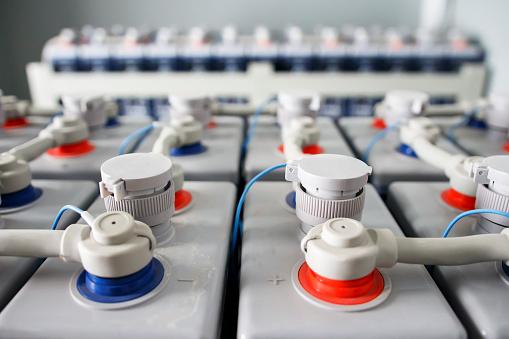
Keywords: OPzV battery, OPzS battery, tubular lead acid battery, solar energy storage battery, deep cycle battery
Solar energy storage systems require batteries with long cycle life, excellent deep discharge performance, and high reliability under continuous charging and discharging conditions. Among all lead-acid technologies, OPzV (tubular gel batteries) and OPzS (flooded tubular batteries) are the most popular choices for medium and large-scale solar storage projects.
However, many project developers and system integrators still face difficulties when deciding which type is more suitable. This article provides a detailed technical and application-based comparison to help you select the right tubular lead-acid battery for your solar energy storage system.
1. Performance Requirements of Solar Energy Storage Batteries
A solar battery must meet several critical requirements:
- High cycle life under daily charge–discharge operation
- Strong deep discharge tolerance
- Stable capacity at partial state of charge (PSOC)
- Good performance in high temperature environments
- Low maintenance cost over long project lifetime
Both OPzV and OPzS batteries meet these basic requirements, but their long-term performance differs significantly depending on site conditions.
2. Cycle Life Comparison Under Solar Operating Conditions
Cycle life is one of the most important indicators for solar battery selection.
- OPzS flooded batteries typically deliver 1500–2000 cycles at 80% depth of discharge (DOD). With proper maintenance, their service life can reach 15–20 years in float or cyclic operation.
- OPzV gel batteries offer 1800–2500 cycles at 80% DOD and demonstrate superior performance under partial state of charge operation, which is common in solar applications.
For projects requiring daily cycling over 10–20 years, OPzV batteries usually provide longer usable life and more stable capacity retention.
3. Maintenance and Operational Considerations
Maintenance capability often determines the final battery choice.
OPzS Batteries (Flooded):
- Require regular distilled water refilling
- Need ventilation systems for hydrogen gas release
- Periodic electrolyte density inspection required
OPzV Batteries (Gel):
- Completely maintenance-free
- Sealed and spill-proof design
- Minimal gas emission, suitable for indoor installation
For remote solar power plants, rural electrification projects, and off-grid systems with limited maintenance access, OPzV batteries are strongly recommended.
4. Temperature and Environmental Adaptability
Solar projects in regions such as the Middle East, Africa, and Southeast Asia often operate under high ambient temperatures.
- OPzV gel batteries show lower water loss and better thermal stability, making them ideal for hot climates.
- OPzS flooded batteries require more frequent maintenance under high temperature conditions due to increased evaporation.
In containerized or poorly ventilated solar battery rooms, OPzV batteries provide higher operational safety.
5. Cost Analysis and Total Cost of Ownership (TCO)
While OPzS batteries generally have a lower initial purchase price, their lifetime cost includes:
- Water replenishment labor
- Maintenance inspections
- Higher risk of electrolyte leakage
OPzV batteries, although more expensive initially, usually deliver lower total cost of ownership over long-term solar projects due to reduced maintenance and longer service intervals.
6. Recommended Applications
Best applications for OPzS in solar systems:
- Large centralized solar farms
- Utility-scale energy storage
- Projects with professional maintenance teams
Best applications for OPzV in solar systems:
- Off-grid solar systems
- Rural electrification
- Telecom + solar hybrid systems
- Containerized ESS
Conclusion
Both OPzV and OPzS batteries are excellent solutions for solar energy storage. The final choice should be based on project size, maintenance capability, climate conditions, and long-term cost considerations.