
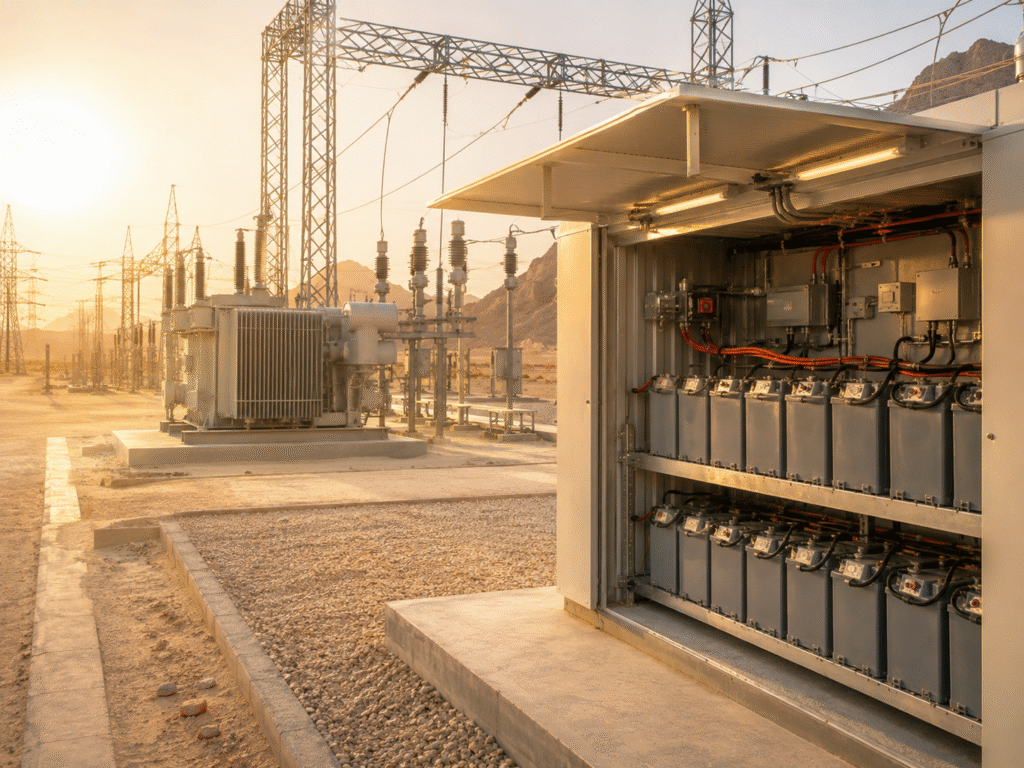
Saudi Arabia has one of the world’s largest and fastest-growing electrical transmission and distribution networks.
With ongoing investments in:
- High-voltage substations
- Renewable energy integration
- Smart grid projects
- Industrial cities
- Oil & gas infrastructure
the demand for reliable DC backup power systems continues to grow.
However, one challenge remains constant:
Extreme environmental conditions.
Daily summer temperatures frequently exceed 45°C, while equipment installed outdoors may experience enclosure temperatures above 60°C.
Under these conditions, selecting the right battery technology is critical.
Why Every Substation Needs a Reliable Battery System
A substation battery bank is not designed to power the entire station.
Instead, it provides uninterrupted DC power for critical equipment during AC failures.
Typical applications include:
- Protection relays
- Circuit breaker tripping and closing
- SCADA systems
- RTUs (Remote Terminal Units)
- Communication equipment
- Emergency lighting
- Alarm systems
If the battery system fails, protection devices may not operate correctly, increasing the risk of equipment damage and prolonged outages.
Environmental Challenges in Saudi Arabia
Electrical substations across Saudi Arabia face unique environmental stresses.
Extreme Heat
Many substations operate in:
- Riyadh
- Dammam
- Jeddah
- Jubail
- Yanbu
- NEOM development areas
Ambient temperatures above 45°C are common.
Battery rooms without adequate cooling can become even hotter.
Industrial NiCd batteries are specifically designed to maintain performance under these conditions.
Dust and Sandstorms
Desert environments expose electrical equipment to:
- Fine sand particles
- Dust accumulation
- Reduced ventilation efficiency
Battery systems must withstand these conditions while maintaining reliable operation.
Remote Installations
Many substations are located far from urban centers.
Maintenance visits may be infrequent.
Long-life, low-maintenance batteries significantly reduce operational costs.
Why Saudi Utilities Continue Choosing NiCd Batteries
Excellent High-Temperature Performance
Industrial NiCd batteries maintain stable performance under high ambient temperatures where conventional lead-acid batteries may age more rapidly.
Long Design Life
Typical service life:
- 15–25 years
This aligns well with utility asset management strategies.
Reliable Float Charging
Substation batteries remain on continuous float charge for most of their operating life.
NiCd batteries are well suited for this duty.
Deep Discharge Recovery
During extended outages, batteries may experience deep discharge.
NiCd technology provides excellent recovery capability.
Proven Utility Experience
Industrial NiCd batteries have been successfully deployed in substations worldwide for decades, making them a trusted solution for mission-critical infrastructure.
Typical DC Battery Configurations
Common utility systems include:
| System Voltage | Typical Cell Count |
|---|---|
| 48V DC | 40 cells |
| 110V DC | 92 cells |
| 125V DC | 104 cells |
| 220V DC | 184 cells |
The final configuration should always be based on:
- Load profile
- Backup duration
- Ambient temperature
- Future expansion
Comparing Battery Technologies
| Feature | NiCd | OPzS | OPzV | AGM | LiFePO4 |
|---|---|---|---|---|---|
| High-temperature resistance | ⭐⭐⭐⭐⭐ | ⭐⭐⭐ | ⭐⭐⭐⭐ | ⭐⭐ | ⭐⭐⭐⭐ |
| Float life | ⭐⭐⭐⭐⭐ | ⭐⭐⭐⭐ | ⭐⭐⭐⭐ | ⭐⭐⭐ | ⭐⭐⭐⭐ |
| Deep discharge recovery | ⭐⭐⭐⭐⭐ | ⭐⭐⭐ | ⭐⭐⭐ | ⭐⭐ | ⭐⭐⭐⭐ |
| Maintenance | ⭐⭐⭐⭐ | ⭐⭐ | ⭐⭐⭐⭐⭐ | ⭐⭐⭐⭐⭐ | ⭐⭐⭐⭐⭐ |
| Expected service life | 15–25 years | 12–20 years | 10–15 years | 3–8 years | 10–15 years |
Procurement Checklist for Saudi Utility Projects
Before selecting a battery supplier, utilities should verify:
- IEC 60623 compliance
- Factory production capability
- Type test reports
- Discharge performance data
- Engineering support
- Long-term spare parts availability
- Experience with utility projects
Frequently Asked Questions
Why are NiCd batteries commonly used in Saudi substations?
Because they provide excellent high-temperature performance, long service life, and reliable operation in harsh desert environments.
Can NiCd batteries operate above 50°C?
Yes. Industrial NiCd batteries are designed for demanding environments, although proper installation and ventilation remain important.
Which battery technology offers the longest service life?
Industrial pocket plate NiCd batteries typically provide the longest operational life for utility applications.
Are NiCd batteries suitable for renewable energy substations?
Yes. They are increasingly used in substations connected to solar and wind power projects.
Conclusion
Saudi Arabia’s power infrastructure requires battery systems capable of operating reliably under some of the world’s harshest environmental conditions.
Industrial NiCd batteries continue to provide:
- Outstanding heat resistance
- Proven reliability
- Long service life
- Low lifecycle cost
making them one of the best solutions for electrical substations throughout the Kingdom.