
Introduction
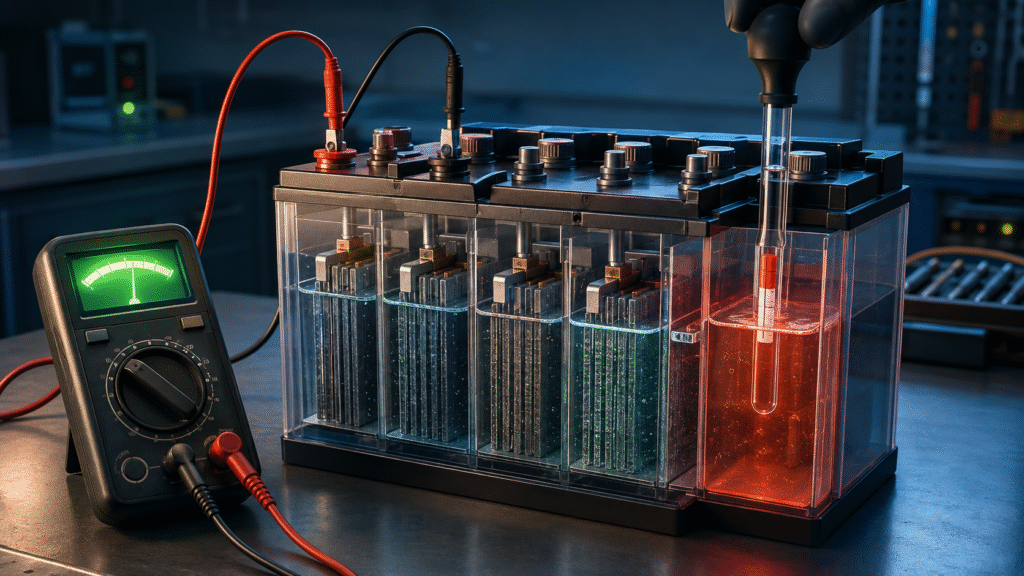
A flooded lead-acid battery may show a normal or nearly normal terminal voltage while hydrometer readings indicate that the battery is undercharged or that individual cells are significantly different.
For example:
- Battery voltage appears fully charged.
- Charger has entered float mode.
- One or more cells show low specific gravity.
- Specific-gravity readings vary across the battery.
- Backup time is shorter than expected.
This situation can confuse technicians who rely mainly on voltage.
Voltage and electrolyte specific gravity measure related but different aspects of battery condition.
For accessible flooded lead-acid batteries, Trojan describes specific gravity as the most accurate method of determining state of charge, provided that readings are taken correctly and interpreted using the battery manufacturer’s data.
Specific-gravity testing is normally applicable to flooded batteries such as OPzS and other serviceable designs. It should not be attempted on sealed AGM, GEL, or OPzV batteries.
What Is Specific Gravity?
Specific gravity compares the density of the battery electrolyte with the density of water.
In a flooded lead-acid battery:
- Discharge converts active material and sulfuric acid into lead sulfate and water.
- Electrolyte density decreases as the battery discharges.
- Charging restores sulfuric acid concentration.
- Electrolyte density rises as charging progresses.
A hydrometer measures this electrolyte density.
The exact fully charged specific-gravity value depends on:
- Battery design
- Electrolyte formulation
- Manufacturer
- Application
- Temperature
- Production specification
Do not apply one universal hydrometer value to every flooded lead-acid battery.
Why Voltage and Specific Gravity May Disagree
Battery terminal voltage can be influenced by:
- Surface charge
- Charging current
- Recent discharge
- Internal resistance
- Temperature
- Charger voltage
- Number of cells
Specific gravity more directly reflects the acid concentration in the sampled electrolyte.
A battery may therefore show high terminal voltage temporarily while the electrolyte remains insufficiently charged.
Routine comparison of voltage and specific gravity can also help identify undercharging, over-watering, or a weak cell.
Reason 1: Surface Charge Is Raising the Voltage
Immediately after charging, a battery can retain surface charge on its plates.
This causes terminal voltage to appear higher than its stabilized open-circuit value.
If the voltage is measured immediately after the charger is disconnected, the battery may appear fully charged even when charging was incomplete.
To reduce the effect of surface charge:
- Allow the battery to rest according to the manufacturer’s procedure.
- Apply a brief controlled load if permitted.
- Measure after voltage has stabilized.
- Compare with specific-gravity readings.
Do not assess state of charge from an immediate post-charge voltage reading alone.
Reason 2: The Battery Has Not Completed Absorption Charging
The battery may reach the charger’s absorption voltage before the electrolyte has returned to its fully charged condition.
This is common when:
- Absorption time is too short.
- Charging current is interrupted.
- Solar charging ends before absorption is complete.
- The charger uses the wrong profile.
- Daytime loads consume most charger output.
- One cell or battery reaches high voltage early.
- Battery internal resistance has increased.
The charger responds mainly to voltage and current. It does not directly measure the acid concentration in each cell.
A battery can therefore display a high charging voltage while specific gravity remains low.
Reason 3: Electrolyte Stratification Has Developed
Electrolyte stratification occurs when denser acid settles toward the bottom of the cell while less dense electrolyte remains near the top.
A hydrometer samples electrolyte near the top of the cell, so the reading may be lower than the average acid concentration inside the battery.
Stratification is more likely when:
- Charging current is consistently low.
- The battery is cycled shallowly.
- Gassing or electrolyte mixing is insufficient.
- The battery remains on float for long periods.
- Large tall cells are used.
- The system repeatedly operates at partial state of charge.
Stratification can cause:
- Corrosion near the bottom of the plates
- Sulfation near the upper plate area
- Uneven plate utilization
- Reduced usable capacity
- Misleading hydrometer readings
A manufacturer-approved boost or equalization procedure may help mix electrolyte in certain flooded batteries. It should not be performed without the correct voltage, current, temperature, and duration specifications.
Reason 4: Water Was Added Before Charging
For flooded batteries, electrolyte level must be maintained using the manufacturer’s approved procedure.
Adding water to a discharged battery can temporarily dilute the upper electrolyte and produce a low hydrometer reading.
In many flooded-battery procedures:
- Plates must remain covered.
- A low level may require limited water before charging.
- Final adjustment is completed after full charging.
- Overfilling must be avoided.
If too much water is added before charging, the electrolyte can become excessively diluted and may overflow during charging.
The correct procedure depends on the battery model. Always follow the battery manufacturer’s filling and maintenance instructions.
Reason 5: The Battery Has Been Over-Watered
Over-watering lowers electrolyte concentration and may cause:
- Low specific gravity
- Electrolyte overflow
- Acid loss
- Corrosion around the battery
- Reduced performance
- Unequal readings between cells
Adding acid is not a routine correction for low specific gravity.
Acid should not normally be added to a battery simply because a hydrometer reading is low. The low reading may be caused by incomplete charging, stratification, excess water, or battery damage.
Electrolyte adjustment should only be carried out under the battery manufacturer’s procedure.
Reason 6: Temperature Correction Was Not Applied
Specific-gravity readings change with temperature.
A reading taken from hot electrolyte cannot be compared directly with a value specified at a standard reference temperature unless correction is applied.
The hydrometer may have:
- Automatic temperature compensation
- A built-in thermometer
- A separate correction table
- No compensation feature
Record:
- Electrolyte temperature
- Battery temperature
- Raw hydrometer reading
- Corrected reading
Manufacturer maintenance procedures often require temperature-corrected specific-gravity measurements.
Reason 7: The Hydrometer Reading Is Incorrect
Measurement errors are common.
Possible causes include:
- Hydrometer not clean
- Air bubbles attached to the float
- Insufficient electrolyte sample
- Float touching the tube
- Reading the wrong part of the meniscus
- Electrolyte not mixed
- Cross-contamination between cells
- Incorrect temperature correction
- Damaged hydrometer
- Poor calibration
For consistent readings:
- Wear appropriate protective equipment.
- Draw and return electrolyte several times to mix the local sample where the manufacturer permits.
- Fill the hydrometer enough for the float to move freely.
- Remove air bubbles.
- Hold the hydrometer vertically.
- Read at eye level.
- Record temperature.
- Rinse the instrument according to the manufacturer’s procedure.
Sulfuric-acid electrolyte is corrosive. Testing must be performed by trained personnel using suitable eye, face, hand, and body protection.
Reason 8: One Cell Is Undercharged
A battery may have acceptable total voltage while one cell remains undercharged.
For example, the other cells may reach slightly higher voltage, compensating for the weak cell in the total battery reading.
Possible causes include:
- Unequal cell capacity
- Internal leakage
- Partial short circuit
- Sulfation
- Low electrolyte level
- Poor internal connection
- Uneven temperature
The weak cell may show:
- Lower specific gravity
- Lower voltage during discharge
- Higher or lower voltage during charging
- Faster self-discharge
- Abnormal temperature
Compare all cells rather than evaluating only the average reading.
Reason 9: One Cell Has Lost Electrolyte
Electrolyte loss can occur because of:
- Overcharging
- Excessive gassing
- Leakage
- Cracked container
- Overflow
- High temperature
- Incorrect maintenance
If acid-containing electrolyte is physically lost and replaced only with water, the cell’s acid concentration may remain below specification.
This is different from normal water loss during charging, where mainly water is replenished.
Investigate:
- Signs of leakage
- Acid corrosion
- Wet battery surfaces
- Cracked containers
- Unequal electrolyte levels
- Maintenance records
Do not attempt to correct acid loss without manufacturer guidance.
Reason 10: Sulfation Has Reduced Charge Conversion
A sulfated battery may not efficiently convert lead sulfate back into active material during charging.
Symptoms may include:
- Low specific gravity after extended charging
- Rapid voltage rise
- Low charge acceptance
- Reduced capacity
- High internal resistance
- Significant voltage drop under load
The charger may reach its voltage limit while the electrochemical charging process remains incomplete.
Mild sulfation may sometimes respond to a controlled recovery procedure approved by the manufacturer. Severe sulfation is often irreversible.
Reason 11: The Battery Has High Internal Resistance
High internal resistance causes terminal voltage to rise more during charging.
The charger may therefore interpret the battery as nearly full even though electrolyte specific gravity remains low.
During discharge, the same resistance causes:
- Larger voltage drop
- Increased heating
- Early inverter shutdown
- Reduced usable capacity
This pattern—high charging voltage, low specific gravity, and poor runtime—is a strong indication that further internal-resistance and capacity testing is required.
Reason 12: The Charger Voltage Is Too Low
If absorption voltage is below the battery manufacturer’s requirement, the battery may remain chronically undercharged.
Possible causes include:
- Wrong battery profile
- Incorrect cell count
- Poor temperature compensation
- Controller set for GEL or AGM instead of flooded battery
- Charger calibration error
- Voltage drop between charger and battery
- Charging period too short
The charger output and actual battery-terminal voltage should be measured while charging current is flowing.
Reason 13: The Charger Voltage Is High but the Current Is Too Low
Voltage alone does not restore capacity.
A very small charger may raise battery voltage but take too long to return the removed ampere-hours.
This may occur with:
- Undersized solar arrays
- Small maintenance chargers
- Current-limited inverter chargers
- Weak generators
- Long charging cables
- Simultaneous loads
The battery may remain at low specific gravity because the total charging energy is insufficient.
Reason 14: Specific Gravity Is Uneven Across Cells
One abnormal reading is more important than a uniformly low set of readings.
All Cells Are Uniformly Low
Possible causes:
- Battery not fully charged
- Charger voltage too low
- Charging time too short
- Over-watering
- Temperature correction error
- System-wide sulfation
One Cell Is Much Lower
Possible causes:
- Weak or damaged cell
- Internal short
- Electrolyte loss
- Severe local sulfation
- Measurement error
- Unequal temperature
Readings Vary Randomly
Possible causes:
- Poor testing method
- Stratification
- Unequal water addition
- Several aging cells
- Inconsistent sampling
The manufacturer’s permitted cell-to-cell difference should be used to evaluate the results.
A Practical Diagnostic Sequence
Step 1: Confirm the Battery Type
Specific-gravity testing is for accessible flooded cells. Do not open sealed batteries.
Step 2: Inspect Electrolyte Level
Confirm that plates are properly covered and that no cell has been overfilled.
Step 3: Fully Charge the Battery
Use the battery manufacturer’s charging voltage, current, and duration.
Step 4: Record Charging Data
Measure:
- Total battery voltage
- Individual cell voltage
- Charging current
- Electrolyte temperature
- Battery temperature
Step 5: Allow Stabilization
Follow the manufacturer’s procedure before taking final measurements.
Step 6: Measure Every Cell
Use the same hydrometer and technique for all cells.
Step 7: Apply Temperature Correction
Record both raw and corrected readings.
Step 8: Compare Voltage and Specific Gravity
Look for:
- One low-gravity cell
- One abnormal-voltage cell
- Uniformly low readings
- High charging voltage with low gravity
Step 9: Perform a Controlled Discharge Test
Specific gravity indicates state of charge, but a capacity test determines whether the battery can deliver the required energy.
Example Diagnostic Patterns
Pattern A: High Voltage and Uniformly Low Specific Gravity
Likely causes:
- Surface charge
- Incomplete absorption
- Charger voltage reached too quickly
- Sulfation
- High internal resistance
Pattern B: Normal Voltage and One Low-Gravity Cell
Likely causes:
- Weak cell
- Internal leakage
- Electrolyte loss
- Measurement error
Pattern C: Low Voltage and Uniformly Low Specific Gravity
Likely cause:
- Battery is discharged or undercharged.
Pattern D: Normal Voltage and Widely Different Cell Readings
Likely causes:
- Cell imbalance
- Stratification
- Unequal water addition
- Internal cell deterioration
Pattern E: High Specific Gravity After Water Loss
Possible cause:
- Electrolyte concentration increased because of excessive water loss.
Do not add acid or water based on one isolated measurement.
Can Equalization Correct Low Specific Gravity?
Equalization may help certain flooded batteries when:
- Cells are undercharged unevenly.
- Mild stratification is present.
- Manufacturer instructions permit it.
- Battery temperature is monitored.
- Electrolyte level is correct.
Equalization will not repair:
- Cracked containers
- Severe plate corrosion
- Active-material loss
- Internal short circuits
- Damaged separators
- Serious capacity loss
Equalization settings used for one flooded battery model should not be copied to another without confirmation.
When Should the Battery Be Replaced?
Replacement should be considered when:
- One cell remains significantly lower after correct charging.
- Capacity testing confirms inadequate performance.
- The battery has excessive self-discharge.
- A cell becomes abnormally hot.
- Electrolyte leakage is present.
- Voltage collapses under load.
- Specific gravity cannot be restored within the approved charging procedure.
- The battery has reached the end of its service life.
In a series-connected battery bank, replacement decisions should consider the age and condition of the entire string.
Common Mistakes
Checking Specific Gravity Immediately After Adding Water
The added water may not yet be fully mixed.
Adding Acid to Correct a Low Reading
Low specific gravity is more commonly caused by undercharging, dilution, or deterioration. Routine acid addition can damage the battery.
Testing Only One Cell
All cells should be compared.
Ignoring Temperature
Uncorrected readings can lead to the wrong conclusion.
Assuming Normal Voltage Means Full Capacity
Voltage can be influenced by surface charge and charging current.
Using a Hydrometer on Sealed Batteries
AGM, GEL, and OPzV batteries should not be opened.
Frequently Asked Questions
Why is battery voltage normal when specific gravity is low?
Surface charge, incomplete absorption, sulfation, high internal resistance, or diluted electrolyte can raise voltage without restoring proper acid concentration.
Which measurement is more accurate for flooded-battery SOC?
Specific gravity is generally more direct when measured correctly and compared with the battery manufacturer’s specification.
Can I add acid when specific gravity is low?
Not as routine maintenance. First confirm full charging, temperature correction, electrolyte level, and battery condition.
Why is one cell’s specific gravity lower than the others?
The cell may be undercharged, damaged, leaking, sulfated, or affected by a measurement error.
Should I equalize the battery?
Only when the selected flooded-battery manufacturer permits it and provides the required procedure.
Can specific gravity show battery capacity?
It primarily indicates state of charge and electrolyte condition. A controlled discharge test is required to verify usable capacity.
Conclusion
A flooded lead-acid battery can show normal voltage while specific gravity remains low or uneven because voltage and electrolyte density respond differently to charging, current, temperature, and battery condition.
The most common causes are:
- Surface charge
- Incomplete absorption
- Electrolyte stratification
- Incorrect water addition
- Temperature errors
- Sulfation
- High internal resistance
- Weak cells
- Electrolyte loss
- Incorrect charger settings
For a project-specific analysis, provide the battery model, age, cell count, charging voltage, charging current, charging time, electrolyte temperature, individual cell voltages, individual specific-gravity readings, and measured discharge capacity.