
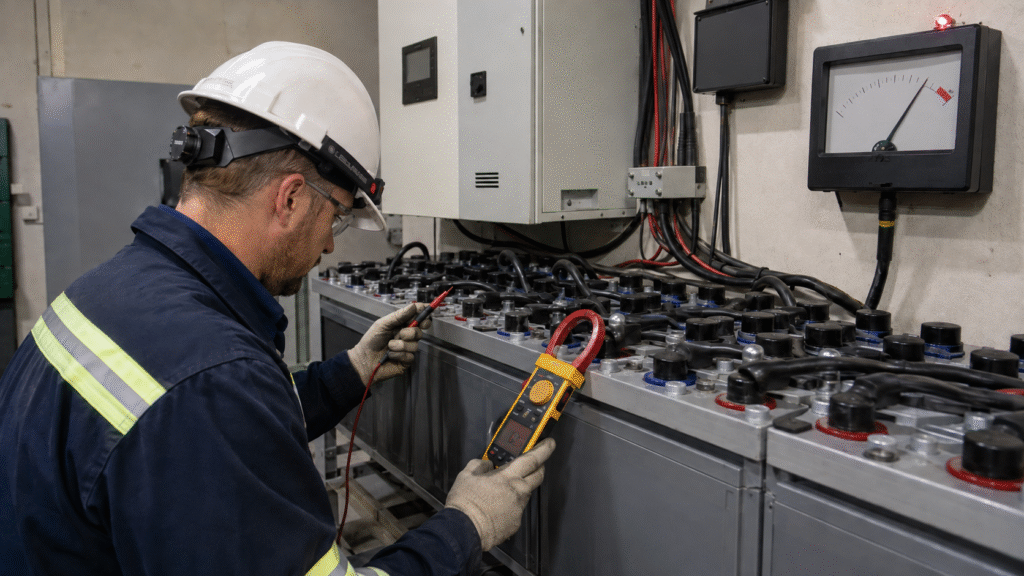
Introduction
A stationary lead-acid battery bank used in a UPS, telecom system, substation, emergency power system, or industrial DC supply may remain on float charge for most of its service life.
Under normal conditions, once the battery is fully charged, the charging current should decrease to a relatively low level sufficient to compensate for self-discharge and internal losses.
But what happens when technicians notice that the float current is gradually increasing?
For example:
- The battery bank previously required very little float current.
- Several months later, the charger supplies noticeably more current.
- Battery voltage still appears normal.
- There has been no major load change.
- One part of the battery bank may feel warmer than the rest.
This condition deserves investigation.
Increasing float current can be associated with:
- Elevated battery temperature
- Excessive float voltage
- Incorrect temperature compensation
- Battery aging
- Increased oxygen recombination
- Internal cell leakage
- Partial internal shorts
- Charger ripple
- Cell imbalance
- Developing thermal runaway
Float current is therefore more than just a charger reading. In stationary VRLA systems, trends in float current can provide useful early information about changing battery condition. Battery-monitoring literature has specifically identified increased float current as a possible early-warning indicator of problems such as shorting cells.
What Is Float Current?
Float charging maintains a fully charged battery while it remains connected to the DC power system.
The charger applies a controlled voltage intended to:
- Compensate for battery self-discharge
- Maintain full state of charge
- Keep the battery immediately available
- Avoid unnecessary cycling
Even a fully charged lead-acid battery continues to consume a small amount of charging current.
This current supports internal electrochemical reactions and compensates for standing losses.
The exact normal float current varies significantly with:
- Battery design
- Battery capacity
- Battery age
- Float voltage
- Temperature
- Grid alloy
- VRLA or flooded construction
For this reason, there is no single universal “normal float current” that applies to all lead-acid batteries.
The most useful measurement is often the trend over time for the same battery bank under similar operating conditions.
Why Float-Current Trend Is Important
Suppose a battery bank has operated for two years with relatively stable:
- Float voltage
- Room temperature
- Charger configuration
- Load
- Battery quantity
If float current suddenly doubles or continues increasing month after month, something in the system has changed.
Possible changes include:
- Battery temperature
- Battery internal chemistry
- Charger regulation
- Individual cell condition
- AC ripple
- Environmental conditions
Float-current monitoring is therefore particularly useful for:
- Telecom battery banks
- Data-center UPS batteries
- Substation DC systems
- Emergency lighting systems
- Utility control batteries
- Industrial standby systems
A single measurement is less useful than a recorded historical trend.
Reason 1: Battery Temperature Has Increased
Temperature strongly affects the electrochemical activity inside a lead-acid battery.
As battery temperature rises, float current generally increases.
This is especially important for VRLA batteries because charging and oxygen recombination also generate heat.
A dangerous feedback process can occur:
- Battery temperature increases.
- Float current increases.
- Internal heat generation increases.
- Battery temperature rises further.
- Float current rises again.
If the battery cannot dissipate the generated heat, thermal runaway may develop.
Technical literature on large-format VRLA batteries describes float-current control as fundamental to thermal-runaway prevention because increasing temperature can cause increasing float current and additional self-heating.
Check for:
- Failed battery-room air conditioning
- Blocked ventilation
- Direct sunlight
- Hot inverter or rectifier exhaust
- Batteries installed too closely
- Increased room temperature
- Battery cabinet hot spots
- One battery significantly warmer than the others
Measure the battery temperature directly rather than relying only on the room thermostat.
Reason 2: Float Voltage Is Too High
Lead-acid batteries are very sensitive to long-term charging voltage.
A relatively small increase in float voltage can increase:
- Charging current
- Gassing
- Oxygen recombination
- Battery temperature
- Grid corrosion
- Water consumption
The correct float voltage depends on:
- Battery technology
- Cell design
- Temperature
- Manufacturer specification
Do not assume that one float voltage is suitable for:
- AGM batteries
- GEL batteries
- OPzV batteries
- OPzS batteries
- Flooded standby cells
Possible causes of excessive voltage include:
- Incorrect charger profile
- Charger calibration drift
- Wrong number of cells configured
- Incorrect manual setting
- Temperature-compensation failure
- Multiple chargers with different settings
- Failed voltage-sensing circuit
Measure voltage using a calibrated meter at the battery terminals and compare it with the charger display.
Reason 3: Temperature Compensation Is Not Working Correctly
Many stationary lead-acid charging systems adjust float voltage according to battery temperature.
At higher battery temperatures, charging voltage is normally reduced.
At lower temperatures, it may be increased.
If temperature compensation fails, the battery may receive excessive float voltage when hot.
Problems include:
- Missing temperature sensor
- Sensor disconnected
- Sensor attached to the wrong location
- Sensor installed near an air-conditioning outlet
- Sensor reading room temperature instead of battery temperature
- Incorrect compensation coefficient
- Software configuration error
EnerSys/Alpha documentation describes temperature-compensated float charging as a protection method against thermal runaway and heat-related life degradation.
Reason 4: Battery Aging Is Changing the Float Behavior
Battery characteristics change throughout service life.
Aging mechanisms may include:
- Positive-grid corrosion
- Electrolyte dry-out
- Separator degradation
- Loss of active material
- Increased internal resistance
- Changes in oxygen-recombination behavior
- Internal leakage paths
Not every aging battery will show high float current.
However, an increasing current trend—particularly when combined with rising temperature or abnormal individual battery voltage—should trigger further investigation.
Do not conclude that a battery is healthy simply because:
- Total string voltage is correct.
- Charger has no alarm.
- Battery can still support a small load.
A capacity or discharge test may be required.
Reason 5: One Cell May Have a Partial Internal Short
A developing internal short can increase current demand in the battery string.
Possible causes include:
- Separator damage
- Conductive material accumulation
- Plate growth
- Active-material shedding
- Internal contamination
- Mechanical damage
A partial short may not immediately reduce the total string voltage enough to trigger an alarm.
Instead, the charger may simply provide more current to maintain the configured float voltage.
Increased float current has been identified as a potential early-warning signal for shorting cells in stationary battery monitoring.
Additional symptoms may include:
- One battery has a lower float voltage.
- Neighboring batteries have slightly higher voltages.
- One battery is warmer.
- The battery self-discharges rapidly when disconnected.
- Float current remains high after temperature correction.
Reason 6: One Battery Has a Different Float Voltage
A charger normally regulates the total series-string voltage.
It does not independently regulate every battery.
For example, the total string voltage can appear perfectly normal even when:
- One battery is operating too low.
- Another battery is operating too high.
This is why individual voltage measurement is important.
Record:
- Total bank voltage
- Individual battery voltage
- Battery temperature
- Float current
Look for units that gradually move away from the rest of the population.
Reason 7: AC Ripple Is Increasing Battery Stress
A rectifier or charger should provide relatively smooth DC output.
Excessive AC ripple can cause additional battery heating and electrochemical stress.
Possible causes include:
- Failed rectifier components
- Aging capacitors
- Charger faults
- Incorrect charger design
- Harmonic interaction
- Power-supply problems
Float-current and ripple-current monitoring are both used in stationary battery condition assessment because changing values may indicate developing system problems.
If float current has increased without an obvious battery explanation, measure:
- DC float current
- AC ripple current
- DC voltage
- AC ripple voltage
- Rectifier temperature
Reason 8: Battery-Room Cooling Has Become Uneven
A battery room may have an acceptable average temperature but still contain localized hot zones.
Common examples:
- Batteries beside the charger are hotter.
- Upper rack levels are warmer.
- Batteries near a wall exposed to sunlight are hotter.
- Air-conditioning airflow reaches only part of the room.
- Batteries in the center of a cabinet have poor heat dissipation.
Thermal imaging can help identify differences that conventional room-temperature measurement may miss.
Infrared monitoring is used in stationary battery systems to identify abnormal cell temperature and potential thermal-runaway conditions.
Reason 9: The Battery Bank Was Recently Discharged
Higher charging current immediately after an outage or discharge is normal.
Do not confuse recharge current with steady-state float current.
After an emergency discharge:
- The charger returns energy to the battery.
- Charging current may remain elevated.
- The battery gradually approaches full charge.
- Current declines.
- The system returns to stable float.
The important question is:
Does the current eventually return to its historical stable value?
If current remains unusually high long after full recharge, further investigation is needed.
Reason 10: Continuous Micro-Cycling Is Occurring
A supposedly standby battery may actually be experiencing repeated small charge-discharge cycles.
Possible causes include:
- Unstable AC supply
- Generator switching
- Rectifier dropout
- Load-sharing problems
- Poor charger regulation
- Solar-controller behavior
- DC bus fluctuations
These micro-cycles can prevent the battery from reaching a truly stable float condition.
Check charger and system event logs for:
- AC failures
- Charger alarms
- Transfer events
- Voltage fluctuations
- Frequent boost-charge activation
Why High Float Current Matters
Sustained excessive float current can contribute to:
- Higher battery temperature
- Increased water loss
- Faster grid corrosion
- VRLA dry-out
- Accelerated aging
- Increased gassing
- Reduced service life
Research on VRLA technology notes that lower float current is associated with reduced positive-plate corrosion, reduced gassing and dry-out, and lower thermal-runaway risk.
This does not mean every high-current reading indicates imminent failure.
What matters is the combination of:
- Current trend
- Temperature
- Voltage
- Battery age
- Individual battery behavior
A Practical Diagnostic Procedure
Step 1: Verify the Measurement
Confirm that the current sensor or shunt is calibrated correctly.
Compare:
- Charger display
- External clamp meter
- Battery-monitor data
Step 2: Record Battery Temperature
Measure temperatures at several locations across the bank.
Do not rely only on room temperature.
Step 3: Verify Float Voltage
Measure:
- Charger output
- Battery-bank terminals
- Individual batteries
Compare the measured values with the selected battery’s data sheet.
Step 4: Check Temperature Compensation
Confirm:
- Sensor location
- Sensor reading
- Compensation setting
- Charger response
Step 5: Compare Individual Battery Voltages
Look for:
- One unusually low battery
- One unusually high battery
- Increasing voltage spread
Step 6: Check for Hot Batteries
Use a temperature probe or thermal camera.
A battery warmer than surrounding units deserves additional testing.
Step 7: Measure AC Ripple
Check the rectifier or charger output.
Step 8: Review Historical Data
Compare current measurements with:
- Previous month
- Previous year
- Commissioning values
Trend analysis is more useful than one isolated reading.
Step 9: Conduct Internal-Resistance Testing
Compare individual units with their previous baseline measurements.
Step 10: Perform a Capacity Test
If battery condition remains uncertain, perform a controlled discharge test according to the battery manufacturer’s procedure.
Warning Signs Requiring Immediate Attention
Investigate urgently if rising float current occurs together with:
- Rapid temperature increase
- Swelling
- Unusual odor
- Venting
- Hissing
- Charger current continuing to climb
- One battery much hotter than the others
- Case deformation
- Smoke
Possible thermal-runaway conditions should not be treated as routine maintenance.
Thermal runaway can generate enough heat to damage the battery and nearby equipment.
Do Not Simply Reduce Float Voltage
When float current is high, lowering the charger voltage may appear to solve the problem.
However, this can create chronic undercharging if the actual cause is:
- A defective cell
- High temperature
- Charger ripple
- Internal short
- Sensor failure
Identify the cause before changing settings.
Any revised float voltage must remain within the battery manufacturer’s specification.
Monitoring Recommendations for Critical Battery Banks
For critical stationary systems, consider trending:
- Total float voltage
- Individual battery voltage
- Float current
- Battery temperature
- Ambient temperature
- Internal resistance or conductance
- AC ripple
- Discharge-test performance
Record the information consistently.
A gradual trend can reveal deterioration before the battery fails during an actual outage.
Frequently Asked Questions
Is float current supposed to be zero when the battery is full?
No. A fully charged lead-acid battery normally continues to draw some current on float to compensate for internal losses.
Is increasing float current always caused by a bad battery?
No. High temperature, incorrect charging voltage, temperature-compensation problems, charger faults, and recent discharge can also increase current.
Can float current indicate thermal runaway?
Rising float current combined with increasing battery temperature can be an important warning condition in VRLA systems.
Why is one battery hotter than the others during float?
Possible causes include internal leakage, excessive local voltage, internal resistance problems, poor ventilation, or developing battery failure.
Should I compare current with another battery brand?
Not necessarily. Battery designs have different normal float-current characteristics. Comparing the same battery bank with its historical baseline is often more useful.
Can I reduce the charger voltage to lower current?
Only after verifying the cause and ensuring the new voltage remains within the battery manufacturer’s requirements.
Conclusion
Increasing float current in a standby lead-acid battery system should not be ignored.
Possible causes include:
- Elevated battery temperature
- Excessive float voltage
- Failed temperature compensation
- Battery aging
- Internal cell faults
- Unequal individual battery voltage
- Excessive ripple
- Poor cooling
- Repeated micro-cycling
The most useful diagnostic approach is to analyze float current together with voltage, temperature, and historical battery data.
For UPS, telecom, substation, solar backup, and industrial DC projects, provide the battery model, battery age, string configuration, float voltage, measured float current, individual battery voltages, battery temperatures, charger model, and historical maintenance readings for a more accurate assessment.