
Introduction
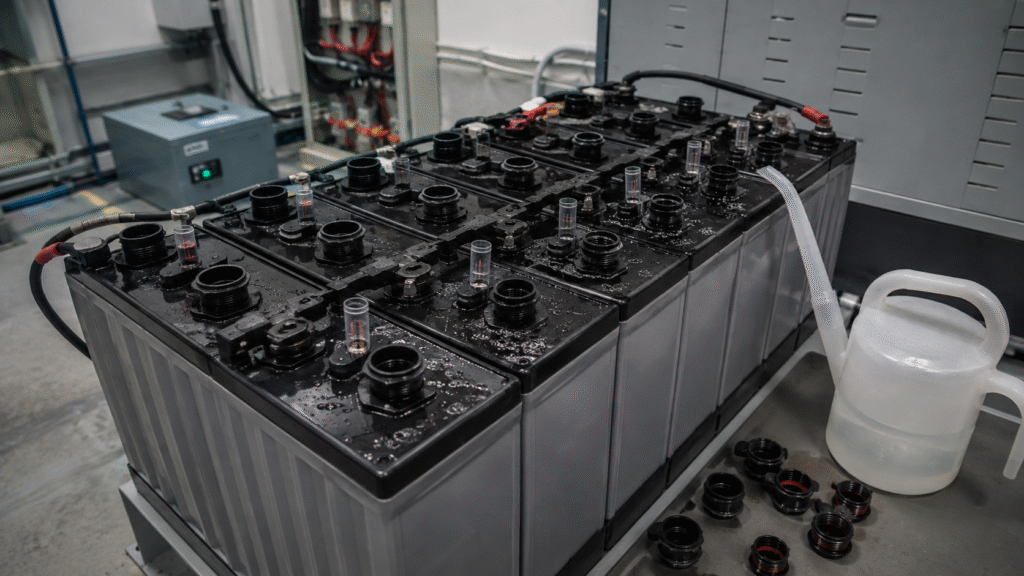
Flooded lead-acid batteries naturally consume some water during charging.
For that reason, periodic watering is a normal maintenance requirement for flooded batteries such as:
- OPzS batteries
- Flooded tubular batteries
- Conventional stationary flooded cells
- Deep-cycle flooded batteries
But what if the battery suddenly needs water much more frequently than before?
For example:
- Electrolyte previously required topping up every few months.
- Now the level falls noticeably within several weeks.
- One cell requires much more water than the others.
- The battery room has become warmer.
- Charging produces stronger bubbling.
- There is more corrosion around vent caps.
These changes can indicate a charging, temperature, battery, or maintenance problem.
Flooded batteries naturally lose water through charging-related gassing, but continuous overcharging increases gassing, heat, and water consumption. Trojan specifically identifies excessive water use as one consequence of continuous overcharging.
Why Do Flooded Batteries Lose Water?
Lead-acid battery electrolyte contains sulfuric acid and water.
During charging—particularly near the end of the charging cycle—electrolysis can produce hydrogen and oxygen.
Some gas leaves the battery through the vents.
As a result, water must periodically be replaced.
This is normal.
The key distinction is between:
Normal, predictable water consumption
and
A sudden or excessive increase in water consumption.
The second condition requires investigation.
Reason 1: Charging Voltage Is Too High
Excessive charging voltage is one of the most common causes of rapid water loss.
When charging voltage remains too high after the battery is already near full charge, more current is used for electrolysis rather than useful energy storage.
This creates:
- Stronger gassing
- Higher water consumption
- Increased battery temperature
- Faster positive-grid corrosion
Check:
- Boost voltage
- Absorption voltage
- Float voltage
- Equalization voltage
- Charger calibration
- Number of cells configured
The correct settings must come from the specific battery data sheet.
Do not use one universal voltage setting for every flooded battery.
Reason 2: Float Voltage Is Too High
Some battery systems spend most of their life on float charge.
A float voltage that is only slightly higher than the recommended value may not cause an immediate failure.
Instead, the effects accumulate gradually:
- More gassing
- More frequent watering
- Higher corrosion rate
- Increased temperature
- Shorter service life
This is especially important for:
- Substation battery banks
- Telecom backup batteries
- UPS systems
- Emergency power systems
If water consumption has gradually increased, compare the actual float voltage with:
- Battery specification
- Original commissioning settings
- Charger logs
Reason 3: Equalization Is Being Performed Too Often
Certain flooded lead-acid batteries may use equalization charging.
Equalization involves a higher charging voltage and normally produces more gas.
It should be used only when:
- The battery manufacturer permits it.
- The battery condition requires it.
- Voltage and temperature are monitored.
- The correct duration is followed.
Excessively frequent equalization can cause unnecessary:
- Water loss
- Gassing
- Battery heating
- Grid corrosion
Do not schedule aggressive equalization simply because it is available in the charger menu.
Reason 4: Equalization Time Is Too Long
Even when the equalization voltage is correct, excessive duration can increase water consumption.
Possible causes include:
- Incorrect timer
- Manual equalization left active
- Charger control fault
- Repeated technician intervention
- Automatic schedule incorrectly configured
Record:
- Equalization start time
- End time
- Battery voltage
- Current
- Temperature
- Specific gravity
Compare these records with the battery manufacturer’s procedure.
Reason 5: Battery Temperature Is Higher
Higher temperatures accelerate electrochemical reactions and can increase both gassing and water consumption.
Possible reasons include:
- Hot climate
- Failed air conditioner
- Poor ventilation
- Battery cabinet installed outdoors
- Generator-room heat
- Direct sunlight
- Increased charger temperature
- Reduced spacing between batteries
Trojan notes that higher temperature increases self-discharge and that overcharging produces additional gassing and heat.
If a system in the Middle East, Africa, Southeast Asia, or another high-temperature market begins consuming more water during the hottest season, temperature should be one of the first checks.
Reason 6: Temperature Compensation Is Incorrect
The charger should account for battery temperature when required by the manufacturer.
If the battery becomes hotter but the charger continues using the same high charging voltage, overcharging may result.
Check:
- Battery temperature sensor
- Sensor connection
- Sensor placement
- Charger setting
- Compensation coefficient
A sensor mounted near an air-conditioning outlet may report a lower temperature than the actual batteries experience.
Reason 7: One Cell Requires Much More Water Than the Others
Uniform water consumption across a battery bank is very different from one cell repeatedly needing more water.
One abnormal cell may have:
- Greater gassing
- Internal leakage
- Higher local charging voltage
- Plate problems
- Electrolyte leakage
- Cracked container
- Damaged vent system
Compare:
- Cell voltage
- Specific gravity
- Water addition quantity
- Temperature
- Visual condition
A maintenance log showing the amount of water added to each cell can be extremely useful.
Reason 8: Electrolyte Is Physically Leaking
Not all electrolyte loss occurs through gassing.
Inspect for:
- Cracks
- Damaged jars
- Loose plugs
- Wet cell surfaces
- Acid stains
- Corroded racks
- Liquid beneath the battery
A leaking battery should not simply be topped up repeatedly.
The cause must be corrected.
Electrolyte leakage can damage:
- Battery racks
- Cables
- Flooring
- Nearby electrical equipment
Reason 9: Batteries Are Being Overfilled
Sometimes the battery is not actually consuming excessive water.
Instead, technicians are adding too much water.
Electrolyte volume expands during charging.
If a discharged battery is filled to its maximum level before charging, the electrolyte may overflow after the battery reaches full charge.
This creates the appearance of rapid electrolyte loss.
Flooded-battery watering guidance generally recommends completing normal topping-up after the battery is fully charged; if plates are exposed before charging, only enough water should be added to cover them before the charge is completed.
Reason 10: Water Is Being Added at the Wrong Time
A correct watering routine matters.
A general flooded-battery process is:
- Inspect electrolyte before charging.
- If plates are exposed, add enough approved water to cover them.
- Fully charge the battery.
- Allow electrolyte level to rise normally.
- Adjust to the manufacturer’s final level.
The exact fill level must follow the battery manufacturer’s instructions.
Do not copy a measurement from one battery brand to another.
Reason 11: The Wrong Water Is Being Used
Flooded batteries normally require distilled or otherwise manufacturer-approved high-purity water.
Tap water may contain:
- Minerals
- Chlorides
- Metals
- Dissolved solids
Repeated addition of contaminated water can introduce impurities into the electrolyte and contribute to battery deterioration.
Trojan recommends distilled water, with de-ionized water acceptable where appropriate, and warns that mineral contamination can accumulate in the battery.
Do not add:
- Tap water without approval
- Mineral water
- Bottled drinking water
- Additional sulfuric acid as routine maintenance
Reason 12: The Charger Is Failing
A charger fault may produce excessive voltage even though the control panel shows the expected setting.
Possible faults include:
- Voltage-sensing error
- Failed control board
- Reference drift
- Incorrect remote sensing
- Rectifier fault
- Software configuration error
Use an independent calibrated meter to measure:
- Charger output voltage
- Battery-terminal voltage
- Individual cell voltage
Also check charger event logs.
Reason 13: Another Charger Is Also Operating
A battery bank may be connected to more than one charging source:
- Solar controller
- Inverter/charger
- Grid rectifier
- Generator charger
If their settings are not coordinated, the battery may receive more charging current or remain at a higher voltage longer than intended.
Check whether excessive water consumption began after:
- Adding solar
- Replacing the inverter
- Adding a generator charger
- Installing a second rectifier
- Updating charger firmware
Treat all charging sources as one combined system.
Reason 14: Daily Cycling Has Increased
Battery water consumption may increase because the battery is doing more work.
For example:
- Power outages occur more often.
- Solar loads increased.
- Generator runtime decreased.
- More nighttime loads were added.
- Battery depth of discharge increased.
More frequent or deeper cycling means more energy must be returned during charging.
That can result in more time spent in high-voltage charging stages and therefore greater water consumption.
Review the operating pattern before assuming battery failure.
Reason 15: Battery Aging Is Increasing Maintenance Demand
An older battery can behave differently from a new one.
Aging may contribute to:
- Higher charging current
- Greater gassing
- Increasing temperature
- Longer recharge requirements
- Unequal cells
If water consumption is gradually increasing together with:
- Declining capacity
- Increasing voltage spread
- Increasing internal resistance
- Reduced runtime
the battery may be approaching the later part of its service life.
How Much Water Consumption Is Normal?
There is no universal answer.
Normal watering frequency depends on:
- Battery design
- Grid alloy
- Charging voltage
- Cycle frequency
- Depth of discharge
- Temperature
- Battery age
- Charger design
Trojan recommends checking new flooded installations regularly—often monthly at first—to establish the watering pattern for the specific application.
For an industrial OPzS project, the correct approach is therefore not:
“Add water every X months.”
Instead:
Establish a baseline and monitor whether the required interval or quantity changes.
A Useful Water-Consumption Log
For large stationary battery projects, record:
| Date | Cell/Battery | Water Added | Specific Gravity | Cell Voltage | Temperature | Charging Mode |
|---|---|---|---|---|---|---|
| Inspection 1 | No. 1 | — | — | — | — | Float |
| Inspection 1 | No. 2 | — | — | — | — | Float |
| Inspection 2 | No. 1 | — | — | — | — | Float |
Over time, this can identify:
- One abnormal cell
- Seasonal patterns
- Charger-setting problems
- Increasing maintenance requirements
Diagnostic Scenario 1: All Cells Use More Water
Likely areas to investigate:
- Charging voltage too high
- Temperature too high
- Equalization too frequent
- Increased cycling
- Charger calibration problem
Diagnostic Scenario 2: Only One Cell Uses More Water
Investigate:
- Cell voltage
- Cell temperature
- Leakage
- Internal fault
- Local overcharging
Diagnostic Scenario 3: Batteries Overflow After Every Charge
Investigate:
- Overfilling
- Water added before charging
- Excessive charge voltage
- Incorrect final electrolyte level
Overfilling can result in acid loss and shortened battery life.
Diagnostic Scenario 4: Water Consumption Increased During Summer
Investigate:
- Battery temperature
- Charging-temperature compensation
- Ventilation
- Cooling system
- Float voltage
Diagnostic Scenario 5: Water Consumption Increased After Charger Replacement
Investigate:
- Battery profile
- Absorption voltage
- Float voltage
- Equalization schedule
- Temperature sensor
- Charger calibration
Practical Troubleshooting Procedure
Step 1: Review Maintenance History
Determine:
- Previous watering frequency
- Current watering frequency
- Which cells require the most water
Step 2: Measure Battery Temperature
Measure several batteries across the room.
Step 3: Verify Charger Settings
Record:
- Absorption voltage
- Float voltage
- Equalization voltage
- Equalization duration
- Current limit
Step 4: Measure Actual Voltage
Use an independent calibrated meter.
Step 5: Measure Individual Cell Voltages
Identify abnormal cells.
Step 6: Measure Specific Gravity
For accessible flooded batteries, compare all cells after proper charging and temperature correction.
Step 7: Inspect for Leakage
Check:
- Battery containers
- Vent caps
- Rack
- Floor
- Cables
Step 8: Review Charging Sources
Confirm whether several chargers operate simultaneously.
Step 9: Review System Cycling
Check whether power outages or daily energy consumption have increased.
Step 10: Perform a Capacity Test if Required
Excessive water consumption combined with poor runtime may indicate battery deterioration.
Important Watering Rules
For flooded batteries:
- Use the water specified by the manufacturer.
- Never allow plates to remain exposed.
- Avoid overfilling.
- Complete final topping-up after charging unless instructed otherwise.
- Keep records.
- Wear appropriate PPE.
- Do not routinely add acid.
Trojan specifically advises adding water rather than acid for normal maintenance and warns against both under-watering and over-watering.
What About AGM, GEL, and OPzV Batteries?
These are valve-regulated designs.
They should not normally be opened and watered.
If an AGM, GEL, or OPzV battery appears to be:
- Losing electrolyte
- Venting
- Leaking
- Drying out
this indicates a different type of problem.
Do not attempt to refill a sealed VRLA battery unless the battery manufacturer has a specific approved service procedure.
Trojan, for example, explicitly states that water should not be added to its AGM batteries.
Frequently Asked Questions
Is water loss normal in a flooded lead-acid battery?
Yes. Some water consumption during charging is normal.
Why does my battery suddenly need water every month?
Possible causes include higher temperature, excessive charging voltage, increased cycling, frequent equalization, or battery deterioration.
Why does only one cell lose water?
The cell may be overcharging, leaking, operating at a different voltage, or developing an internal fault.
Can I add sulfuric acid instead of water?
Not as routine maintenance. Normal water loss should be replaced with the manufacturer-approved water.
Should water be added before or after charging?
Final topping-up is generally done after full charging. If plates are exposed before charging, add enough water to cover them first and complete the final adjustment afterward.
Can excessive water consumption reduce battery life?
Yes. Excessive gassing and water consumption may accompany overcharging, high temperature, and accelerated grid corrosion.
Should I replace the battery if water consumption increases?
Not automatically. First investigate charger settings, temperature, leakage, cycling frequency, and individual cell behavior.
Conclusion
An increase in flooded lead-acid battery water consumption is an important maintenance signal.
The most common causes include:
- Excessive charging voltage
- Excessive float voltage
- Frequent equalization
- High battery temperature
- Incorrect temperature compensation
- Overfilling
- Increased cycling
- Charger faults
- Cell leakage
- Battery aging
For OPzS, flooded solar, telecom, substation, and industrial battery projects, recording the amount of water added per cell over time can provide valuable diagnostic information.
For technical evaluation, provide the battery model, battery age, number of cells, charging voltage, float voltage, equalization settings, battery temperature, watering frequency, specific-gravity readings, and amount of water being added.