
Introduction
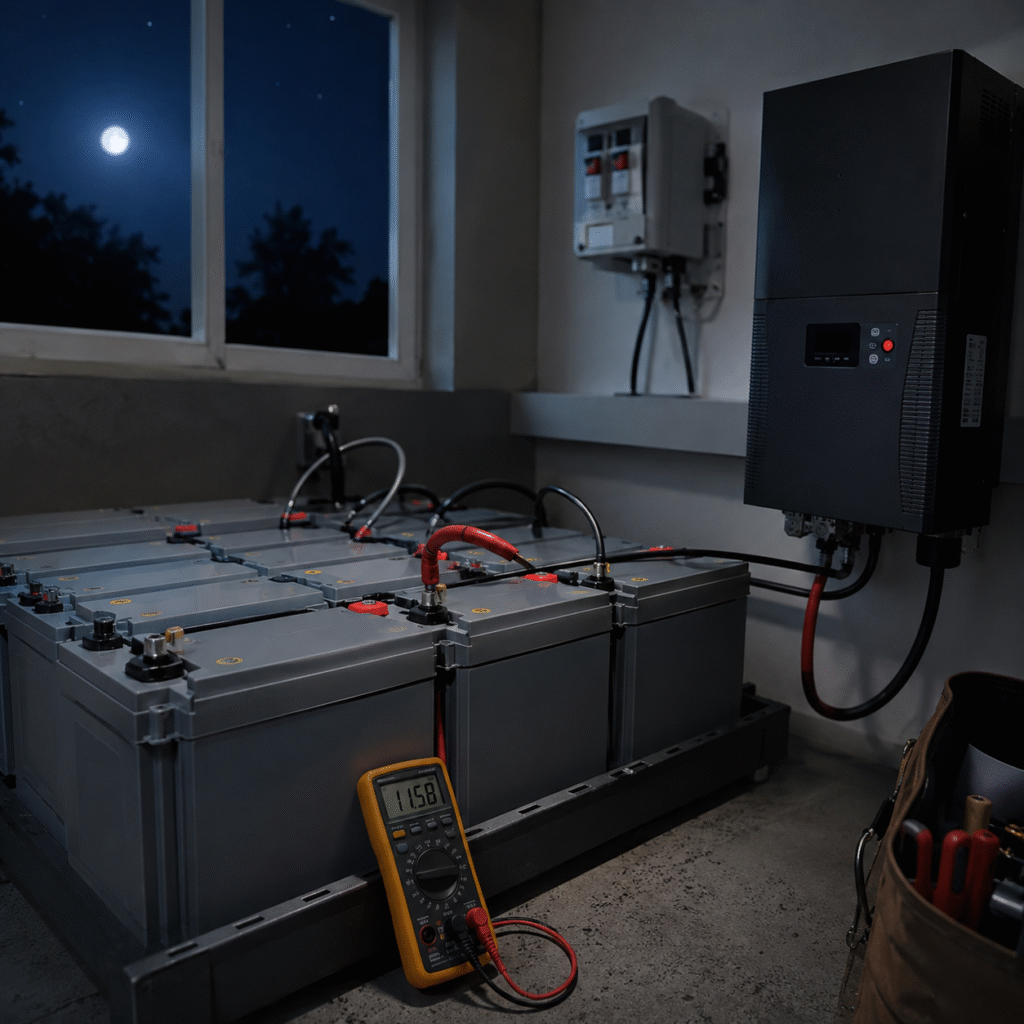
A solar or backup battery may be fully charged in the evening but show a noticeably lower voltage the next morning—even when the customer believes that everything has been switched off.
This commonly leads to the conclusion:
“The battery must be defective because nothing was using power.”
Sometimes the battery is indeed experiencing excessive self-discharge.
But in many systems, “inverter off” does not mean “zero current.”
Small loads may remain connected through:
- Inverter electronics
- Solar controllers
- Battery monitors
- Wi-Fi modules
- Relays
- Alarm systems
- Displays
- DC accessories
- Contactors
Other possible causes include:
- Surface-charge disappearance
- Battery contamination
- Damaged wiring
- Internal leakage
- Partial short circuits
- Battery aging
- One weak battery in the string
High self-discharge is a recognized sign of lead-acid battery deterioration, but it should be separated from external parasitic consumption before the battery is replaced.
First: Voltage Drop Is Not Always Capacity Loss
Suppose a battery measures a relatively high voltage immediately after charging.
Several hours later, voltage is lower.
This does not automatically mean substantial energy disappeared overnight.
Immediately after charging, lead-acid battery voltage can be temporarily elevated by:
- Surface charge
- Recent charger activity
- Battery temperature
- Electrochemical polarization
After the charger is removed and the battery rests, the voltage settles toward its open-circuit value.
Therefore, when diagnosing overnight voltage loss, compare:
- Stabilized voltage after resting
- Morning voltage
- Actual Ah removed
- Measured current
Do not compare only the charger-end voltage with the next morning’s resting voltage.
Reason 1: The Inverter Is Not Completely Off
Many inverters have several operating states:
- On
- Standby
- Search mode
- Remote off
- Soft off
- Complete DC isolation
These states are not necessarily equivalent.
An inverter display may be dark while internal circuits remain connected to the battery.
Possible standby loads include:
- Control electronics
- Communication circuits
- Remote switch receivers
- Internal relays
- Battery-voltage monitoring
- Wi-Fi modules
- Bluetooth modules
For a small battery bank, even a modest continuous standby current can become significant over many hours.
How Small Loads Become Significant
Suppose parasitic consumption is only: 1A
Over 12 hours: 1A × 12h = 12Ah
For a 100Ah battery, that is already a meaningful portion of its capacity.
If several devices together consume 3A: 3A × 12h = 36Ah
The customer may believe that the system is “off,” but over one night the parasitic load can remove substantial capacity.
This is why current measurement is more useful than assumptions about switch positions.
Reason 2: The Solar Charge Controller Still Consumes Power
A solar controller normally remains connected to the battery overnight so that it can operate and detect the next morning’s PV voltage.
Its own consumption may be small, but it is not necessarily zero.
In a properly sized large battery bank this is usually minor.
However, combined with other loads it can contribute to overnight discharge.
Check:
- MPPT/controller standby consumption
- Display modules
- Communication gateways
- External sensors
- Remote monitoring equipment
Reason 3: Battery Monitoring Equipment Is Still Running
Modern systems may contain:
- Shunt monitors
- LCD displays
- Wi-Fi data loggers
- GSM modules
- Cloud gateways
- Remote alarms
- Bluetooth devices
- Battery temperature sensors
Each device may consume little power individually.
Together they can become significant, especially in:
- Small solar systems
- RV systems
- Remote telecom sites
- Seasonal installations
- Systems stored for weeks or months
Reason 4: DC Loads Bypass the Inverter
Switching off the inverter only removes AC loads connected through that inverter.
Many DC appliances may remain directly connected to the battery.
Examples include:
- 12V lighting
- Routers
- CCTV systems
- DC refrigerators
- Alarm systems
- Pumps
- Fans
- USB chargers
- Communication equipment
- Automotive accessories
Inspect the complete DC distribution system, not only the inverter.
Reason 5: A Relay or Contactor Coil Remains Energized
Energy-storage systems may use:
- DC contactors
- Transfer relays
- Generator-start relays
- Battery protection relays
- Remote-control modules
A coil that remains energized continuously can create an overlooked parasitic load.
Check the schematic to identify equipment connected directly to:
- Battery positive
- Battery negative
- DC busbars
Reason 6: The Battery Is Self-Discharging Normally
Even when completely disconnected, lead-acid batteries gradually lose charge.
The rate varies with:
- Battery type
- Battery age
- Temperature
- State of charge
- Cleanliness
- Manufacturing design
Self-discharge is one reason stored lead-acid batteries require periodic recharging.
Higher temperature generally increases self-discharge, while cooler storage slows it.
However, normal self-discharge usually should not be confused with a dramatic overnight capacity loss.
A substantial overnight decline often suggests either:
- External load
- Battery condition problem
- Measurement issue
Reason 7: High Temperature Is Accelerating Self-Discharge
A battery stored at elevated temperature loses charge faster than the same battery stored under cooler conditions.
This matters in:
- Outdoor solar cabinets
- Telecom shelters
- Tropical climates
- Desert environments
- Generator rooms
- Metal containers
Battery temperature during the night may remain much higher than expected if the enclosure stores heat from the day.
Measure actual battery temperature.
Do not rely only on outdoor nighttime temperature.
Reason 8: Dirt and Moisture Are Creating Surface Leakage
Battery tops should be kept clean and dry.
Contamination can include:
- Electrolyte residue
- Dust
- Salt
- Moisture
- Conductive dirt
A conductive path across the battery top can create leakage current.
Trojan specifically warns that accumulated water, oil, and dirt on AGM battery surfaces can allow electrical tracking and current leakage, contributing to self-discharge and potentially short circuits.
This problem can be particularly relevant in:
- High-humidity areas
- Coastal sites
- Dusty industrial environments
- Flooded-battery rooms with acid mist
Reason 9: There Is an External Wiring Leakage
Damaged wiring can create unwanted current flow.
Check for:
- Cracked insulation
- Water ingress
- Cable touching metalwork
- Damaged connectors
- Corroded fuse boxes
- Moisture inside junction boxes
- Incorrect equipment wiring
The leakage may be too small to blow a fuse but large enough to discharge a battery over many hours.
Reason 10: One Accessory Was Connected Directly to the Battery
Installers sometimes add equipment after commissioning.
Examples:
- Wi-Fi router
- Camera
- USB charger
- DC fan
- Lighting
- Alarm
- Tracking device
The accessory may be connected directly to the battery terminal and therefore remain energized even when the inverter is off.
Compare the present wiring with the original system schematic.
Reason 11: One Battery Has Excessive Internal Self-Discharge
If the complete battery bank is disconnected from all external equipment and still loses charge unusually quickly, one battery may have an internal problem.
Possible causes include:
- Internal leakage
- Separator damage
- Partial internal short
- Contamination
- Severe aging
A battery with excessive self-discharge may:
- Charge normally
- Show normal voltage initially
- Lose voltage faster than other batteries
- Become weak after sitting
- Require frequent charging
Compare individual batteries after they have been:
- Fully charged
- Disconnected
- Allowed to rest for the same period
- Stored at the same temperature
A battery that consistently loses voltage much faster requires further evaluation.
Reason 12: One Battery Is Weak in a Series String
Consider four 12V batteries forming a 48V bank.
Three batteries may remain stable overnight while one deteriorated battery falls significantly.
The total bank voltage then appears to drop.
Measure individual battery voltage rather than only the total string.
Record:
- Evening voltage
- Morning voltage
- Difference for each battery
This quickly shows whether the loss is:
- System-wide
- Concentrated in one battery
Reason 13: Parallel Strings Have Unequal Leakage
In a multi-string battery bank, one string may discharge into another under certain abnormal conditions.
Potential contributing factors include:
- Different battery ages
- Different resting voltages
- One weak string
- Wiring imbalance
- Missing string protection
Parallel strings should use matched batteries and appropriate individual string protection.
Measure overnight current separately in each string if unexplained battery loss continues.
Reason 14: The Battery Was Never Fully Charged
Sometimes the battery appears to lose energy overnight when it actually began the evening partially charged.
For example, the solar controller may have reached a high voltage briefly, but:
- Absorption was incomplete.
- Cloud cover reduced charging.
- Daytime loads consumed solar energy.
- The battery had high internal resistance.
- Charging stopped too early.
The evening voltage can look acceptable because of recent charging.
After resting overnight, the true state becomes more obvious.
Verify:
- Time in absorption
- Charging current
- Net Ah returned
- Specific gravity for flooded batteries
- Actual capacity
Reason 15: Battery Capacity Has Declined
Suppose a customer has a nominal 200Ah battery that now has only 100Ah of usable capacity.
A 20Ah overnight parasitic load represents:
- 10% of the original rated capacity
- But 20% of the present usable capacity
As the battery ages, the same standby load produces a much larger apparent percentage loss.
This is one reason systems may begin showing overnight-discharge problems after several years even though no new equipment has been added.
Reason 16: The Battery-Monitor SOC Is Drifting
Sometimes the battery voltage is not the main issue—the displayed percentage is.
A battery monitor can become inaccurate if:
- Ah capacity is configured incorrectly.
- Battery capacity has aged.
- The monitor is not synchronized.
- A load bypasses the shunt.
- Charging current bypasses the shunt.
Compare the SOC display with:
- Measured current
- Voltage
- Actual runtime
- Capacity-test results
Do not diagnose battery self-discharge from SOC percentage alone.
How to Determine Whether the Battery or the System Is Responsible
The most useful test is to separate:
External discharge
from
Internal self-discharge.
Test A: Measure Current with Everything “Off”
Use a suitable DC clamp meter or battery shunt.
If current still leaves the battery:
- Identify connected devices one by one.
- Remove branch fuses if safe.
- Observe when the current disappears.
Test B: Completely Isolate the Battery
After fully charging the battery:
- Disconnect charging sources.
- Disconnect loads.
- Electrically isolate the battery according to the system procedure.
- Record individual voltages.
- Allow the batteries to rest.
- Measure again.
If the battery remains stable when isolated, the problem is probably external.
If one battery still loses voltage abnormally, investigate the battery itself.
Practical Parasitic-Load Test
Step 1: Fully Charge the Battery
Confirm a genuine full charge using the correct battery procedure.
Step 2: Record Evening Values
Measure:
- Total bank voltage
- Individual battery voltages
- SOC if available
- Battery temperature
Step 3: Measure “Off” Current
With the inverter switched off, measure current at the main battery cable.
Step 4: Isolate Loads One at a Time
Disconnect or switch off:
- Inverter
- Solar controller
- DC distribution
- Wi-Fi monitor
- Alarm systems
- Accessories
Observe the current change after each step.
Step 5: Identify the Branch
Once the current falls significantly, investigate that circuit.
Step 6: Repeat Overnight
Record:
- Remaining parasitic current
- Evening voltage
- Morning voltage
Example
Suppose a 24V 200Ah battery bank has:
- Inverter standby: 0.8A
- Monitoring equipment: 0.2A
- DC router: 0.5A
- Alarm system: 0.3A
Total: 1.8A
Over 12 hours: 1.8 × 12 = 21.6Ah
That is more than 10% of the nominal 200Ah capacity.
If the batteries are aged and actual capacity is only 120Ah, the impact becomes much larger.
This is why apparently “small” standby loads should not be ignored.
Does Opening the Main Battery Breaker Solve the Problem?
If the main battery disconnect genuinely isolates all external circuits, opening it can prevent parasitic discharge.
However, verify the schematic.
Some systems may have:
- Solar controllers connected directly
- Emergency circuits bypassing the main breaker
- Monitoring devices connected upstream
- Separate DC distribution
Never assume the breaker isolates every circuit without checking the wiring.
Storage Systems Need a Different Strategy
A battery used every day can be recharged regularly.
A battery that will remain unused for months should be prepared specifically for storage.
Important considerations include:
- Full charge before storage
- Proper isolation
- Cool, dry environment
- Periodic voltage checks
- Manufacturer-specified supplementary charging
- Clean battery surfaces
Existing storage guidance for lead-acid batteries emphasizes regular inspection and maintaining proper charge during long periods of inactivity.
Common Troubleshooting Mistakes
Assuming the Inverter Switch Disconnects the Battery
Many electronic devices remain partially energized.
Checking Only Battery Voltage
Measure current as well.
Disconnecting Only the AC Loads
DC loads may remain connected.
Replacing the Battery Before Testing Parasitic Current
A new battery may suffer exactly the same problem.
Comparing Voltage Immediately After Charging
Allow for normal post-charge voltage relaxation.
Ignoring Dirty Battery Surfaces
Moisture and contamination can create leakage paths.
Trusting the SOC Display Completely
Monitor configuration errors can mimic battery drain.
When Is Excessive Self-Discharge Likely?
Battery condition becomes more suspicious when:
- The battery is fully charged.
- All external loads are physically disconnected.
- Battery surfaces are clean and dry.
- Storage temperature is controlled.
- One battery loses voltage much faster than identical batteries.
- The problem repeats after recharge.
Further testing may include:
- Internal resistance
- Conductance
- Capacity testing
- Controlled storage observation
Frequently Asked Questions
Why does the battery drain when the inverter is switched off?
The inverter may still consume standby power, or other DC equipment may remain connected.
Is some overnight voltage drop normal?
Yes. Post-charge surface voltage can settle during rest, and all lead-acid batteries have some self-discharge.
How can I find a parasitic load?
Measure total DC current with the system switched off, then isolate individual circuits until the unexplained current disappears.
Can an MPPT drain the battery at night?
A connected controller has its own operating consumption. Check the specific controller’s standby specification.
Can dirt on a battery cause discharge?
Conductive contamination and moisture can create surface leakage current.
Why does only one battery lose voltage?
That battery may have greater self-discharge, internal leakage, reduced capacity, or an internal fault.
Should I replace the battery immediately?
Not before distinguishing between external parasitic discharge and internal battery self-discharge.
Conclusion
A lead-acid battery losing voltage overnight while the inverter appears to be off does not automatically mean that the battery is defective.
The most common causes include:
- Inverter standby consumption
- Solar-controller consumption
- Monitoring equipment
- Hidden DC loads
- Relay and contactor coils
- Surface leakage
- Wiring faults
- Normal self-discharge
- High temperature
- Weak individual batteries
- Reduced battery capacity
The fastest way to diagnose the problem is to measure actual battery current when the system is supposedly off and then isolate circuits systematically.
For a technical diagnosis, provide the battery model, battery age, series-parallel configuration, evening and morning voltages, inverter model, measured standby current, DC accessories, solar-controller model, battery temperature, and whether the voltage drop continues when the battery is completely isolated.