
Introduction
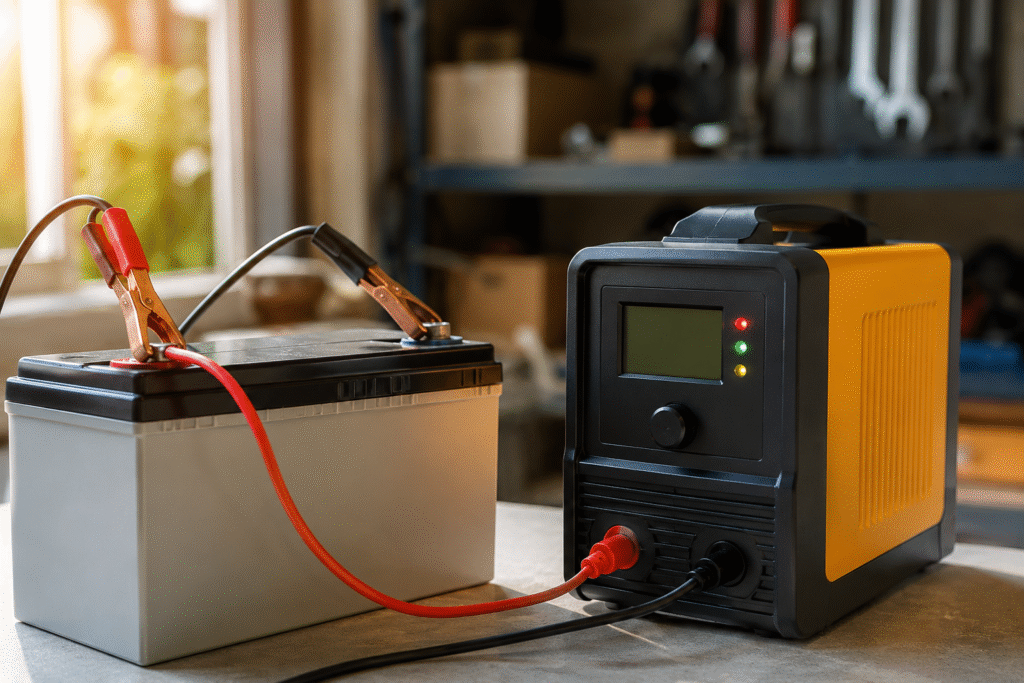
A charger is connected to a lead-acid battery bank. The charger display shows what appears to be the correct voltage, but the charging current is extremely low—or even close to zero.
At first glance, this can be confusing.
If the charger has output voltage, why is current not flowing into the battery?
There are several very different possibilities.
The battery may already be fully charged. The charger may have entered float mode. A fuse or breaker may be open. A cable connection may have excessive resistance. One battery in a series string may be causing the total voltage to rise prematurely. The battery may also have severe sulfation or high internal resistance and may no longer accept charge normally.
Correct diagnosis therefore requires checking both the charger side and the battery side rather than simply replacing the charger or battery.
Modern lead-acid chargers normally reduce current as the battery reaches its absorption voltage and transitions toward full charge, so low current can be completely normal under some conditions.
First Question: Is the Battery Actually Discharged?
Before treating low charging current as a fault, determine whether the battery genuinely needs significant charging.
If a fully charged battery is connected to a constant-voltage charger, the current should naturally fall as the battery approaches the charger’s target voltage.
During a typical multi-stage charging process:
- Bulk stage: relatively high current is supplied.
- Absorption stage: voltage is held while current gradually decreases.
- Float stage: the charger maintains the battery with relatively low current.
Trojan recommends charging lead-acid batteries using the correct charger profile and verifying that charger voltage settings match the battery specification.
Therefore:
Low charging current + fully charged battery = potentially normal.
But:
Low charging current + deeply discharged battery = requires investigation.
Reason 1: The Battery Is Already Near Full Charge
This is the simplest explanation.
Suppose a 48V battery bank has recently completed absorption charging and is now on float. The charger may display the expected float voltage while supplying only a small maintenance current.
This current compensates for:
- Battery self-discharge
- Internal electrochemical losses
- Small standby loads
A charger does not need to continue supplying its maximum rated current once the battery is full. In fact, forcing high current into a fully charged lead-acid battery would increase gassing, heat, and overcharging risk.
How to Check
Review:
- Current charger stage
- Battery voltage
- Previous charging history
- Time spent in absorption
- Ah removed during the previous discharge
- Battery monitor SOC, if properly calibrated
If the battery later delivers normal runtime, low float current is probably not a problem.
Reason 2: Battery Voltage Is Rising Too Quickly Because of High Internal Resistance
This is one of the most important fault conditions.
A deteriorated lead-acid battery can develop increased internal resistance because of:
- Sulfation
- Plate corrosion
- Active-material degradation
- Electrolyte problems
- Long periods at partial state of charge
- Battery aging
When charging current flows through increased internal resistance, terminal voltage can rise rapidly.
The charger sees the target voltage and begins reducing current—even though relatively little energy has actually been stored.
The result can look like this:
- Battery starts at a low state of charge.
- Charger begins charging.
- Voltage rises unusually quickly.
- Current falls early.
- Charger enters absorption or float.
- Battery appears “charged.”
- Runtime is still very short.
A fully charged battery can also show normal open-circuit voltage even when its available capacity has declined significantly, so voltage alone is not a reliable capacity test.
Reason 3: The Battery Is Severely Sulfated
Sulfation develops when lead-acid batteries remain partially or deeply discharged for extended periods.
As sulfation becomes more severe:
- Charge acceptance may decrease.
- Internal resistance may increase.
- Voltage may rise rapidly during charging.
- Charging current may fall prematurely.
- Usable capacity may decline.
Lead-acid manufacturers recommend recharging batteries after use and avoiding extended periods at low state of charge because prolonged undercharging contributes to sulfation and capacity loss.
A charger showing normal voltage but very little current may therefore be dealing with a battery that can no longer accept energy normally.
Can Sulfation Be Reversed?
Sometimes mild sulfation may respond to a manufacturer-approved recovery or reconditioning procedure.
However, this should not be confused with guaranteed battery restoration.
Severe sulfation may be accompanied by permanent:
- Capacity loss
- Plate shedding
- Grid corrosion
- Internal damage
High-voltage reconditioning can also increase gassing and should only be used when the battery manufacturer permits it.
Reason 4: The Charger Has Reached Its Voltage Limit
Lead-acid chargers often operate in constant-current mode initially and then switch to constant-voltage regulation.
Once the battery reaches the absorption set point, the charger no longer tries to force maximum current.
Instead, it holds the voltage and allows current to taper.
This means a charger can simultaneously show:
- Correct absorption voltage
- Much lower current than its maximum rating
and still be operating normally.
The important question is how quickly this happened.
If a deeply discharged 600Ah battery reaches absorption after only a few minutes at a modest charging current, that is suspicious.
If a nearly full battery reaches absorption quickly, that may be completely normal.
Reason 5: The Charger Is Configured for the Wrong Battery Type
Lead-acid charging profiles should match the selected battery technology.
Different products may require different:
- Absorption voltages
- Float voltages
- Absorption times
- Charging-current limits
- Temperature compensation
- Equalization settings
A charger configured with an absorption voltage that is too low may reduce current before the battery is fully charged.
The charger may technically be doing exactly what it has been programmed to do—the programmed values are simply wrong for the battery.
Trojan recommends verifying the charger program before charging AGM and flooded batteries, while charger manufacturers likewise specify that charge voltage must match the battery manufacturer’s recommendations.
Reason 6: A Fuse or Circuit Breaker Is Open
Sometimes the charger display has voltage because the charger itself is operating, but there is no complete current path to the battery.
Possible causes include:
- Blown charging fuse
- Tripped DC breaker
- Open battery disconnect
- Failed fuse holder
- Broken cable
- Disconnected terminal
Solar-controller troubleshooting guidance specifically recommends checking continuity, battery cables, fuses, circuit breakers, and cable connections when charging is not occurring normally.
Important
Do not assume a breaker is closed only because its handle appears to be in the ON position.
A damaged breaker can fail internally.
Measure voltage:
- Before the breaker
- After the breaker
- At the battery terminals
while the charger is operating.
Reason 7: A High-Resistance Connection Is Blocking Charging Current
A connection does not need to be completely open to create a charging problem.
A loose, corroded, or poorly crimped joint can create enough resistance to limit current.
Common locations include:
- Battery terminals
- Charger terminals
- Cable lugs
- Fuse holders
- Circuit breakers
- Busbars
- Disconnect switches
High resistance can also create a difference between charger-terminal voltage and actual battery-terminal voltage.
The charger may reach its target voltage while the battery receives a lower voltage and less charging power. Cable voltage drop can lengthen charging time and leave batteries undercharged.
Check for:
- Hot cable lugs
- Discolored terminals
- Melted insulation
- Loose bolts
- Corrosion
- Abnormal voltage drop
Trojan also recommends keeping battery connections correctly tightened because poor connections can lead to heating and serious damage.
Reason 8: The Charging Cable Is Too Long or Too Small
The longer and thinner a cable is, the more electrical resistance it contributes.
This can reduce charging performance, particularly in:
- Low-voltage systems
- High-current battery banks
- Remote solar installations
- Long charger-to-battery cable runs
Suppose a charger outputs 28.8V, but because of cable resistance the battery receives only 27.6V under load.
The charger may think it has reached its intended operating voltage while the battery remains inadequately charged.
Battery-cable voltage drop should therefore be measured while meaningful current is flowing, not only with the charger disconnected.
Reason 9: One Battery in the Series String Is Reaching High Voltage Early
Consider four 12V batteries connected in series.
The charger controls the total voltage of the 48V bank.
If one battery has:
- Lower capacity
- Higher resistance
- Different state of charge
- Internal damage
its voltage may rise faster than the others.
For example:
- Battery 1: 13.5V
- Battery 2: 13.6V
- Battery 3: 13.5V
- Battery 4: 15.2V
Total:
55.8V
The charger may begin reducing current based on the total voltage, even though three batteries remain undercharged.
Large series/parallel banks are more difficult to balance because small differences in battery resistance and wiring can create unequal conditions.
Measure individual battery voltages during charging rather than relying only on total bank voltage.
Reason 10: Another Charger Is Raising the Battery Voltage
A battery bank may have several charging sources:
- Solar MPPT
- Grid inverter/charger
- Generator charger
- Standalone charger
Suppose the grid charger is already holding the battery at absorption voltage.
The solar charger sees the high battery voltage and may reduce its own current to almost zero.
Nothing is necessarily wrong.
The battery simply does not require the full output of both chargers at that moment.
When multiple chargers are used, compare:
- Output current from each charger
- Net current entering the battery
- Actual battery voltage
- Charging stage of each charger
Do not troubleshoot one charger in isolation without checking what the others are doing.
Reason 11: Daytime Loads Are Consuming the Charger Output
A charger may be producing current, but that current may be going directly to loads instead of into the battery.
Example:
- Charger output: 40A
- DC and inverter loads: 37A
- Net battery charging current: 3A
A battery shunt would show only approximately 3A entering the battery even though the charger reports 40A output.
This is common in:
- Telecom sites
- Off-grid homes
- Solar pumping systems
- CCTV installations
- Communication equipment
Always distinguish between:
charger output current
and
net battery current.
Reason 12: Temperature Protection Is Limiting the Charger
Some chargers automatically reduce their output when internal temperature becomes too high.
Possible causes include:
- Poor ventilation
- Direct sunlight
- High ambient temperature
- Dust-blocked cooling
- Undersized enclosure
- Fan failure
A charger capable of 50A under normal conditions may intentionally reduce output at elevated temperature.
Check:
- Charger alarm codes
- Internal temperature
- Derating status
- Cooling fan
- Installation clearance
Battery charging itself also requires temperature consideration because recommended charging voltage changes with battery temperature.
Reason 13: The Charger Is Too Small for the Battery Bank
A 10A charger connected to a 600Ah battery bank is not necessarily defective because it produces only 10A.
It may simply be undersized for the required recharge time.
The relationship between battery capacity and available charging current determines how quickly removed capacity can be restored.
For stationary systems, some manufacturer commissioning procedures specify minimum available charging current relative to C10 capacity. The exact requirement is product-specific.
Sizing should consider:
- Battery Ah capacity
- Depth of discharge
- Required recharge time
- Simultaneous loads
- Available charging hours
- Manufacturer charge-current limits
Reason 14: The Charger’s Current Sensor or Display Is Wrong
Occasionally the battery is charging correctly but the displayed current is inaccurate.
Possible causes include:
- Sensor calibration error
- Failed shunt
- Software error
- Incorrect current-sensor orientation
- Communication fault
Verify with an independent:
- DC clamp meter
- External shunt
- Battery monitor
Compare the measured current with the charger display before concluding that no current is flowing.
A Practical Troubleshooting Procedure
Step 1: Measure the Battery Before Charging
Record:
- Total bank voltage
- Individual battery voltages
- Battery temperature
- Estimated SOC
Step 2: Start the Charger
Record:
- Charger output voltage
- Charger output current
- Charger operating stage
Step 3: Measure Directly at the Battery
Compare:
Charger voltage vs. battery-terminal voltage
A significant difference indicates wiring or connection losses.
Step 4: Measure Net Battery Current
Use a clamp meter or shunt.
Step 5: Check Fuses and Breakers
Measure voltage on both sides of each protection device.
Step 6: Check Individual Batteries
Look for one battery reaching an unusually high charging voltage.
Step 7: Disconnect Major Loads
Determine whether charger output is being consumed by operating equipment.
Step 8: Review Charger Settings
Confirm:
- Battery chemistry
- System voltage
- Absorption voltage
- Float voltage
- Charging-current limit
- Temperature compensation
Step 9: Perform an Under-Load Test
After charging, determine whether the battery actually delivers usable capacity.
Step 10: Conduct a Capacity Test
If the battery reaches voltage rapidly but runtime remains short, a controlled capacity test is more useful than repeated voltage measurements.
Diagnostic Pattern 1: High Voltage + Low Current + Good Runtime
Likely condition:
Battery is already charged.
Diagnostic Pattern 2: High Voltage + Low Current + Very Short Runtime
Possible causes:
- Sulfation
- High internal resistance
- Reduced battery capacity
- Weak battery in the string
Diagnostic Pattern 3: Charger Voltage Normal + Battery Voltage Low
Possible causes:
- Cable voltage drop
- Loose connection
- Fuse or breaker resistance
- Cable undersizing
Diagnostic Pattern 4: Charger Shows Current + Battery Shunt Shows Almost Zero
Possible causes:
- Operating loads are consuming charger output
- Current-sensor arrangement is incorrect
- Another circuit bypasses the shunt
Diagnostic Pattern 5: Zero Current + No Voltage at the Battery
Possible causes:
- Open fuse
- Tripped breaker
- Broken cable
- Battery disconnect open
- Charger-output fault
Frequently Asked Questions
Why does my charger show 14V but 0A?
The battery may already be full, the charger may be in float, or there may be an open/high-resistance connection. Measure voltage directly at the battery and check the charger operating stage.
Can a bad battery show high voltage but accept almost no current?
Yes. A sulfated or high-resistance battery can reach the charging-voltage limit quickly while storing little usable energy.
Does zero charging current always mean the charger is faulty?
No. A fully charged battery may draw very little current. Wiring, protection devices, charger settings, and battery condition should be checked first.
Why does charging current decrease even though the battery is not 100% full?
Current normally decreases during constant-voltage absorption. If it decreases unusually early, investigate battery resistance, charger settings, and individual battery voltages.
Can a blown fuse still allow me to measure charger voltage?
Depending on where the voltage is measured and the circuit design, the charger side can show normal voltage even when the current path to the battery is open.
Should I increase charging voltage to force more current?
No. Excessive charge voltage can damage lead-acid batteries. Use only the values approved by the battery manufacturer.
Conclusion
A lead-acid battery charger showing normal voltage but little charging current can indicate either normal charging behavior or a real system problem.
The most important causes include:
- Battery already near full charge
- High internal resistance
- Sulfation
- Incorrect charger settings
- Blown fuse or open breaker
- High-resistance connections
- Cable voltage drop
- One abnormal battery in the series string
- Other chargers influencing voltage
- Loads consuming charger output
The best diagnosis comes from measuring voltage and current at several points in the system, not from the charger display alone.
For a technical assessment, provide the battery model, bank voltage and capacity, battery age, charger model, charging settings, charger output voltage/current, battery-terminal voltage, individual battery voltages, cable size, and connected loads.