
Introduction
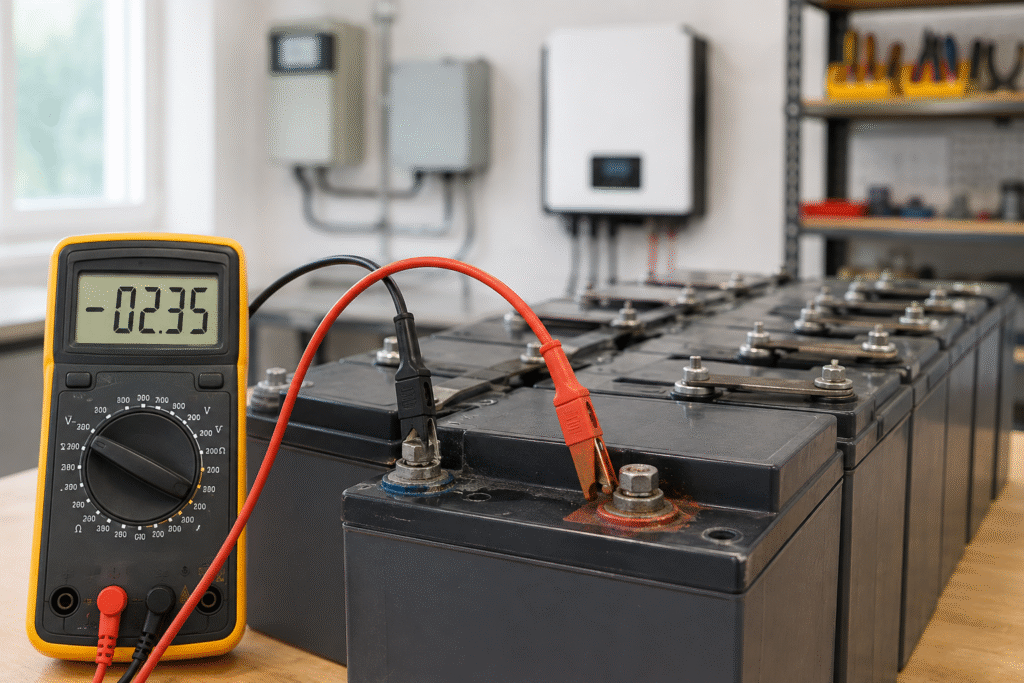
A technician measuring a series-connected lead-acid battery bank may occasionally find something that appears impossible:
One battery that normally measures around 12V now reads:
- 1V
- 0V
- or even a negative voltage
when the complete battery bank is heavily discharged.
After the load is disconnected, the same battery may partially recover and once again show positive voltage.
What happened?
In many cases, the battery has not magically changed its permanent terminal polarity.
Instead, a severely weak battery—or an individual weak cell inside it—has reached the end of its available capacity before the other batteries in the series string. Because the same discharge current continues flowing through the entire series circuit, the stronger batteries can drive current through the exhausted unit in the opposite electrochemical direction.
This phenomenon is commonly described as cell reversal or voltage reversal.
Deep or complete discharge is harmful to lead-acid batteries, and manufacturers recommend avoiding prolonged operation at very low state of charge.
How Can a Battery Voltage Become Negative?
Consider four batteries connected in series.
All four carry exactly the same discharge current.
Initially:
- Battery 1: healthy
- Battery 2: healthy
- Battery 3: healthy
- Battery 4: weak
The weak battery has less usable capacity.
During discharge:
- All batteries supply the same current.
- Battery 4 reaches its discharged state first.
- Batteries 1–3 still contain energy.
- The load continues drawing current.
- Current is forced through Battery 4 even though it has little usable energy left.
- Battery 4 voltage falls toward zero.
- Continued current can drive its voltage below zero.
The stronger batteries are effectively forcing current through the exhausted battery.
This is why a weak unit in a series bank can suffer much more severe damage than the rest of the batteries.
Why Series-Connected Batteries Are Vulnerable
In a parallel circuit, branches can supply different currents.
In a series circuit, the same current passes through every battery.
The batteries do not have to contain the same usable capacity.
For example:
- Battery A actual capacity: 200Ah
- Battery B: 195Ah
- Battery C: 190Ah
- Battery D: 90Ah
The entire series string is effectively limited by Battery D.
Once Battery D reaches its discharge limit, continuing to operate the string risks pushing it into damaging over-discharge and possible voltage reversal.
This is one reason series-connected batteries should be matched for:
- Battery type
- Capacity
- Age
- Condition
- Charging history
Large series/parallel lead-acid banks become increasingly difficult to keep balanced when batteries have different resistances and conditions.
Reason 1: One Battery Has Much Lower Capacity Than the Others
This is the most common underlying cause.
A battery may lose capacity because of:
- Sulfation
- Battery aging
- Plate corrosion
- Active-material loss
- Chronic undercharging
- Excessive deep cycling
- High temperature
- Electrolyte problems
A degraded battery can still show acceptable voltage when rested.
Its weakness becomes obvious only when the series string is discharged.
Manufacturers note that a fully charged battery can still have significantly reduced available capacity, demonstrating why open-circuit voltage alone cannot confirm battery health.
Reason 2: One Battery Began the Discharge at a Lower State of Charge
The batteries may have similar capacity but different SOC.
This can happen because:
- One battery was stored longer.
- One battery has greater self-discharge.
- Batteries were individually charged differently.
- A 12V auxiliary load was connected to one battery in a 48V string.
- One battery was previously replaced.
- Charging imbalance developed over time.
The lower-SOC battery reaches the discharge limit first.
Continued string operation then puts that battery at risk of reversal.
Reason 3: One Battery Has Excessive Self-Discharge
A battery with an internal leakage path may lose charge faster than the rest of the string.
At the beginning of an outage:
- Three batteries may be nearly full.
- One battery may already be partially discharged.
The weak battery therefore reaches zero usable capacity much earlier.
Regular individual voltage measurements can identify batteries that repeatedly arrive at a lower state of charge before an actual outage occurs.
Reason 4: One Cell Inside a 12V Battery Has Failed
A 12V lead-acid battery contains multiple series-connected cells.
If one cell becomes:
- Severely sulfated
- Internally shorted
- Low capacity
- Damaged
the complete 12V battery may behave abnormally.
Plate-material shedding can eventually create an internal short if accumulated conductive material bridges positive and negative plates, causing loss of cell voltage.
A failed cell can reduce the overall battery voltage and cause the complete string to reach inverter cutoff earlier.
Reason 5: The Inverter Low-Voltage Cutoff Is Set Too Low
The inverter should stop discharging before individual batteries are pushed into damaging over-discharge.
But many inverters monitor only:
total battery-bank voltage
not the voltage of each individual battery.
Suppose a 48V string contains one weak battery.
The other three batteries may remain at relatively high voltage and mask the weak unit.
The total bank voltage can therefore stay above the inverter’s cutoff even while one battery is approaching zero volts.
If the shutdown voltage is set excessively low, the weak battery can be driven further into reversal.
Very deep discharge is known to damage lead-acid batteries, so cutoff settings should follow the selected battery and inverter manufacturer’s requirements rather than being lowered simply to extract more runtime.
Reason 6: The Bank Is Being Discharged for Too Long
A battery bank designed for four hours of backup may be forced to run for six or eight hours during an extended outage.
The weakest battery reaches exhaustion first.
Continuing the discharge increases the risk of:
- Very low individual voltage
- Cell reversal
- Sulfation
- Capacity loss
- Permanent damage
This is particularly important in:
- Telecom sites
- Remote solar systems
- Long grid outages
- Generator failure scenarios
- UPS systems with unexpectedly long outages
Battery sizing should include realistic autonomy requirements and adequate reserve margin.
Reason 7: One Battery Was Replaced Without Testing the Others
Suppose one failed 12V battery in an old 48V string is replaced with a new battery.
The new battery may have:
- Higher capacity
- Lower resistance
- Better voltage stability
The remaining old batteries may have substantially lower actual capacity.
The mismatch can become more severe during charging and discharging.
Conversely, if one used or partially charged replacement battery is installed into an otherwise healthy bank, it may become the first battery to reach the discharge limit.
Matched batteries are strongly preferred in series battery banks.
Reason 8: A Partial-Bank Load Has Created Imbalance
A common installation error is obtaining 12V power from one battery in a 24V or 48V battery bank.
For example:
A 48V bank consists of four 12V batteries.
A router or fan is connected directly to Battery 1.
During normal operation:
- Main inverter current passes through all four batteries.
- Auxiliary current is removed only from Battery 1.
Battery 1 therefore becomes more deeply discharged than the others.
Eventually it may reach the discharge limit first during an outage.
Use a suitable DC-DC converter connected across the complete battery bank for lower-voltage loads.
Reason 9: Charging Imbalance Has Gradually Developed
A battery that is repeatedly undercharged will begin each discharge at a disadvantage.
Possible causes include:
- Different internal resistance
- One high-voltage battery forcing early charger regulation
- Incorrect float charging
- Auxiliary loads
- Temperature differences
Over many cycles, one battery becomes progressively weaker.
The eventual negative-voltage event may therefore be the final symptom of a problem that developed over months.
What Happens Inside a Reversed Cell?
When an exhausted cell is forced to continue carrying discharge current, its normal electrochemical process can no longer support the current in the intended direction.
The cell voltage can cross zero.
Continued reversal may cause:
- Additional plate damage
- Increased sulfation
- Heating
- Gas generation
- Permanent capacity loss
- Internal structural damage
A deeply discharged battery should therefore not simply be returned to service because its voltage “recovered” after the load was removed.
Why Does the Voltage Become Positive Again After the Load Stops?
When discharge current stops:
- Internal voltage drop disappears.
- Electrochemical polarization decreases.
- The battery terminal voltage partially recovers.
This is similar to the voltage recovery seen in an ordinary weak battery after a heavy load is removed.
The recovery does not prove that the battery has recovered its usable capacity.
A severely damaged battery may return to:
- 8V
- 10V
- 11V
- or even a superficially normal-looking voltage
and still fail immediately under load.
How to Confirm Battery Reversal
Step 1: Verify Meter Polarity
Before diagnosing the battery, make sure the measurement itself is correct.
Confirm:
- Red probe on positive terminal
- Black probe on negative terminal
- Meter operating correctly
Step 2: Measure All Batteries at the Same Time
Record:
- Battery 1
- Battery 2
- Battery 3
- Battery 4
- Total bank voltage
Step 3: Measure Under Load
The weak battery may only become obvious during discharge.
Step 4: Stop the Discharge if One Battery Approaches Abnormal Voltage
Do not deliberately continue operating the system merely to see how far negative the voltage will go.
Step 5: Measure After Rest
Observe voltage recovery.
Step 6: Fully Recharge Using the Approved Procedure
Monitor:
- Individual battery voltage
- Charging current
- Temperature
Step 7: Perform a Capacity Test
A capacity test determines whether the battery still provides useful energy.
Typical Diagnostic Example
A 48V system has four 12V 200Ah batteries.
Near the end of discharge:
- Battery 1: 11.7V
- Battery 2: 11.6V
- Battery 3: 11.8V
- Battery 4: -0.8V
Total:
34.3V
Battery 4 has clearly reached exhaustion much earlier.
After load removal:
- Battery 4 recovers to 8.9V
After charging:
- Battery 4 reaches high voltage quickly
- Runtime remains poor
This pattern strongly suggests severe battery/cell deterioration rather than a simple SOC difference.
Can the Battery Be Recovered?
Possibly—but not always.
The answer depends on:
- How deeply it was discharged
- How long reversal continued
- Battery age
- Battery construction
- Temperature
- Physical condition
- Degree of sulfation
- Internal cell damage
A single accidental over-discharge discovered quickly may sometimes allow partial recovery after correct charging.
Repeated or prolonged reversal is much more likely to cause permanent damage.
Manufacturers emphasize that very deep discharge and prolonged low state of charge are harmful to lead-acid batteries.
Should You Apply a High-Voltage Recovery Charge?
Do not automatically apply an aggressive high-voltage charge.
Some chargers provide a recondition mode for certain lead-acid batteries, but charger manufacturers warn that unnecessary use can increase gassing and reduce battery life.
Before attempting recovery:
- Identify battery type.
- Check for swelling or leakage.
- Check battery temperature.
- Obtain manufacturer charging instructions.
- Use an appropriate charger.
Do not apply flooded-battery equalization procedures to sealed GEL or AGM batteries unless specifically approved.
When Should the Battery Be Replaced?
Replacement is usually the safer choice when:
- The battery repeatedly reaches zero or negative voltage.
- Capacity is substantially below requirement.
- One cell remains abnormal after correct charging.
- Battery temperature rises excessively.
- The case is swollen.
- Leakage is present.
- Internal resistance is much higher than the rest of the string.
- The battery self-discharges rapidly.
The age and condition of the other batteries should also be considered.
In an old battery bank, replacing only the reversed battery may create a new mismatch.
How to Prevent Cell Reversal
1. Avoid Excessive Depth of Discharge
Do not regularly run the battery bank until the inverter can extract no more power.
2. Set Correct Low-Voltage Cutoff
Follow battery and inverter recommendations.
3. Monitor Individual Battery Voltage
Total bank voltage can hide a weak battery.
4. Test Battery Capacity Periodically
Capacity testing can identify a deteriorating battery before an actual outage.
5. Do Not Mix Different Batteries
Keep series strings matched by:
- Model
- Capacity
- Age
- Condition
6. Avoid 12V Taps from Higher-Voltage Strings
Use a DC-DC converter.
7. Keep Batteries Fully Charged
Avoid prolonged partial state of charge.
8. Investigate Repeated Voltage Imbalance
Do not wait until one battery reaches zero.
A Better Monitoring Strategy for Critical Projects
For telecom, UPS, substation, and industrial backup systems, consider monitoring:
- Total string voltage
- Individual battery voltage
- Discharge current
- Battery temperature
- Internal resistance
- Capacity-test history
A weak battery is much easier to replace during scheduled maintenance than during a long grid outage.
Frequently Asked Questions
Can a lead-acid battery really reverse polarity?
A severely exhausted cell or battery in a series string can be driven to a negative terminal voltage while discharge current continues through it.
Does negative voltage mean I connected the meter backwards?
That should always be checked first. If polarity is confirmed and the negative voltage appears only during deep discharge, a weak or reversed cell may be involved.
Why does the battery become positive again after disconnecting the load?
Removing the load eliminates current-related voltage drop and allows partial voltage recovery. It does not mean the battery is healthy.
Can I recharge a battery that went negative?
It may sometimes accept charge, but it should be carefully inspected, correctly recharged, and capacity-tested before reuse.
Why did only one battery reverse?
That battery likely reached its usable capacity limit before the others because of lower capacity, lower SOC, higher self-discharge, or internal damage.
Will the inverter protect against this?
Not necessarily. Many inverters monitor only total bank voltage and cannot see the voltage of every individual battery.
Can a battery balancer prevent reversal?
A balancer may help with certain voltage imbalances, but it cannot restore a battery with severe capacity loss or internal damage.
Conclusion
A lead-acid battery showing zero or negative voltage during discharge is an important warning that the series bank contains a seriously weak or exhausted unit.
The most common causes include:
- Reduced battery capacity
- Unequal state of charge
- Severe self-discharge
- Failed internal cell
- Excessive depth of discharge
- Incorrect inverter cutoff
- Mixed old and new batteries
- Partial-bank auxiliary loads
- Long-term charging imbalance
The key lesson is that total battery-bank voltage is not enough.
In a series-connected energy storage system, individual battery monitoring can reveal a weak unit long before it is driven into damaging reversal.
For a technical assessment, provide the battery model, age, number of batteries in series, measured individual voltages under load, total bank voltage, inverter cutoff setting, discharge current, runtime, charging voltages, and whether the abnormal battery recovers after load removal.