
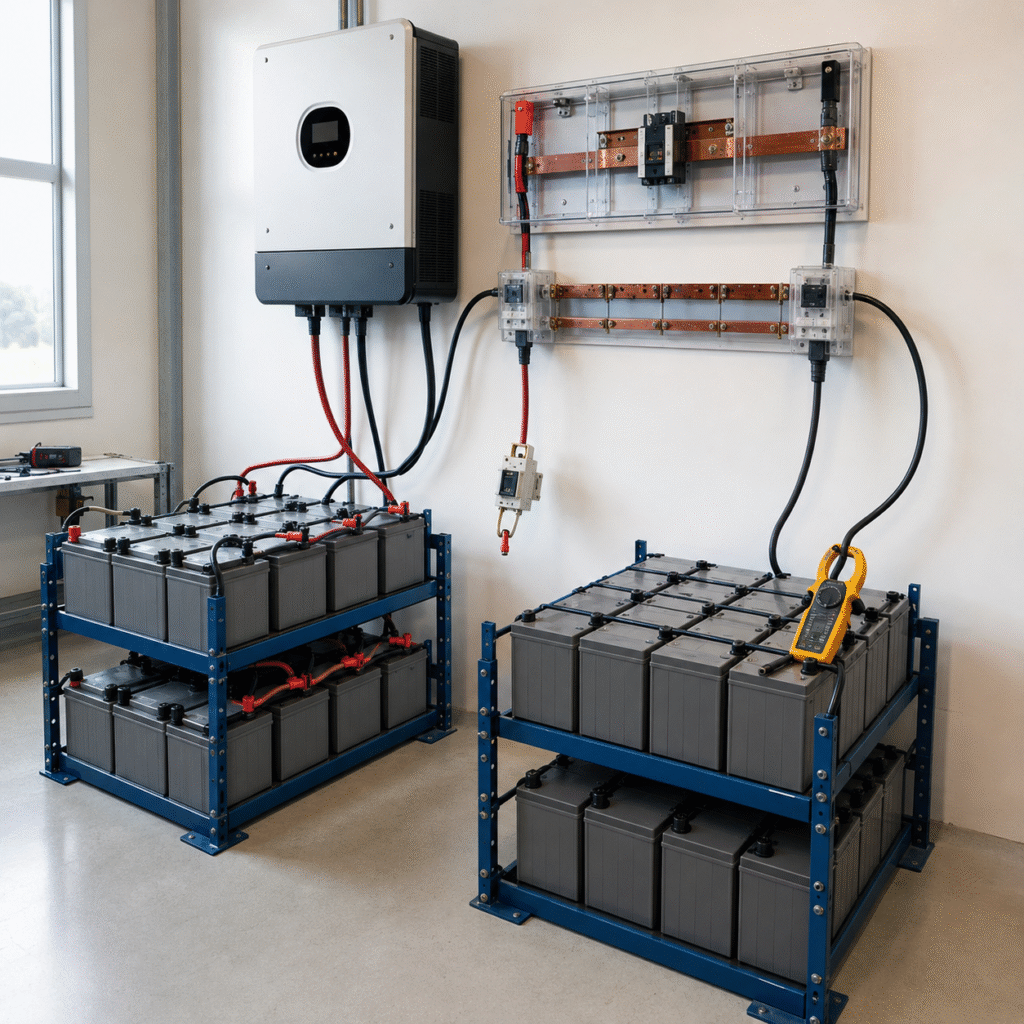
Introduction
Large lead-acid energy storage systems often use multiple battery strings connected in parallel.
For example, three identical 48V 200Ah strings may be connected in parallel to create a nominal:
48V 600Ah battery bank
Under normal conditions, all three strings should participate in charging and discharging.
But during maintenance, technicians may discover something unusual:
- String 1: 38A
- String 2: 41A
- String 3: 0A
The overall battery bank may still appear to work because the other two strings continue supplying the inverter.
This can make a zero-current string difficult to detect.
A completely inactive parallel string is different from ordinary current imbalance. Normal resistance differences may cause unequal current distribution, but a string carrying almost no current at all often indicates an open circuit, failed protection device, broken connection, or severe battery/string problem. Large series/parallel banks are inherently harder to balance and troubleshoot because wiring and battery resistance differences affect current distribution.
Why a Zero-Current String Is Important
Suppose a system was designed for three parallel 200Ah strings.
Expected capacity:
3 × 200Ah = 600Ah
If one string becomes electrically disconnected, the system effectively operates with:
2 × 200Ah = 400Ah
The inverter may continue operating, so the fault can remain hidden.
But the remaining strings now carry more current.
This can lead to:
- Shorter backup time
- Greater voltage sag
- Higher discharge rate
- More heating
- Deeper cycling
- Faster aging
- Earlier inverter shutdown
The missing string therefore affects both capacity and loading of the healthy strings.
Normal Current Imbalance vs. Zero Current
These two conditions should not be confused.
Current Imbalance
Example:
- String A: 38A
- String B: 32A
- String C: 30A
All strings are participating, but current sharing is imperfect.
Near-Zero String Current
Example:
- String A: 49A
- String B: 51A
- String C: 0.2A
String C is contributing almost nothing.
This points toward a more significant problem.
Reason 1: The String Fuse Has Blown
This is one of the first things to check.
Large parallel battery systems should normally provide appropriately designed protection for individual strings.
If one string fuse opens:
- Battery voltage may still appear at parts of the circuit.
- Other strings continue operating.
- Total bank voltage remains normal.
- The failed string carries no current.
Possible causes of fuse operation include:
- Short circuit
- Excessive string current
- Incorrect fuse rating
- Loose fuse-holder connection
- Fuse aging or damage
- Fault during maintenance
- Incorrect polarity connection
Solar-system troubleshooting guidance recommends checking battery fuses, circuit breakers, cable continuity, and connections whenever normal power flow is lost.
Important
Do not replace a blown fuse without investigating why it opened.
Installing a larger fuse simply to prevent repeat operation can leave cables and equipment inadequately protected.
Reason 2: The String Circuit Breaker Is Open or Has Failed
A battery string may use a DC breaker instead of—or in addition to—a fuse.
The breaker may be:
- Manually open
- Tripped
- Mechanically damaged
- Internally failed
- Incorrectly wired
- Poorly connected
The handle position does not always prove the internal contact condition.
Measure voltage on both sides of the breaker.
Also check:
- Breaker temperature
- Terminal torque
- DC voltage rating
- Current rating
- Polarity requirements
Reason 3: A Cable or Connector Is Open
A battery string requires a complete circuit from the positive busbar through the batteries and back to the negative busbar.
One broken connection is enough to stop current completely.
Possible locations include:
- Main positive cable
- Main negative cable
- Inter-battery connector
- Cable lug
- Busbar connection
- Disconnect switch
- Fuse holder
Common causes include:
- Broken conductor
- Poor crimp
- Loose terminal
- Mechanical stress
- Corrosion
- Heat damage
- Accidental disconnection
Correctly tightened connections are important because both loose and improperly tightened battery connections can create heating and damage.
Reason 4: A Cable Lug Looks Connected but Is Electrically Open
This fault can be deceptive.
A cable may appear firmly attached, yet the conductor inside the lug may be:
- Broken
- Corroded
- Poorly crimped
- Partially pulled out
Visual inspection alone may therefore miss the problem.
Perform:
- Continuity testing with the system safely isolated
- Voltage-drop measurement under current
- Physical inspection
- Thermal inspection
A good-looking connector is not automatically a good electrical connection.
Reason 5: A Battery Terminal Has Failed
Lead-acid battery terminals carry significant current.
A terminal can develop:
- Internal fracture
- Post damage
- Severe corrosion
- Melted connection
- Mechanical failure
If the electrical path through the terminal is interrupted, the entire series string can become inactive.
Check the voltage directly on:
- Battery terminal posts
- Cable lugs
- Interconnect bars
A difference between the terminal-post voltage and connector voltage can reveal a connection problem.
Reason 6: One Battery Has an Internal Open Circuit
Less commonly, a battery itself can develop an internal open connection.
Possible mechanisms include:
- Broken internal strap
- Terminal-to-plate connection failure
- Severe corrosion
- Mechanical damage
A string containing an internal open circuit cannot carry normal current even if all external cables appear intact.
When safely testing the string, measure individual battery voltages and continuity according to the manufacturer’s procedure.
Do not short terminals or improvise high-current tests.
Reason 7: The String Is at a Different Voltage from the Main Bus
Suppose one parallel string has been disconnected for maintenance or has remained offline for an extended period.
Its resting voltage may now differ significantly from the active battery bank.
If it is reconnected without proper preparation, a large equalization current can flow between battery strings.
Therefore, technicians may intentionally leave the string isolated until:
- It is fully charged.
- Its voltage is checked.
- Battery condition is verified.
- The reconnection procedure is approved.
Trojan advises against mixing batteries with materially different conditions and recommends fully charging batteries after use and before long-term storage.
A string that remains isolated by design will obviously show zero operating current.
Confirm whether maintenance personnel intentionally disconnected it before assuming failure.
Reason 8: A Battery Disconnect Switch Is Open
Large installations may contain more switches than expected.
Examples include:
- String disconnect
- Main battery disconnect
- Maintenance isolator
- Emergency disconnect
- Service switch
Check the complete single-line diagram.
A technician may verify the main battery breaker but miss a separate isolator installed in the string cabinet.
Reason 9: Current Is Bypassing the Measurement Point
Sometimes the string is actually carrying current, but the measuring method is wrong.
Possible issues include:
- Clamp meter positioned around both positive and negative cables
- Shunt installed in the wrong location
- Current sensor wired backwards
- One parallel cable bypasses the sensor
- Sensor calibration problem
- Monitoring channel assigned incorrectly
When a clamp meter surrounds both positive and negative conductors, the magnetic fields can cancel and the instrument may display nearly zero.
Verify the reading with a second measurement method before opening the battery string.
Reason 10: A String Monitor or Shunt Has Failed
Automated battery-monitoring systems may report individual string current.
A sensor failure can produce:
0A
even though current is actually flowing.
Check:
- Sensor power supply
- Communication
- Calibration
- Wiring
- Shunt voltage
- Comparison with a DC clamp meter
Do not disconnect a functioning battery string solely because a monitoring display shows zero current.
Reason 11: One String Has Much Higher Resistance Than the Others
A completely open circuit gives true zero current.
However, extremely high resistance can make current so low that it effectively looks like zero compared with the other strings.
Possible causes include:
- Severe corrosion
- Loose connection
- Damaged fuse holder
- Undersized cable
- Aged batteries
- Sulfation
- High-resistance internal fault
Large parallel battery banks are sensitive to differences in wiring resistance and battery internal resistance, which is one reason limiting the number of parallel lead-acid strings can simplify reliable design.
Reason 12: String Cables Are Not Connected Symmetrically
Poor parallel-bank wiring generally causes imbalance rather than complete zero current.
However, severe wiring asymmetry can make one string contribute far less than the others.
Examples include:
- One string connected through significantly longer cables
- Smaller cable size on one branch
- Different busbar connection locations
- Multiple connector joints in one branch
For reliable parallel operation:
- Use identical battery models.
- Use equal or carefully engineered cable resistance.
- Use appropriately sized busbars.
- Protect each string individually.
- Measure string current.
Reason 13: One String Contains Significantly Older Batteries
If one string has much higher internal resistance, the newer strings may carry a disproportionate share of current.
This is another reason old and new batteries should not normally be mixed indiscriminately in the same battery bank.
Aged lead-acid batteries commonly develop increased resistance and reduced available capacity.
If the current difference developed gradually rather than suddenly, compare:
- String age
- Capacity
- Internal resistance
- Individual battery voltage
- Temperature
Reason 14: One String Is Colder Than the Others
Low temperature can reduce battery performance and increase effective resistance.
A string positioned:
- Near an outdoor wall
- Near an air-conditioning outlet
- On a cold floor
- In a separate cabinet
may behave differently.
Temperature usually produces reduced current rather than a true zero-current condition, but it can worsen an existing imbalance.
Reason 15: String Protection Operates Only During High Loads
A system may appear normal at light load.
But when a large inverter starts:
- One string fuse opens.
- The other strings continue supplying the load.
- The system remains online.
- Backup capacity unexpectedly drops.
This can create a repeating maintenance pattern where one string seems to “disappear” only after high-load events.
Check:
- Fuse rating
- Peak string current
- Inverter startup current
- Parallel-current sharing
- Protection coordination
Why the Battery Bank May Still Show Normal Voltage
This is one of the most confusing aspects of the fault.
Parallel strings share the same nominal bus voltage.
If three strings are connected in parallel and one becomes disconnected, the other two still maintain the DC bus.
Therefore:
Normal total battery voltage does not prove every parallel string is connected.
This is why current measurement is essential in multi-string systems.
How to Find the Fault Safely
Battery systems can deliver extremely high short-circuit current. Lead-acid battery safety documentation warns of electrical-shock, short-circuit, acid, and flammable-gas hazards, so string testing should be performed by trained personnel using appropriate procedures.
Step 1: Confirm the Current Reading
Use:
- Installed string monitor
- DC clamp meter
- Shunt measurement
Verify that the string really carries no current.
Step 2: Compare String Voltages
Measure each complete string at the same time.
Record:
- String A voltage
- String B voltage
- String C voltage
Step 3: Check String Protection
Inspect:
- Fuses
- Breakers
- Disconnect switches
Step 4: Measure Across Protection Devices
A voltage appearing across a supposedly closed fuse or breaker under operating conditions can indicate an open or high-resistance device.
Step 5: Inspect Main Cables
Check both:
- Positive cable
- Negative cable
Step 6: Inspect Inter-Battery Connections
One open link can disable the entire series string.
Step 7: Measure Individual Battery Voltages
Look for abnormal units.
Step 8: Compare Internal Resistance
Use appropriate battery-test equipment and compare readings against:
- Baseline data
- Other batteries
- Manufacturer guidance
Step 9: Test Under Charge and Discharge
A string should participate in both directions.
Measure during:
- Stable charging current
- Stable inverter load
A Useful Diagnostic Example
Suppose three 48V strings are connected in parallel.
During Discharge
- String 1: 42A
- String 2: 39A
- String 3: 0A
Measured String Voltage
- String 1: 49.1V
- String 2: 49.0V
- String 3 battery-side voltage: 50.3V
- String 3 bus-side voltage: 49.0V
If the voltage difference appears across the String 3 fuse or breaker, the protection device or connection is a strong suspect.
This illustrates why measuring only voltage at the common busbar would miss the fault completely.
What Happens If the System Continues Running with One String Offline?
The remaining battery strings carry more current.
This can increase:
- Discharge rate
- Voltage sag
- Heat generation
- Depth of discharge
- Cycle stress
It can also reduce expected backup time.
If a system designed for 600Ah is effectively operating at 400Ah, the remaining batteries may be repeatedly discharged deeper than the original design intended.
Over time, this can accelerate deterioration of the remaining strings.
Should the Faulty String Be Reconnected Immediately?
Not necessarily.
Before reconnecting a string, confirm:
- Correct polarity
- Correct voltage
- State of charge
- Battery condition
- Protection status
- No short circuit
- No major voltage difference from the live bus
Connecting parallel batteries at significantly different voltages can produce a high equalization current.
Follow the project switching procedure and battery manufacturer’s instructions.
Should One Failed Battery Be Replaced?
That depends on:
- Battery-bank age
- Cause of failure
- Battery model
- Remaining battery capacity
- Production dates
- Manufacturer guidance
If the complete string is already aged, replacing a single battery with a new one can create further mismatch.
For older banks, complete-string replacement may be more reliable.
Preventing Future Zero-Current String Problems
1. Install Individual String Protection
Each string should have correctly engineered protection.
2. Install Current Monitoring
Current monitoring makes it easier to detect an inactive string before a real power outage.
3. Label Every String
Use clear numbering:
- String 1
- String 2
- String 3
4. Record Baseline Current Sharing
During commissioning, record current under known charge and discharge conditions.
5. Inspect Connections Periodically
Look for:
- Heat
- Corrosion
- Loose hardware
- Damaged cables
6. Keep Batteries Matched
Avoid mixing:
- Different capacities
- Different models
- Significantly different ages
7. Perform Periodic Capacity Testing
Voltage alone will not identify every weak string.
Frequently Asked Questions
Can one parallel battery string fail while the system still works?
Yes. Other parallel strings can maintain system voltage, making the fault difficult to notice.
Why does the battery-bank voltage still look normal?
The healthy parallel strings maintain the common bus voltage.
Is zero current always caused by a blown fuse?
No. Open breakers, broken cables, internal battery faults, switches, measurement errors, and high-resistance connections can also cause it.
Can I replace the fuse and restart?
First determine why the fuse operated and confirm that the string voltage, polarity, and battery condition are safe for reconnection.
Why does one string show current during charging but almost none during discharge?
This requires further investigation of measurement arrangement, connection resistance, string condition, and protection devices. Current should normally be evaluated under controlled conditions in both directions.
How often should parallel-string current be checked?
The appropriate interval depends on system criticality and manufacturer maintenance requirements, but critical UPS, telecom, and industrial systems benefit from trending rather than waiting for a failure alarm.
Conclusion
One parallel lead-acid battery string carrying zero current is a serious hidden fault because the overall battery bank may continue operating and therefore appear normal.
The most common causes include:
- Blown string fuse
- Open or failed circuit breaker
- Broken cable
- Failed cable lug
- Open battery terminal
- Internal battery open circuit
- Disconnect switch left open
- Measurement or sensor error
- Extremely high connection resistance
For large solar, UPS, telecom, substation, and industrial energy-storage systems, monitoring individual string current is one of the best ways to identify this problem early.
For a project-specific diagnosis, provide the battery model, number of batteries per string, number of parallel strings, string fuse/breaker ratings, individual string voltages, charging currents, discharge currents, cable sizes, battery age, and wiring diagram.