
Introduction
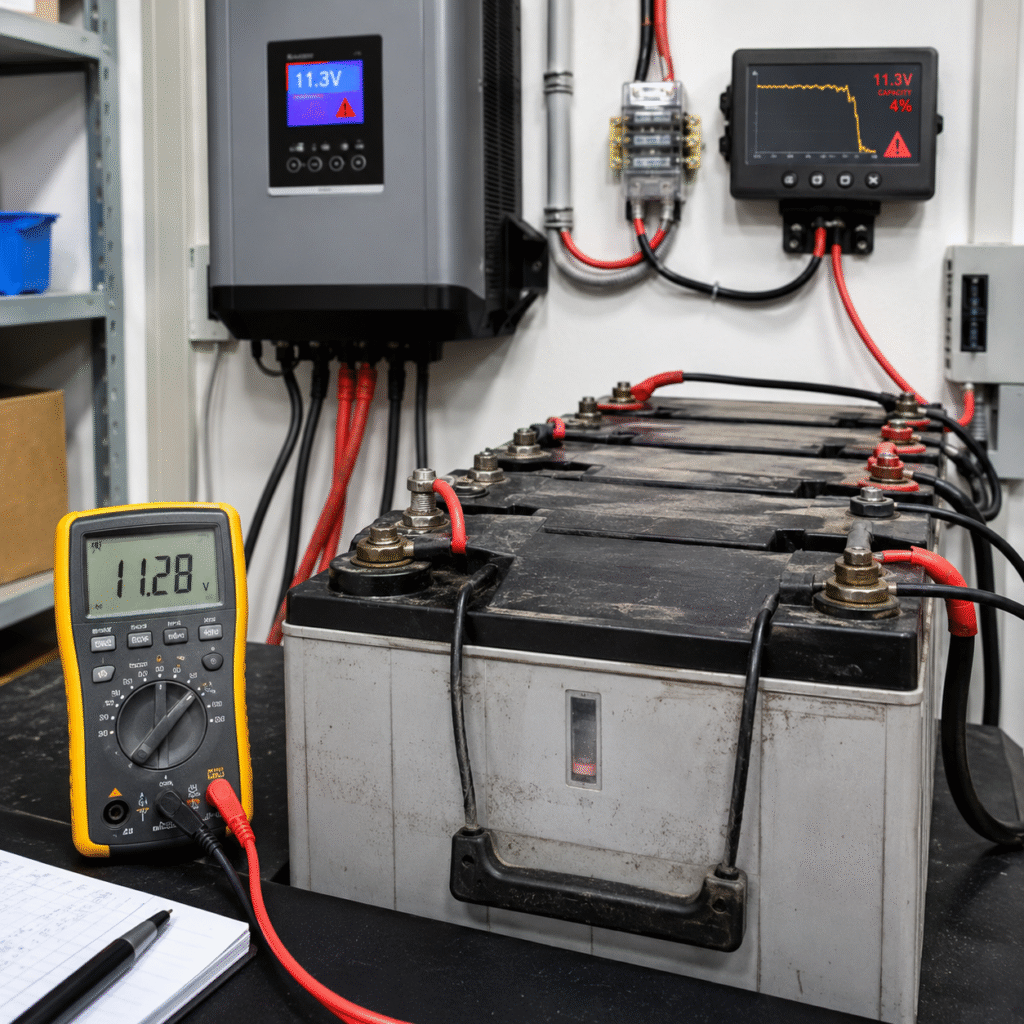
A lead-acid battery bank may operate normally for several hours and then appear to “collapse” very quickly.
For example:
- 48.8V
- 48.4V
- 48.0V
- 47.5V
may occur gradually over several hours.
Then, during the final part of discharge:
- 46.5V
- 45.0V
- 43.5V
may occur within a much shorter period.
Customers often ask:
“Why was the battery voltage stable for so long and then suddenly dropped?”
In many cases, this is partly a normal characteristic of the lead-acid discharge curve.
Lead-acid voltage generally declines gradually through much of the discharge and then falls more rapidly as the battery approaches its end-of-discharge region. Technical battery guidance describes a gradual voltage decline during much of discharge followed by a rapid nonlinear drop near the end.
However, an excessively early or unusually steep voltage drop can also indicate:
- Reduced battery capacity
- One weak cell
- Excessive discharge current
- High internal resistance
- Low temperature
- Cable voltage drop
- Incorrect inverter cutoff
- Battery aging
The key is determining whether the sudden drop occurs at the expected end of usable capacity or far earlier than it should.
Understanding the Lead-Acid Discharge Curve
A lead-acid battery does not discharge with a perfectly linear voltage curve.
A simplified discharge curve has three general regions:
1. Initial Voltage Drop
When the load is first connected, voltage falls from the resting value to the loaded operating voltage.
2. Relatively Stable Discharge Region
For much of the discharge, voltage declines gradually.
3. End-of-Discharge Knee
As available active material becomes depleted and internal resistance effects become more significant, voltage begins falling much faster.
The final portion of the curve is often called the knee.
Once the battery reaches this region, only a relatively small amount of useful runtime may remain.
This is why inverter low-voltage shutdown should be set according to the battery manufacturer’s discharge data rather than assuming that the battery can continue operating simply because voltage has not reached zero.
Reason 1: The Battery Is Reaching Its Normal End of Discharge
A sudden voltage decline near the end of the expected runtime may be completely normal.
Suppose a battery is specified to support a particular constant current for five hours to a defined final voltage.
If it:
- Remains stable for approximately the expected time
- Reaches the manufacturer’s specified end voltage
- Delivers expected Ah or Wh capacity
then the final rapid voltage drop is part of normal discharge behavior.
Battery capacity testing is normally terminated at the published final voltage rather than continuing until the battery is completely exhausted.
The battery should not be deliberately discharged far below this point simply to obtain additional runtime.
Reason 2: Discharge Current Is Too High
Lead-acid capacity depends strongly on discharge rate.
A battery may be rated:
200Ah at the 20-hour rate
but it will not necessarily deliver the same 200Ah when discharged over only one or two hours.
At higher currents:
- Internal voltage drop increases.
- Electrolyte diffusion becomes limiting.
- Effective capacity decreases.
- The end-of-discharge knee is reached earlier.
Technical guidance on stationary lead-acid batteries notes that increased discharge rate reduces available Ah capacity because electrolyte diffusion and plate reaction become more limiting and internal voltage loss increases.
Example
A battery that performs well with:
- Lighting
- Small electronics
- Telecom loads
may show a much earlier voltage collapse when connected to:
- Air conditioners
- Pumps
- Compressors
- Heating loads
- Large inverters
Battery sizing must therefore consider both:
- kWh requirement
- discharge current / power requirement
Reason 3: One Battery in the Series String Is Weak
This is one of the most important faults to check.
Consider a 48V bank built from four 12V batteries.
The total voltage may look relatively normal while one battery is much weaker than the others.
During discharge:
- Battery 1: 11.9V
- Battery 2: 11.8V
- Battery 3: 11.9V
- Battery 4: 10.2V
Total:
45.8V
The inverter sees only the total voltage.
Battery 4 may already be close to its usable limit.
If discharge continues, the weak battery can collapse rapidly and eventually approach cell reversal.
Battery performance-test guidance notes that individual cells can fall below their proper end-of-discharge voltage before the overall battery string reaches the specified final voltage.
This is why critical systems should monitor individual battery or cell voltage.
Reason 4: Battery Capacity Has Declined with Age
A battery bank may originally have delivered eight hours but now reaches its voltage knee after four or five hours.
Possible aging mechanisms include:
- Sulfation
- Positive-grid corrosion
- Active-material shedding
- Electrolyte loss
- Separator degradation
- Increased internal resistance
The shape of the discharge curve may still look normal.
The major change is that the end-of-discharge knee arrives much earlier.
This can mislead users because:
- Resting voltage looks normal.
- Charging voltage looks normal.
- The battery still reaches float.
- The inverter works normally at first.
Only runtime reveals the reduced capacity.
A controlled capacity test is the correct way to verify this condition.
Reason 5: The Battery Was Not Fully Charged
A partially charged battery starts the discharge with less stored energy.
It may still show a seemingly acceptable voltage because of:
- Recent charging
- Surface charge
- Low load at the beginning
But the voltage knee appears much earlier.
Incomplete charging may be caused by:
- Solar array too small
- Short absorption time
- Wrong charger settings
- Insufficient charging current
- Daytime loads
- Cloudy weather
- Generator stopped too early
- Cable voltage drop
Before concluding that the battery has failed, confirm that it completed the correct charging cycle.
Reason 6: High Internal Resistance
Increased battery internal resistance causes more voltage loss as current increases.
The relationship can be simplified as:
Loaded voltage = internal battery voltage – current × internal resistance
Therefore, when:
- Current increases
- Internal resistance increases
terminal voltage decreases more sharply.
High internal resistance may develop because of:
- Sulfation
- Aging
- Corrosion
- Electrolyte deterioration
- Internal connection problems
The battery may:
- Show normal resting voltage
- Drop sharply when a heavy load starts
- Recover voltage when the load stops
This pattern indicates reduced power capability even if some energy capacity remains.
Reason 7: Inverter Loads Increase Near the End of the Discharge
Sometimes the battery does not change—the load changes.
For example:
- Air conditioner starts
- Water pump activates
- Refrigerator compressor starts
- Heater turns on
- Several appliances are used simultaneously
The higher DC current causes:
- Greater internal battery voltage drop
- Greater cable voltage drop
- Faster approach to inverter shutdown
Check the load power at the exact time when the rapid voltage decline begins.
Reason 8: Low Temperature
Lead-acid batteries deliver less usable capacity at low temperature.
In cold environments:
- Chemical reactions slow.
- Effective internal resistance increases.
- Available capacity falls.
- Voltage under load can be lower.
A battery system that provides normal runtime in summer may reach its voltage knee much earlier in winter.
This is particularly important for:
- Outdoor telecom cabinets
- Mountain sites
- Solar systems in cold climates
- Unheated warehouses
Battery sizing should use the manufacturer’s temperature correction factors for the lowest expected operating conditions.
Reason 9: Cable Voltage Drop Is Being Mistaken for Battery Voltage Drop
The inverter measures voltage at its own input terminals.
Suppose:
Battery terminals:
47.0V
Inverter terminals:
44.5V
The difference may come from:
- Undersized cables
- Long cables
- Loose battery terminals
- Poor cable-lug crimps
- High-resistance breakers
- Fuse-holder problems
As discharge current increases, voltage loss in these components increases.
The inverter may therefore shut down even though the battery itself has not yet reached its true discharge limit.
Measure voltage simultaneously at:
- Battery terminals
- Main DC busbar
- Inverter terminals
under the same load.
Reason 10: One Connection Becomes Hot During Discharge
A high-resistance connection may worsen as current and temperature increase.
Symptoms include:
- Voltage appears acceptable at first.
- Terminal gradually heats.
- Voltage drop increases.
- Inverter voltage falls faster.
- Shutdown occurs.
After the system stops, the connection cools and voltage appears normal again.
Use:
- Voltage-drop testing
- Thermal imaging
- Terminal inspection
to identify the problem.
Reason 11: Parallel Strings Are No Longer Sharing Current Equally
Suppose a battery bank contains three parallel strings.
If one string:
- Has a blown fuse
- Has higher resistance
- Contains older batteries
- Has a loose cable
the other two strings carry more current.
Higher current means the remaining strings reach their voltage knee sooner.
The system may appear to have experienced sudden battery aging when the real problem is that part of the battery bank is no longer participating properly.
Measure individual string current during discharge.
Reason 12: Battery Monitor SOC Is Giving False Confidence
A monitor may display:
40% SOC
while the battery is already close to inverter shutdown.
Reasons include:
- Capacity configured too high
- Battery has aged
- Monitor not synchronized
- Incorrect Peukert setting
- Loads bypassing the shunt
The voltage may therefore appear to “collapse unexpectedly” only because the SOC estimate was inaccurate.
Compare monitor data with actual discharge-test performance.
Is a Rapid Voltage Drop Always a Bad Sign?
No.
A rapid fall near the correct final voltage after the battery has delivered its expected capacity is a normal part of lead-acid behavior.
The important warning signs are:
- Voltage knee occurs much earlier than before.
- One battery collapses before the others.
- Runtime is substantially below specification.
- Voltage falls sharply under a modest load.
- Battery becomes abnormally hot.
- Voltage recovers dramatically after load removal.
These symptoms require further testing.
Example: Healthy vs. Weak Battery Bank
Healthy Bank
Rated backup time:
6 hours
Observed:
- 0–5 hours: gradual voltage decline
- 5–6 hours: faster decline
- Final voltage reached after approximately 6 hours
This can be normal.
Weak Bank
Rated backup time:
6 hours
Observed:
- First 2 hours: relatively normal voltage
- 2.5 hours: rapid voltage decline
- 3 hours: inverter shutdown
This indicates that available capacity or power capability is much lower than expected.
Practical Troubleshooting Procedure
Step 1: Fully Charge the Battery Bank
Confirm correct:
- Absorption voltage
- Absorption time
- Float voltage
Step 2: Record Individual Battery Voltages
Measure before the test.
Step 3: Apply a Known Load
Record:
- Load watts
- DC battery current
Step 4: Log Voltage Over Time
For example:
- Every 15 minutes
- Every 30 minutes
Record both total and individual battery voltages.
Step 5: Monitor the Final Part Closely
Increase measurement frequency as voltage approaches the expected cutoff.
Step 6: Identify the First Weak Battery
Look for the unit whose voltage falls significantly faster.
Step 7: Compare Battery and Inverter Voltage
Check for cable losses.
Step 8: Measure Temperature
Compare all batteries and connections.
Step 9: Calculate Delivered Capacity
For a constant-current test:
Capacity = Current × Time
Compare with the applicable discharge specification.
Step 10: Review Battery Age and History
Consider:
- Deep-discharge history
- High-temperature operation
- Long periods undercharged
- Storage
- Maintenance
Should You Lower the Inverter Cutoff to Get More Runtime?
Usually not as the first solution.
Lowering the cutoff may extract slightly more energy but can also cause:
- Excessive depth of discharge
- Weak-cell reversal
- Shorter battery life
- Permanent capacity damage
Use the battery manufacturer’s recommended end-of-discharge voltage at the relevant discharge rate.
Why Does Voltage Recover After the Load Is Removed?
When current stops:
- Internal voltage drop disappears.
- Cable voltage drop disappears.
- Battery polarization relaxes.
The terminal voltage rises.
This does not mean the lost capacity has returned.
A weak battery can recover to a normal-looking resting voltage and still collapse again immediately when the load is reapplied.
Frequently Asked Questions
Why does my battery stay at 12V for hours and then suddenly fall?
Lead-acid batteries have a relatively stable middle portion of their discharge curve followed by a steeper end-of-discharge region.
Does the sudden drop mean the battery is bad?
Not necessarily. It becomes suspicious when the drop occurs much earlier than the expected runtime.
Why does only one battery fall quickly?
That battery may have lower capacity, higher resistance, lower SOC, or an internal cell problem.
Can high load cause a sudden voltage drop?
Yes. Higher discharge current increases internal voltage drop and reduces effective lead-acid capacity.
Why does voltage recover after inverter shutdown?
The voltage loss caused by discharge current disappears once the load is removed.
Can I judge battery capacity from voltage alone?
No. A controlled capacity test gives much better information.
Should I discharge the battery until voltage reaches zero?
No. Battery testing should stop at the manufacturer’s specified final voltage.
Conclusion
A rapid voltage drop near the end of lead-acid battery discharge can be normal—but an early voltage collapse is an important diagnostic signal.
Possible causes include:
- Normal end-of-discharge behavior
- High discharge current
- Reduced battery capacity
- One weak battery or cell
- Incomplete charging
- High internal resistance
- Low temperature
- Cable voltage drop
- Parallel-string faults
For a project-specific diagnosis, provide the battery model, Ah rating and discharge rate, battery age, system voltage, inverter power, actual load, individual battery voltages, runtime, cutoff voltage, cable size, and operating temperature.