
Introduction
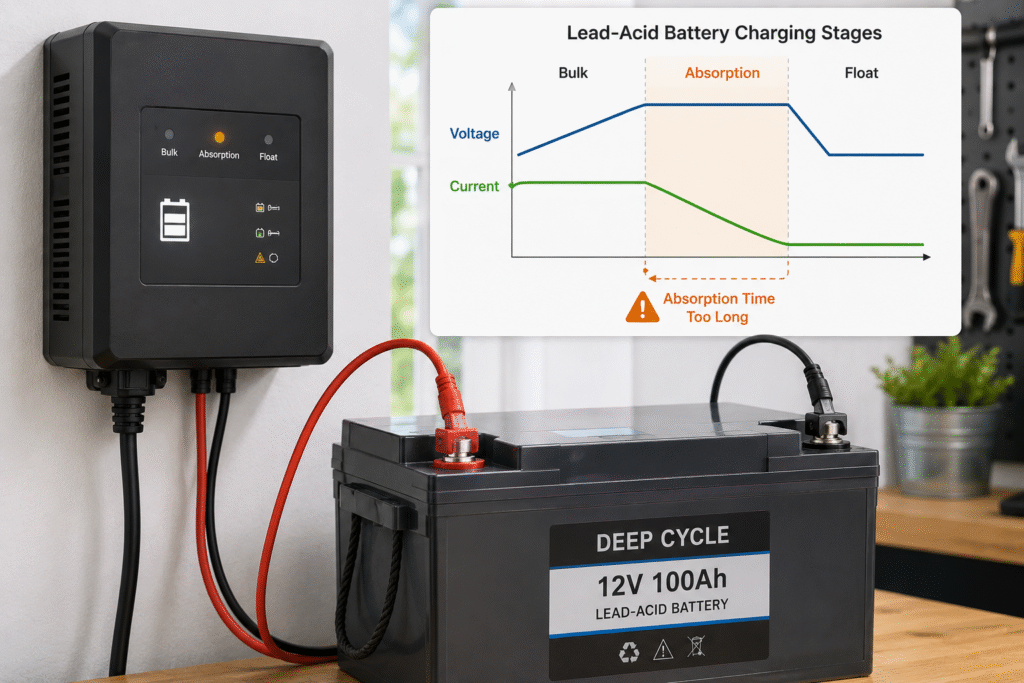
A lead-acid battery charger normally progresses through several charging stages:
Bulk → Absorption/Boost → Float
But some systems remain in absorption for many hours and seem unable to reach float.
Customers may notice:
- Charger remains at the absorption voltage all afternoon.
- Solar controller never displays float.
- Charging current remains higher than expected.
- Batteries become warmer.
- Generator runs much longer than planned.
- Water consumption increases in flooded batteries.
- The system repeats the same behavior every day.
This does not necessarily mean the charger is faulty.
Many chargers decide when to leave absorption by monitoring:
- Charging current
- Absorption time
- Battery voltage
- Previous depth of discharge
For example, some inverter/chargers remain in absorption until current falls below a configured threshold or a maximum absorption timer expires. DC loads can prevent current from falling below that threshold and therefore keep the charger in absorption longer.
Correct diagnosis requires determining why the charger believes the battery is not ready for float.
What Is the Purpose of Absorption Charging?
During bulk charging, the charger normally supplies a relatively high current.
Battery voltage gradually increases.
Once the absorption voltage is reached, the charger stops increasing voltage and holds it at a controlled level.
During this period:
- Battery SOC continues increasing.
- Charging current gradually decreases.
- Remaining lead sulfate is converted.
- The battery approaches full charge.
Lead-acid batteries require this slower final charging stage because they cannot generally accept maximum bulk current all the way to 100% SOC.
Some modern chargers use adaptive absorption times ranging from relatively short periods for lightly discharged batteries to several hours for deeply discharged batteries.
Therefore, spending several hours in absorption is not automatically abnormal.
The question is whether the duration matches the battery’s actual condition and manufacturer requirements.
Reason 1: DC Loads Are Preventing the Charging Current from Falling
This is one of the most overlooked causes.
Suppose the charger is supplying:
30A
but simultaneously:
- Inverter load: 20A DC equivalent
- DC accessories: 5A
Only:
5A
is actually charging the battery.
However, depending on where the charger measures current, it may interpret the total 30A as battery charging current.
If the charger requires current to fall below, for example, 10A before entering float, it may never see that condition.
Schneider/Xantrex charging documentation specifically notes that connected DC loads can prevent charging current from falling sufficiently to trigger the transition from absorption to float.
How to Check
Compare:
- Charger output current
- Battery-shunt current
- Load current
A shunt at the battery connection is particularly useful because it measures the net current actually entering the battery.
Reason 2: The Battery Was Deeply Discharged
A heavily discharged battery requires more time to recharge.
If the battery started the day at:
- 70% SOC
its absorption stage may be much shorter than if it started at:
- 30% SOC
Some adaptive chargers deliberately extend absorption duration after a deep discharge. Victron documentation, for example, describes adaptive absorption times that can extend up to several hours depending on battery condition and configuration.
Therefore, a long absorption period after an unusually long outage may be completely normal.
The problem becomes more suspicious when:
- Absorption is long every day.
- Battery usage has not increased.
- Runtime is declining.
- Charging current never tapers normally.
Reason 3: The Battery Bank Is Much Larger Than the Charger
A large battery bank connected to a relatively small charger takes much longer to restore the energy removed during discharge.
Example:
Battery bank:
48V 800Ah
Charger:
20A
If the system has removed 300Ah, even the ideal minimum bulk replacement time would be:
300Ah ÷ 20A = 15 hours
before considering:
- Charging inefficiency
- Absorption taper
- Operating loads
The charger may therefore spend long periods attempting to complete the charging cycle.
A charger should be selected using:
- Battery Ah capacity
- Permitted charge current
- Required recharge time
- Simultaneous loads
Reason 4: The Absorption Timer Is Configured Too Long
Some chargers use a fixed absorption timer.
Others allow the maximum duration to be programmed.
If the setting is excessive, the charger may remain at absorption voltage much longer than the selected battery requires.
This can increase:
- Gassing
- Water consumption
- Battery temperature
- Positive-grid corrosion
Review:
- Absorption timer
- Adaptive/fixed mode
- Battery capacity setting
- Charger battery preset
Do not simply shorten the timer to make the display show float sooner.
First compare it with the battery manufacturer’s charging specification.
Reason 5: Tail-Current Setting Is Too Low
Some chargers terminate absorption when current falls below a defined tail-current threshold.
Suppose a charger is configured to switch to float only when current falls below:
2A
But the battery naturally stabilizes at:
4A
because of:
- Large battery-bank size
- Battery age
- Connected standby loads
- Elevated temperature
The charger may remain in absorption until the maximum timer expires.
Tail-current logic must therefore match the actual battery and system.
Reason 6: Battery Capacity Setting Is Incorrect
Some inverter/chargers calculate:
- Tail current
- Absorption time
- Charging limits
using the programmed battery Ah capacity.
If four 12V 200Ah batteries are connected in series, the resulting bank is:
48V 200Ah
—not 48V 800Ah.
If the user incorrectly programs:
800Ah
the charger may calculate a completely inappropriate charging strategy.
Conversely, parallel strings increase Ah capacity.
Always confirm final bank capacity before configuring the charger.
Reason 7: One Battery Is Weak or Sulfated
A deteriorated battery can alter the charging behavior of the complete string.
Depending on the failure mechanism, it may:
- Reach high voltage too quickly
- Accept current poorly
- Remain at abnormal voltage
- Cause other batteries to remain undercharged
Severe sulfation may reduce charge acceptance and increase internal resistance.
A battery bank that spends long periods charging but still provides poor runtime should be capacity-tested rather than simply given more absorption time.
Reason 8: One Battery Remains at Lower Voltage Than the Others
In a series string, the charger controls total voltage.
Consider four batteries:
- Battery 1: 14.2V
- Battery 2: 14.3V
- Battery 3: 14.2V
- Battery 4: 13.0V
The charger may continue maintaining the overall absorption voltage while the individual batteries are badly imbalanced.
The higher batteries risk overcharge while the low unit remains inadequately charged.
Measure individual battery voltages during the absorption stage.
Reason 9: Battery Is Too Cold
Cold batteries accept charge differently.
At low temperature:
- Electrochemical reactions slow.
- Charging may require more time.
- Charge acceptance may decrease.
- Correct charging voltage may differ.
If temperature compensation is not working properly, the charger may struggle to complete the expected charge cycle.
Check:
- Actual battery temperature
- Charger sensor
- Compensation coefficient
Reason 10: Battery Is Too Hot
High temperature can also affect end-of-charge behavior.
An overheated battery may:
- Draw more float/charging current
- Gas more
- Fail to taper normally
- Approach thermal-runaway conditions in severe VRLA cases
If absorption time becomes longer while battery temperature is also increasing, investigate immediately rather than simply extending the timer.
Reason 11: Solar Power Falls Before Absorption Can Finish
Solar charging is different from grid charging because available power changes throughout the day.
Example:
- Morning: battery in bulk
- 2:00 PM: absorption starts
- 4:00 PM: solar production declines
- 5:00 PM: controller cannot maintain absorption voltage
- Sunset: battery still not fully charged
The next day, the controller repeats the process.
The customer may say:
“My solar controller stays in absorption all day.”
The real issue may be:
- Insufficient PV capacity
- Excessive nighttime consumption
- High daytime loads
- Shading
- Seasonal low irradiance
Increasing absorption time does not solve an energy shortage.
Reason 12: The Solar Array Is Too Small
A large battery bank can create impressive theoretical storage capacity but becomes problematic if the PV array cannot recharge it.
The system should be designed so that normal daily discharge can be restored with enough time remaining to complete absorption.
Otherwise, chronic partial-state-of-charge operation can develop.
Possible consequences include:
- Sulfation
- Reduced capacity
- Shorter runtime
- Increasing internal resistance
Reason 13: Charger Voltage Is Too Low
If absorption voltage is below the battery manufacturer’s requirement, charging current may continue for a long period while the battery never completes charging properly.
Possible causes include:
- Wrong battery profile
- Incorrect charger setting
- Incorrect temperature compensation
- Charger calibration error
Measure actual battery-terminal voltage rather than relying only on the setting displayed on the charger.
Reason 14: Cable Voltage Drop Is Causing False Regulation
Suppose:
Charger terminal:
57.6V
Battery terminals:
56.3V
because charging current passes through:
- Long cables
- Undersized cables
- Loose connections
- Circuit breakers
- Fuse holders
The charger believes absorption voltage has been reached while the actual battery sees less voltage.
Charging can remain inefficient and incomplete.
Measure voltage under charging current at:
- Charger output
- DC busbar
- Battery terminals
Reason 15: Charger Voltage Is Too High
The opposite problem can also occur.
An excessively high absorption voltage may cause:
- Continuous gassing
- Higher battery temperature
- Higher current
- Delayed current taper
- Excessive water loss
The charger may therefore remain in absorption because the battery never reaches the expected low-current exit condition.
Do not assume “more voltage = faster charging.”
Lead-acid batteries require controlled charging.
Reason 16: Another Charger Is Interfering
Modern systems may include:
- Solar MPPT
- Grid inverter/charger
- Generator charger
- Standalone rectifier
Each charger may have slightly different:
- Absorption voltage
- Float voltage
- Timer logic
- Tail-current logic
The chargers can therefore appear to disagree about battery state.
One may display:
Float
while another displays:
Absorption
This is not always a fault.
However, poorly coordinated charging profiles can keep the battery at elevated voltage longer than necessary.
Reason 17: Battery Monitor or Shunt Is Wired Incorrectly
If a charger depends on data from an external battery monitor, incorrect shunt wiring can cause bad decisions.
For example, if:
- An inverter load bypasses the shunt
- Another charger bypasses the shunt
the control system does not see true battery current.
Check that all battery charging and discharging paths are measured correctly.
How Long Should Absorption Last?
There is no single correct answer such as:
“Every lead-acid battery needs exactly two hours.”
Absorption duration depends on:
- Battery design
- Ah capacity
- Previous depth of discharge
- Charging current
- Battery temperature
- Battery age
- Manufacturer recommendations
Some modern chargers use adaptive absorption algorithms rather than a single fixed period.
Use the battery data sheet and charger manual together.
Is Long Absorption Dangerous?
It can be if charging voltage is excessive or the duration is unnecessary.
Potential consequences include:
Flooded Batteries
- Excessive gassing
- High water consumption
- Grid corrosion
- Higher temperature
AGM / GEL / OPzV
- Internal pressure
- Venting
- Electrolyte dry-out
- Capacity loss
- Reduced service life
Therefore, “never reaches float” should not simply be accepted as normal operation indefinitely.
Practical Diagnostic Procedure
Step 1: Record the Charging Timeline
Note:
- Bulk start time
- Absorption start time
- Float start time, if reached
Step 2: Record Charger Current
Measure throughout absorption.
Does current gradually taper?
Step 3: Measure Net Battery Current
Use a battery shunt.
This distinguishes battery charging current from current being used by loads.
Step 4: Disconnect Non-Essential Loads
Observe whether charging current now drops sufficiently for the charger to enter float.
Step 5: Check Battery Settings
Confirm:
- Ah capacity
- Battery type
- Absorption voltage
- Absorption time
- Tail current
- Float voltage
Step 6: Measure Individual Batteries
Look for abnormal high or low units.
Step 7: Compare Charger and Battery Voltage
Check cable voltage drop.
Step 8: Measure Battery Temperature
Look for abnormal heat.
Step 9: Check Available Charging Energy
For solar systems, compare:
- Daily PV kWh
- Daily load kWh
- Battery Ah removed
Step 10: Perform a Capacity Test
If charging behavior remains abnormal and runtime is short, verify actual battery capacity.
Diagnostic Pattern 1: Long Absorption + High Daytime Loads
Likely cause:
Loads prevent charging current from falling below the exit threshold.
Diagnostic Pattern 2: Long Absorption + Low Net Battery Current + Large Battery Bank
Likely cause:
Charger too small or insufficient charging energy.
Diagnostic Pattern 3: Long Absorption + One Battery High Voltage
Likely cause:
Battery imbalance or weak battery.
Diagnostic Pattern 4: Long Absorption + Excessive Gassing
Check:
- Absorption voltage
- Temperature
- Charger profile
- Battery condition
Diagnostic Pattern 5: Solar System Never Reaches Float
Check:
- PV array size
- Nighttime depth of discharge
- Daytime loads
- Shading
- Available sunlight
before changing charging parameters.
Common Mistakes
Increasing Absorption Voltage to Make Charging Faster
This can increase gassing and damage.
Shortening Absorption Until the Display Shows Float
The battery may remain undercharged.
Ignoring DC Loads
Charger current is not necessarily battery charging current.
Entering the Wrong Battery Capacity
This can affect charging algorithms.
Assuming Float Is the Only Proof of Full Charge
Charging systems use different algorithms. Evaluate current, voltage, time, and actual battery performance together.
Leaving the Charger in Boost Indefinitely
Extended high-voltage charging can shorten battery life.
Frequently Asked Questions
Why does my charger stay in absorption for five hours?
The battery may have been deeply discharged, the charger may use a long adaptive timer, connected loads may prevent current taper, or the battery bank may be large relative to charger capacity.
Why does the solar controller never reach float?
The solar array may not produce enough excess energy to complete bulk and absorption after supplying daytime loads.
Does remaining in absorption mean the battery is bad?
Not necessarily. Check loads, charging current, battery size, settings, and solar availability first.
Can a weak battery prevent the bank from entering float?
Yes. A weak or imbalanced battery can disrupt normal series-bank charging behavior.
Should I reduce absorption time?
Only according to the battery and charger manufacturer specifications.
Why does the charger show 20A during absorption when the battery monitor shows only 5A?
The remaining current may be supplying operating loads.
Can absorption last longer in winter?
Yes. Battery temperature and seasonal solar production can both affect charging time.
Conclusion
A lead-acid battery charger staying in absorption or boost mode for a long time does not automatically indicate a charger failure.
The most common causes include:
- DC loads operating during charging
- Deep previous discharge
- Charger too small
- Incorrect absorption timer
- Incorrect tail-current setting
- Wrong battery Ah setting
- Battery imbalance
- Weak or sulfated batteries
- Insufficient solar production
- Cable voltage drop
- Incorrect charging voltage
- Temperature problems
- Poor coordination between multiple chargers
The most important diagnostic value is often net current entering the battery, not merely the current shown on the charger.
For a technical evaluation, provide the battery model, battery-bank voltage and Ah capacity, charger or inverter model, absorption/boost voltage, float voltage, charging current, absorption duration, daytime load, battery temperature, individual battery voltages, and whether the system is charged by solar, grid, generator, or multiple sources.