
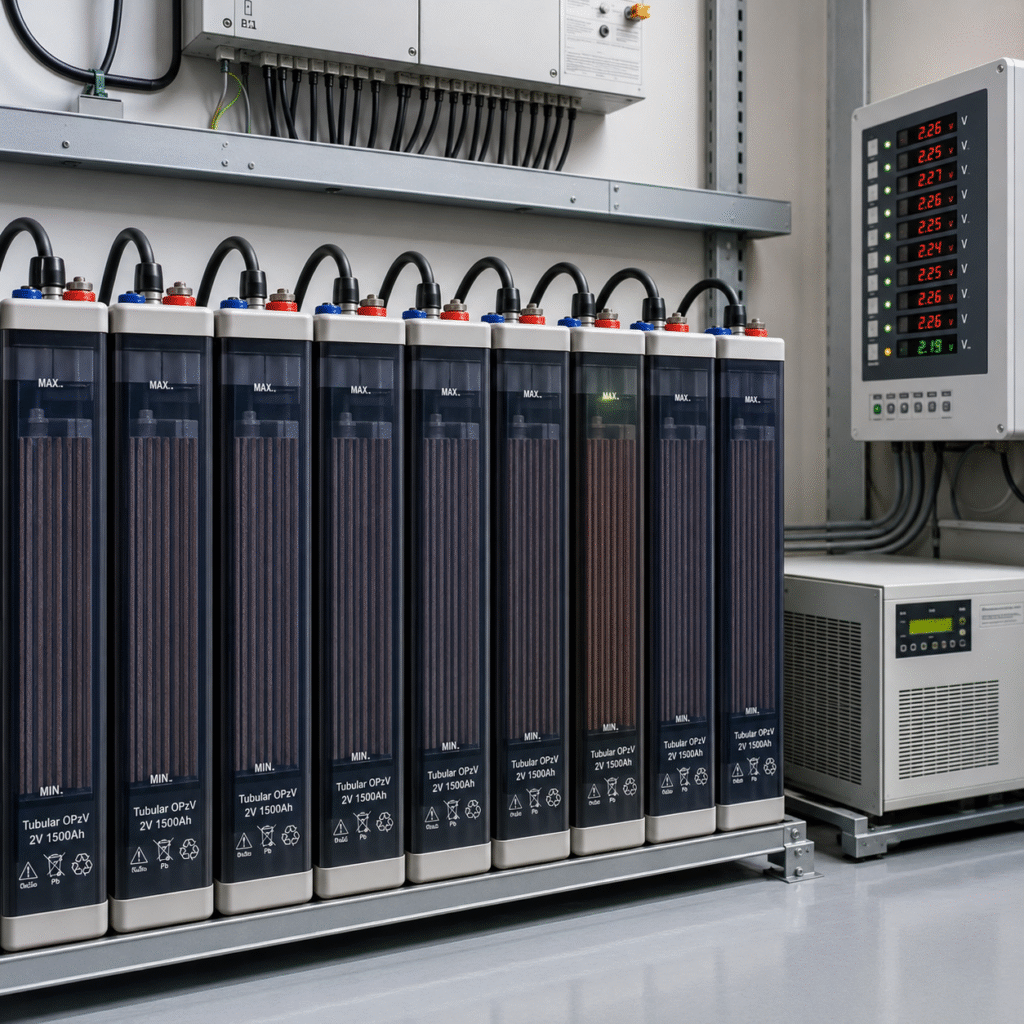
Introduction
A common maintenance finding in an OPzV battery bank is that the total string voltage appears normal, but one 2V cell consistently measures lower than the others during float charging.
For example, a 48V nominal battery bank may consist of 24 × 2V OPzV cells.
Most cells may remain close to the expected float range, while one cell repeatedly measures noticeably lower.
The charger may show no alarm because it controls the total battery-bank voltage, not necessarily every individual cell.
This raises several questions:
- Is the low-voltage OPzV cell already defective?
- Can it be recovered by equalization?
- Is the charger setting incorrect?
- Should only one 2V cell be replaced?
- Can the complete battery string continue operating?
The answer depends on how large the deviation is, how long it has existed, what happens during discharge, battery temperature, internal resistance, and the history of the cell.
A voltage difference by itself should not immediately be treated as proof of failure.
Some OPzV technical manuals note that individual float-voltage differences can occur during initial operation and may become more uniform after an extended period of normal float service. They also recommend investigating cells that remain substantially below their specified float level.
Why Total Battery Voltage Can Look Perfectly Normal
Suppose a 48V OPzV battery bank contains 24 cells.
If one cell voltage decreases, the charger continues regulating the total string voltage.
As a result, the remaining cells may operate at slightly higher voltages.
A simplified example:
- Cell 1–23: approximately 2.26V each
- Cell 24: 2.10V
The overall string voltage can still look reasonably close to the charger target.
This means:
Correct total string voltage does not prove that every OPzV cell is operating correctly.
This is particularly important in:
- Telecom DC power systems
- Substations
- Utility control systems
- UPS installations
- Solar energy storage systems
- Railway signaling systems
For critical stationary battery banks, individual cell-voltage trending is much more useful than checking only the total voltage.
Reason 1: The Cells Started with Different States of Charge
An OPzV bank may contain cells that are nominally identical but do not begin service at exactly the same state of charge.
Differences can develop because of:
- Different storage periods
- Temperature differences during storage
- Incomplete commissioning charge
- Replacement of one cell
- Transportation history
- Different self-discharge rates
After the cells are connected in series, the same charging current flows through every cell.
However, cells with different SOC can show different terminal voltages.
This is why correct commissioning is important before a new stationary battery bank is placed into service.
Reason 2: The Low-Voltage Cell Has Higher Self-Discharge
A deteriorating cell may lose charge faster than the other cells while on standby.
Possible causes include:
- Internal leakage
- Contamination
- Separator deterioration
- Partial internal short
- Battery aging
The charger continues supplying the entire series bank, but the abnormal cell continually loses more charge internally.
Possible symptoms include:
- Low float voltage
- Higher float current for the complete string
- Faster voltage loss when disconnected
- Reduced capacity
- Abnormal temperature
A cell with excessive self-discharge may initially appear acceptable after charging but gradually move away from the rest of the string.
Reason 3: A Partial Internal Short Is Developing
A partial internal short is more serious than simple SOC imbalance.
Possible mechanisms include:
- Separator damage
- Conductive material accumulation
- Internal contamination
- Plate growth
- Mechanical damage
- Severe aging
The short creates an internal current path.
The affected cell may therefore show:
- Lower float voltage
- Increased self-discharge
- Higher temperature
- Abnormal current demand
- Reduced capacity
If a low-voltage cell is also warmer than nearby cells, the combination deserves immediate investigation.
Reason 4: The Cell Has Lost Capacity
A cell can have the correct nominal voltage but substantially reduced usable capacity.
Capacity loss may result from:
- Sulfation
- Positive-grid corrosion
- Active-material deterioration
- Long-term undercharging
- Repeated deep discharge
- High-temperature operation
A low-capacity cell can behave differently during both charging and discharge.
During discharge, it may reach the end voltage much earlier than the rest of the string.
This is one of the most important tests for distinguishing:
a voltage-balance issue
from
an actual weak cell.
Reason 5: Battery Temperature Is Different
OPzV charging voltage is temperature-sensitive.
One cell may operate at a different temperature because it is:
- Near an inverter
- Near a charger
- Close to a wall exposed to sunlight
- At the top of a warm cabinet
- Near an air-conditioning outlet
- In an area with poor airflow
OPzV technical manuals commonly specify temperature compensation for float and equalizing charging rather than assuming one voltage is correct at every temperature.
Therefore, when comparing individual voltages, record temperature at the same time.
A voltage difference without temperature data can be misleading.
Reason 6: One Connection Has Excessive Resistance
Before blaming the OPzV cell itself, inspect the connection.
Possible problems include:
- Loose terminal bolt
- Oxidized contact surface
- Poor cable lug
- Damaged intercell connector
- Incorrect torque
- Corrosion
Measure voltage directly at the battery terminal posts, not only across external connectors.
A high-resistance connection may create:
- Voltage measurement errors
- Localized heating
- Voltage drop under load
- Early inverter or DC-system shutdown
Inspect connection temperature as well as voltage.
Reason 7: The Cell Voltage Is Being Measured Incorrectly
In a 24-, 54-, 108-, or 110-cell industrial battery system, measurement errors are easy to make.
Common problems include:
- Multimeter accuracy
- Incorrect probe placement
- Loose probe contact
- Recording the wrong cell number
- Measuring cells at different times while charger current is changing
Use the same calibrated meter and measure all cells within a reasonably short period under stable charging conditions.
Number the cells clearly.
For example:
01 → 02 → 03 → … → 108
This also makes future trend analysis easier.
Reason 8: One Old Cell Has Been Mixed with a Newer String—or Vice Versa
Replacing one cell may sometimes be technically necessary, but it creates a new variable.
A new OPzV cell can have:
- Different actual capacity
- Lower internal resistance
- Different charge acceptance
- Different self-discharge behavior
than cells that have already operated for several years.
Conversely, installing a used replacement cell into a relatively new string can create the opposite problem.
Before replacing one individual 2V OPzV cell, evaluate:
- String age
- Remaining capacity
- Internal resistance
- Voltage distribution
- Battery manufacturer recommendations
For an aged bank, complete-string replacement may sometimes be more economically rational than repeatedly replacing individual weak cells.
Reason 9: Float Charging Voltage Is Incorrect
If the complete float voltage is too low, weaker cells may gradually become more undercharged.
If float voltage is too high, other cells may compensate for the weak unit by operating at excessive voltages.
Check:
- Number of cells configured
- Float voltage per cell
- Temperature compensation
- Charger calibration
- Remote voltage sensing
OPzV manuals commonly specify manufacturer-specific float-voltage ranges and recommend regular measurement of individual float voltages. EnerSys guidance likewise recommends periodic cell-voltage checks because voltage dispersion can occur within an OPzV string.
Do not copy a float setting from an OPzS or conventional AGM system without checking the OPzV data sheet.
Reason 10: The Battery Has Spent Too Long Undercharged
A remote solar or telecom site may spend extended periods at partial state of charge because:
- Solar array is undersized
- Rainy season reduces PV production
- Generator charging is too short
- Charger current is insufficient
- Loads have increased
One weak cell may become increasingly undercharged and sulfated.
Eventually its voltage distribution becomes noticeably different from the rest of the bank.
The real solution may require correcting the system energy balance—not merely servicing one battery.
Is Equalizing Charge the Solution?
Possibly, but not automatically.
OPzV is a valve-regulated tubular GEL battery.
It should not be treated exactly like a flooded OPzS battery.
Some OPzV manufacturers specify that normal continuous float service does not require routine equalizing charge, while equalizing may be considered under specific conditions such as abnormal low individual float voltage, prolonged storage, or reduced capacity.
Therefore:
Do not perform equalization merely because one cell is slightly lower.
First determine:
- Voltage difference
- Battery temperature
- Internal resistance
- Charging history
- Discharge performance
Then follow the specific OPzV manufacturer’s instructions.
A Better Diagnostic Test: Watch What Happens During Discharge
Float voltage is useful, but the most revealing information often appears when the battery is carrying a load.
Record individual cell voltages:
Before Discharge
All cells should be fully charged and stabilized.
During the First Part of Discharge
Look for a cell that immediately drops more than the others.
Near the End of Discharge
A genuinely weak cell may begin falling rapidly before the rest.
After Load Removal
Record voltage recovery.
A cell that:
- Is low on float
- Drops fastest under load
- Recovers strongly after load removal
is much more suspicious than a cell showing only a small float-voltage deviation.
OPzV maintenance guidance recommends periodic discharge and capacity testing in addition to float-voltage measurement because voltage alone does not establish available capacity.
Check Internal Resistance or Conductance
Internal-resistance or conductance testing is useful for trending stationary battery condition.
The most important comparison is often:
current reading vs. previous reading for the same cell
rather than comparing one absolute number with an unrelated battery.
Look for a cell whose resistance:
- Is significantly higher than neighboring cells
- Has increased rapidly since the previous inspection
- Is accompanied by low discharge voltage
A resistance test should complement—not replace—a capacity test.
Should a Low-Voltage OPzV Cell Be Replaced?
Replacement becomes more likely when the cell:
- Repeatedly shows abnormal float voltage
- Cannot be corrected through the manufacturer’s approved charging procedure
- Shows excessive internal resistance
- Has abnormal temperature
- Self-discharges rapidly
- Reaches end voltage early
- Fails a capacity test
- Shows swelling or physical damage
For critical systems, one weak cell should not be ignored simply because the total DC voltage remains acceptable.
Example: 110V DC Substation Battery Bank
Assume a substation uses a long series string of 2V OPzV cells.
During float inspection:
- Most cells: stable and similar
- Cell 37: consistently lower
The wrong response is:
“The total bank voltage is correct, so everything is fine.”
A better procedure is:
- Confirm Cell 37 measurement.
- Measure its temperature.
- Inspect connectors.
- Review previous voltage records.
- Measure internal resistance.
- Monitor it during a controlled discharge.
- Review charging settings.
- Determine whether the problem follows the cell or the installation position.
This allows the technician to identify a deteriorating cell before a real utility outage.
Preventive Maintenance Recommendations
For OPzV battery banks, build a trend table containing:
- Individual cell voltage
- Total float voltage
- Cell temperature
- Ambient temperature
- Internal resistance
- Float current
- Discharge-test results
A maintenance record is far more useful than isolated measurements.
A gradual change can often identify a deteriorating cell before it causes backup failure.
Frequently Asked Questions
Is one low OPzV cell voltage always a bad battery?
No. Initial SOC variation, temperature, measurement error, and charging history can also create voltage differences.
Can the total bank voltage be normal with one defective cell?
Yes. Other cells can operate at slightly higher voltages and mask the weak cell.
Should I equalize an OPzV battery every month?
No universal schedule should be applied. OPzV equalizing charge should follow the specific manufacturer’s instructions and actual battery condition.
Why does one low-voltage cell become even lower under load?
It may have reduced capacity or higher internal resistance.
Can I replace only one 2V OPzV cell?
Sometimes, but battery age, remaining string capacity, model compatibility, and manufacturer recommendations should be evaluated first.
Is internal-resistance testing enough?
No. It is useful for trending, but a controlled discharge/capacity test provides more direct information about usable capacity.
Conclusion
One low-voltage 2V OPzV cell in a large battery bank should be treated as a diagnostic signal, not automatically as proof that the cell has failed.
Common causes include:
- SOC imbalance
- Incomplete commissioning
- Excessive self-discharge
- Partial internal short
- Reduced capacity
- Temperature difference
- Connection resistance
- Incorrect float settings
- Long-term undercharging
The best diagnosis combines:
individual voltage + temperature + internal resistance + charging history + discharge performance.
For telecom, substation, UPS, solar, and industrial projects, provide the OPzV model, battery age, number of cells, total float voltage, individual cell voltages, cell temperatures, charger settings, internal-resistance readings, and discharge-test data for a more accurate assessment.
Suggested Internal Links:
- Environmental and Operational Factors Affecting OPzV Battery Performance
- How to Choose Between OPzV and OPzS Batteries for Energy Storage Systems?
- OPzV vs OPzS Battery Life, Cycle Performance, and Cost Analysis for Energy Storage Projects