
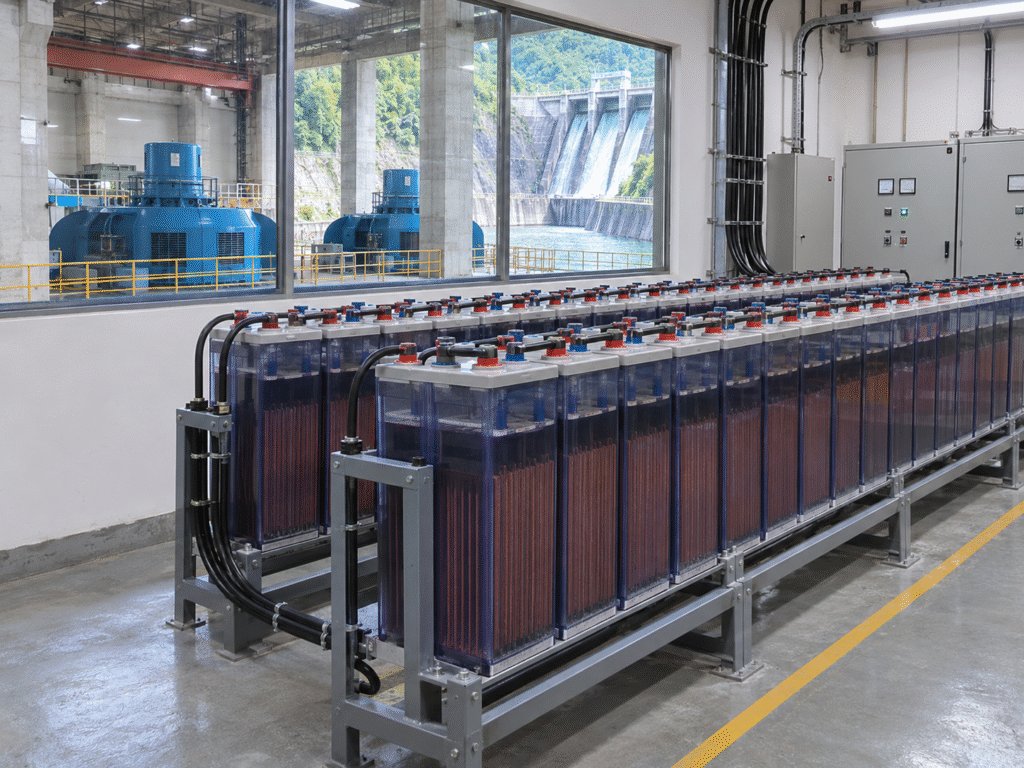
What Happens to a Hydropower Plant When Auxiliary AC Power Fails?
Hydropower plants depend on reliable auxiliary electrical systems to support protection, control, monitoring and selected emergency operations. Although a hydroelectric facility generates electricity, it may still lose its normal auxiliary AC supply during a network disturbance, generator trip or station fault. When this happens, designated DC systems must continue to operate independently of the normal AC source.
Protection relays may need to remain energized, circuit breakers may need to trip, and critical monitoring or communication equipment may require uninterrupted power. For many facilities, the station battery bank is therefore a critical part of the electrical protection and control architecture. OPzS tubular flooded lead-acid batteries can be considered for these stationary DC applications because of their established use in industrial and utility battery systems. The final selection must be based on the station duty cycle, voltage limits and project technical specification.
Which Hydropower Equipment Depends on Station DC Power?
A typical hydropower station may contain several categories of DC loads.
Protection Relays and Switchgear Control
Protection and control equipment may need to operate during abnormal electrical conditions, including the loss of normal auxiliary power. Circuit-breaker trip coils can create short-duration current demands that must be included in battery sizing. These loads may be small in terms of total ampere-hours but important in terms of instantaneous current and voltage performance.
Turbine and Generator Control Systems
Selected turbine and generator monitoring or control functions may require backup power to support an orderly shutdown or preserve critical system information. However, large hydraulic pumps, gate motors and other substantial auxiliary equipment should not automatically be assumed to operate directly from the station battery. Whether these loads are battery-supported depends on the plant design, emergency operating sequence and power conversion equipment.
Communication and SCADA Systems
Hydropower plants often require continuous communication with dispatch centers, grid operators and remote monitoring systems. DC power may support portions of the communication and automation infrastructure during AC disturbances. For remotely operated hydroelectric plants, maintaining monitoring and event records can be particularly important.
Why OPzS Is Relevant to Hydropower Stations
OPzS batteries use tubular positive plates and flooded electrolyte. This construction is commonly associated with long-duration stationary applications where a mature lead-acid technology and predictable maintenance procedures are valued. Unlike valve-regulated OPzV batteries, OPzS cells require electrolyte inspection and appropriate water maintenance.
At a staffed power station, this requirement may be manageable because electrical maintenance personnel already perform routine inspections. The ability to inspect the electrolyte level and record individual-cell condition can be useful within a structured preventive-maintenance program. Nevertheless, OPzS is not automatically the best option for every hydropower plant. Maintenance resources, battery-room conditions, utility specifications and lifecycle economics should determine the final technology.
Understanding the Battery Duty Cycle
A hydropower station battery is normally sized using a load schedule rather than a simple average-current calculation. The schedule may include continuous protection and monitoring loads, temporary loads during operating sequences and short-duration breaker operations. Consider a hypothetical station with a nominal 110V DC system. The continuous DC load is 18A for four hours. The basic demand is: 18A × 4h = 72Ah
Suppose the station also requires an additional 100A for five seconds during a defined breaker operation. The extra energy demand is relatively small: 100A × 5 ÷ 3,600 ≈ 0.14Ah
However, the battery must be capable of delivering the combined instantaneous current without allowing the DC voltage to fall below the minimum required by the equipment. Consequently, the correct battery selection must account for both discharge duration and high-current performance. The engineer must also consider battery aging, temperature, cable losses and allowable end voltage. The final capacity should be established from manufacturer discharge data and the specified duty cycle.
Do 110V and 220V DC Systems Require Fixed Numbers of 2V Cells?
Hydropower plants may use nominal DC systems such as 110V or 220V, depending on the equipment and utility design. For 2V stationary battery cells, nominal arithmetic provides an initial reference, but the final number of cells must be based on the complete DC voltage range.
The system designer must review the charger’s float and boost settings, permissible equipment voltage, minimum load voltage and discharge end voltage. For replacement projects, maintaining compatibility with the existing rectifier and DC distribution system is particularly important. A replacement battery bank with the correct nominal voltage but unsuitable charging or discharge characteristics can create commissioning difficulties.
The Difference Between Generator Starting and Station DC Backup
Some hydropower procurement requests refer to batteries for generator starting, even when the actual requirement is for station protection and control power. These applications should be distinguished. A stationary OPzS battery bank may support control circuits involved in the startup sequence, but this does not mean it is intended to supply the main mechanical starting power or large motor loads.
If the project includes high-current motors or special starting equipment, those loads must be identified separately. The battery supplier should request the load schedule and system diagram before recommending a configuration.
Battery-Room Planning in Hydropower Facilities
Hydropower stations may have battery rooms located underground, within powerhouse structures or in dedicated auxiliary buildings. The installation must account for ventilation, electrical protection, electrolyte hazards, floor loading and maintenance access. Large-capacity OPzS cells can be heavy, and battery racks must be suitable for the installed equipment.
Flooded batteries may release hydrogen during charging, making ventilation an important part of the installation design. The relevant safety requirements should be incorporated into the project specifications from the beginning. Battery-room accessibility also matters for future replacement. Large cells should not be selected without confirming that they can be transported into the designated installation area.
How to Evaluate the Existing Battery Bank During Replacement
A replacement project should begin with an assessment of the existing DC system. The engineering team should review the present load schedule, charger output, battery capacity, installation temperature and records of previous battery tests. If individual cells have deteriorated, the cause should be investigated rather than assuming the problem is simply battery age.
Improper charging, excessive temperature, high-resistance connections and inadequate maintenance can all affect battery performance. Where the plant’s electrical equipment has been upgraded, the original battery capacity may no longer be appropriate. The new battery bank should therefore be selected for the current operating requirements.
OPzS Versus OPzV for Hydropower Applications
Both technologies may be considered, subject to the project specification. OPzS can be attractive at staffed facilities where electrolyte maintenance is routinely performed. OPzV may be more appropriate at remote or unattended sites where reducing routine maintenance visits is a priority.
However, neither technology should be chosen without reviewing the plant’s discharge requirements, charging system and environmental conditions. The lowest purchase price does not necessarily represent the lowest lifetime cost.
What Hydropower EPC Contractors Should Request from Suppliers
International hydroelectric projects often involve detailed technical approvals. The battery RFQ should identify the DC system voltage, load schedule, required autonomy, short-time current demands, maximum and minimum operating temperatures, existing charger details and required installation arrangement.
Buyers should also state which technical standards and factory tests are required. The supply scope may include battery cells, racks, inter-cell connectors, terminal hardware, installation drawings and technical documentation. Clearly defining these items at the quotation stage helps avoid disagreement during project execution.
International OPzS Battery Supply for Hydropower Projects
Wuxi Huizhong Power supplies OPzS flooded tubular and OPzV tubular GEL stationary lead-acid batteries for power infrastructure and industrial backup applications. For hydropower station projects, we can review battery capacity, DC voltage, installation layout and required project documentation before preparing a quotation. For EPC contractors and international distributors, early technical communication can help ensure that the proposed battery configuration matches the project specification and delivery requirements.
Conclusion
Hydropower station DC systems must remain dependable when normal auxiliary electricity is unavailable. Battery performance during breaker operation, the required backup period, charging compatibility, temperature and installation conditions all influence system reliability. OPzS tubular batteries can be a practical option for suitable staffed hydroelectric facilities with established maintenance procedures.
Sourcing OPzS batteries for a hydroelectric power station or station DC system replacement project?
Send Wuxi Huizhong Power your nominal DC voltage, duty-cycle schedule, required autonomy, charger specifications, installation dimensions and project quantity.
We can evaluate an appropriate OPzS battery configuration and provide a technical quotation.
Website: www.huizhongpower.com