
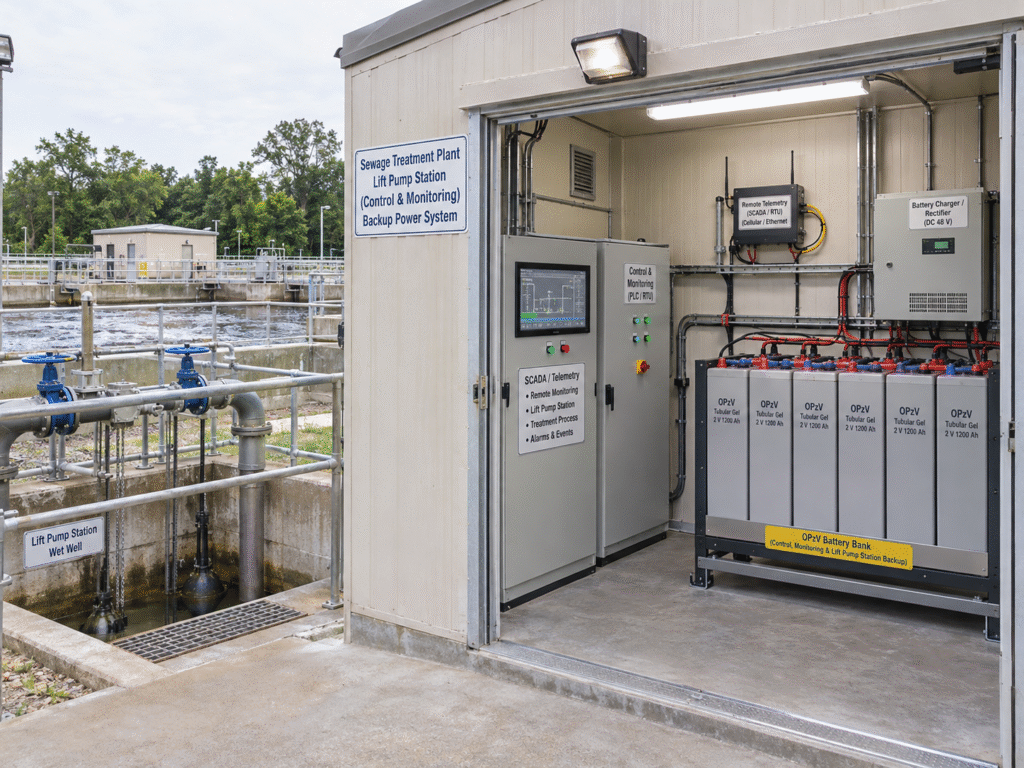
A Power Outage at a Wastewater Plant Can Create More Than an Operational Delay
Wastewater treatment facilities depend on electrical systems to operate pumps, monitoring equipment, process controllers, alarms and communication networks. When the normal electricity supply fails, the resulting problem may extend beyond production interruption. Operators may lose visibility of tank levels, flow conditions, pump status or alarm information. At remote sewage lift stations, a power failure can also prevent operators from receiving information about rising wastewater levels.
Although many treatment facilities rely on diesel generators for major mechanical loads, dedicated battery systems remain relevant for selected monitoring, control and communication equipment. OPzV tubular GEL batteries can be considered for stationary DC backup applications where relatively long backup periods and reduced routine electrolyte maintenance are important. For utility operators and engineering contractors, the key is to identify which equipment genuinely needs battery backup and how long it must remain operational.
Which Wastewater Treatment Applications Can Use OPzV Batteries?
SCADA and Process Monitoring Systems
Modern wastewater treatment plants use supervisory control and data acquisition (SCADA) systems to monitor pumping equipment, flow rates, tank levels and other operational parameters. During an AC power interruption, designated SCADA equipment may need to remain available to record events, communicate with operators and monitor essential conditions.
A stationary DC battery bank can provide backup energy to these loads directly or through suitable power conversion equipment. The required capacity depends on the actual electrical demand, backup duration and acceptable voltage range.
Remote Sewage Lift Stations
Sewage lift stations are often distributed across large municipal networks. Some locations are unmanned and may be several kilometers from the main treatment facility. A remote station may contain level sensors, a programmable logic controller, communication equipment and alarm devices.
Maintaining these functions during a utility outage can help operators assess conditions and coordinate a response. Where long-duration backup is required, OPzV batteries may be considered if the battery enclosure, charging system and installation environment are suitable.
Industrial Wastewater Facilities
Manufacturing plants, chemical facilities and industrial processing sites may operate dedicated wastewater treatment systems. These installations may require backup power for selected instruments, control circuits or monitoring systems. However, equipment related to functional safety or regulated environmental protection must follow the relevant engineering specifications and approval requirements. A standard industrial battery should not automatically be considered an approved power supply for every safety-related function.
Should the Battery Operate the Wastewater Pumps?
This is one of the most important questions to resolve before choosing battery capacity. A wastewater treatment facility may have pumps rated at several kilowatts or considerably higher. Operating these pumps from batteries requires an appropriately sized inverter or motor-drive system, sufficient energy capacity and suitable starting-current capability.
For example, a 5kW pump operating for two hours consumes approximately 10kWh before inverter and electrical losses. By comparison, a monitoring system consuming 100W requires only 2.4kWh over 24 hours. These are completely different battery applications. For many wastewater projects, using a generator for major pumps and a dedicated battery for critical monitoring and control functions is worth evaluating. The final arrangement should follow the facility’s operating requirements and emergency response plan.
A Practical Battery-Sizing Example for a Remote Lift Station
Consider a remote sewage lift station with the following continuous auxiliary loads:
| Equipment | Average Power |
|---|---|
| PLC and monitoring equipment | 35W |
| Communication equipment | 25W |
| Level monitoring and alarm electronics | 20W |
| Total | 80W |
Suppose the station requires 24 hours of battery operation without external charging. The theoretical energy demand is: 80W × 24 hours = 1,920Wh
At a nominal 24V battery voltage, this corresponds to: 1,920Wh ÷ 24V = 80Ah
However, selecting an 80Ah battery would not automatically satisfy the requirement. The final battery bank must account for usable depth of discharge, battery aging, low-temperature capacity, discharge rate, system losses and any additional intermittent loads. If an indicative design assumes 50% usable depth of discharge and a combined 85% allowance for energy delivery and reserve, the preliminary capacity becomes: 80Ah ÷ (0.50 × 0.85) ≈ 188Ah
A battery around 200Ah could be an initial candidate for further evaluation, but suitability must be verified using the manufacturer’s discharge tables and actual system conditions.
Wastewater Facilities Present Special Environmental Challenges
Wastewater treatment environments can expose electrical equipment to high humidity, condensation, corrosive gases and chemical contamination. Hydrogen sulfide may be present in some wastewater facilities, creating corrosion concerns for exposed electrical connections and equipment. Battery terminals, connectors and cabinets should therefore be protected through appropriate enclosure design, material selection and maintenance procedures.
The presence of corrosive gases does not mean an OPzV battery is automatically suitable for installation anywhere within a wastewater facility. For example, areas classified as hazardous due to flammable gases require a separate assessment of the complete electrical installation. A standard OPzV battery does not automatically carry approval for hazardous-area operation.
Why Reduced Maintenance Can Matter to Water Utilities
Large water utilities may operate dozens or hundreds of remote pumping stations. Sending technicians to every location can create significant maintenance expenses. OPzV batteries use an immobilized gel electrolyte and do not normally require routine water topping-up.
This can reduce one element of battery maintenance compared with flooded OPzS batteries. However, operators must still monitor charging conditions, terminal integrity, physical condition and battery performance. In a remote installation, the maintenance strategy should balance inspection frequency with the criticality of the equipment. Reduced electrolyte maintenance is valuable, but it is not a substitute for a reliable monitoring program.
Grid Backup and Solar-Powered Stations Require Different Charging Designs
At a grid-connected lift station, the battery may spend most of its time on float charge and operate only during power interruptions. At an off-grid monitoring station, the battery may discharge every night and recharge during daylight. These operating patterns affect battery selection and expected service life.
A solar-powered system must generate enough energy to support daytime consumption and restore the energy removed during battery discharge. If the solar array is undersized, persistent partial-state-of-charge operation can contribute to premature lead-acid battery deterioration. The battery and solar charging system must therefore be designed together.
OPzV or OPzS for Municipal Wastewater Projects?
OPzV batteries are often attractive where routine maintenance access is limited and the installation requires a stationary, reduced-maintenance battery solution. OPzS flooded batteries may be suitable at staffed treatment facilities where electrolyte inspection and water maintenance are already part of the electrical maintenance program.
The choice should consider battery cycling frequency, installation temperature, charger compatibility, maintenance resources and project budget. For wastewater applications, enclosure protection and environmental conditions may be just as important as the battery technology.
What Should EPC Contractors Include in a Wastewater Battery RFQ?
For accurate battery selection, project contractors should provide the DC system voltage, actual load schedule, required backup time and expected installation temperature. They should also identify whether the battery supports monitoring equipment only or must supply motor loads.
For remote stations, details of the communication equipment, available charging source and cabinet dimensions are especially important. If the batteries will be installed in a corrosive or potentially hazardous environment, the project specification should identify the relevant environmental and safety requirements. Providing these details allows the supplier to evaluate a technically appropriate battery arrangement instead of simply quoting a nominal capacity.
Sourcing OPzV Batteries for Water and Wastewater Infrastructure
Wuxi Huizhong Power manufactures OPzV tubular GEL and OPzS flooded tubular lead-acid batteries for industrial stationary power applications. For wastewater treatment plants, municipal lift stations and remote monitoring projects, battery capacity and configuration can be evaluated according to the operating voltage, electrical load, autonomy and installation requirements. For international distributors and engineering contractors, we can review project requirements and prepare a quotation covering suitable battery models and available supporting documentation.
Conclusion
Reliable wastewater infrastructure requires electrical backup solutions that match the actual equipment and operational risks. Large pumps, control systems and monitoring equipment should not automatically share the same battery-sizing assumptions. For selected stationary DC backup applications, OPzV batteries may provide a practical solution where long-duration backup and reduced routine maintenance are required.
Looking for batteries for a wastewater treatment plant, sewage lift station or water utility SCADA project?
Send Wuxi Huizhong Power your system voltage, equipment load, required backup duration, installation conditions and project quantity.
Our team can evaluate a suitable OPzV battery configuration and prepare a project quotation.
Website: www.huizhongpower.com