
Introduction
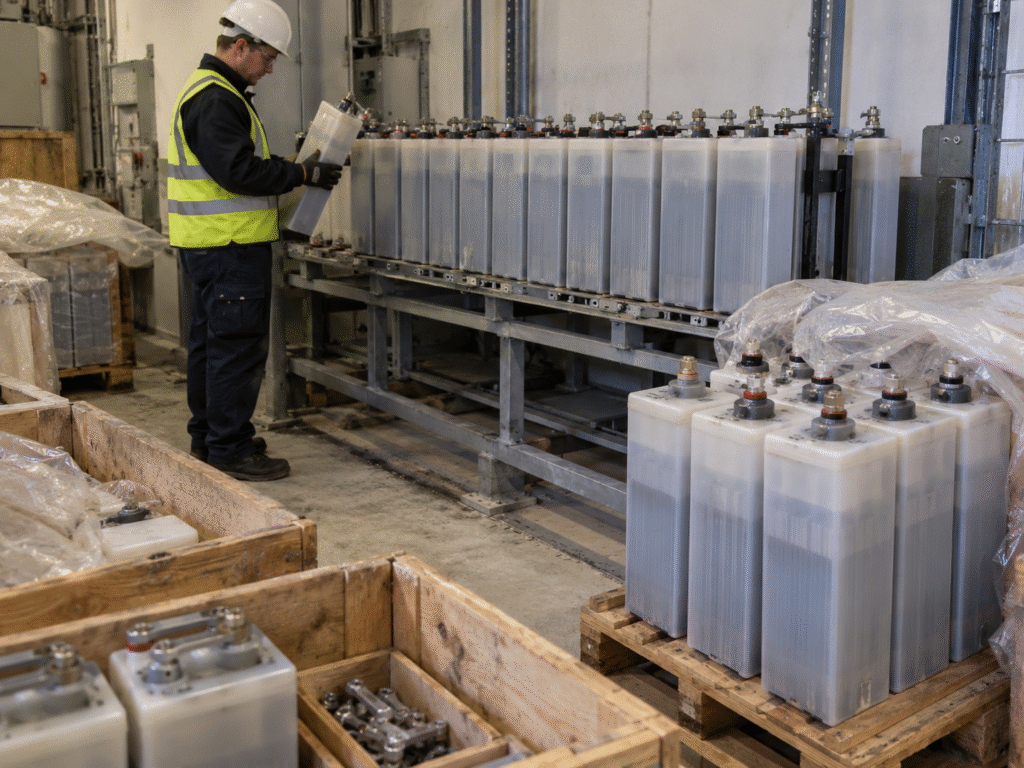
An industrial nickel-cadmium (NiCd) battery bank is delivered to a power plant construction site, but the project experiences an unexpected delay. The batteries remain in a warehouse for six months, twelve months, or even longer before installation begins.
When construction finally resumes, the engineering team faces an important question: can these batteries still be installed, or has prolonged storage affected their performance?
This situation is common in international infrastructure projects, particularly power generation facilities, electrical substations, railway developments, and oil and gas installations. Equipment delivery schedules do not always match actual construction progress, and batteries may arrive long before the DC power system is ready for commissioning.
Industrial NiCd batteries can offer favorable storage characteristics compared with certain other rechargeable battery technologies. However, their suitability after storage depends heavily on the battery design, shipment condition, storage temperature, and manufacturer’s instructions.
Before putting a stored battery bank into service, the EPC contractor or maintenance team should determine whether the batteries remain suitable for commissioning and whether additional inspection or testing is required.
1. How Long Can an Industrial NiCd Battery Be Stored?
There is no single storage period applicable to every industrial nickel-cadmium battery. Some vented NiCd batteries are supplied filled with electrolyte and charged, while others may be delivered discharged or in another manufacturer-defined condition. These differences can significantly affect permissible storage duration.
For example, certain industrial NiCd designs supplied filled and discharged may be suitable for long storage periods under controlled conditions, while filled and charged designs may require installation, maintenance, or other procedures within a shorter period.
Published manufacturer instructions demonstrate that storage requirements vary substantially between product series. Therefore, a storage limit recommended for one battery model should never be applied automatically to another. For international buyers, the most important documents are the manufacturer’s specific storage instructions, shipment records, and commissioning manual.
2. Charged and Discharged NiCd Batteries Have Different Storage Requirements
One of the first questions to ask is whether the battery was delivered charged or discharged.
Batteries Delivered Filled and Charged
A filled and charged industrial NiCd battery may be ready for service shortly after delivery, subject to the manufacturer’s installation instructions. However, charged batteries gradually lose stored energy during storage through self-discharge. The rate depends on temperature, battery design, and other conditions.
An extended delay may therefore require an approved recharge or commissioning procedure before the battery can provide its specified capacity. It is also important to distinguish a reduction in the state of charge from permanent battery degradation. A battery that has self-discharged during storage is not necessarily damaged.
Batteries Delivered Filled and Discharged
Some industrial vented NiCd battery designs can be stored in a discharged condition for extended periods. This capability can be valuable for infrastructure projects where the installation schedule is uncertain.
However, being discharged does not mean the battery can be stored under any environmental conditions or installed without preparation. The battery must still be protected from temperature extremes, contamination, mechanical damage, and inappropriate handling.
Batteries Delivered Dry or Without Electrolyte
Certain industrial battery designs may be supplied without electrolyte, subject to their construction and manufacturer’s shipping arrangements. These products require specific preparation and filling procedures before charging or commissioning.
Because potassium hydroxide electrolyte is caustic, electrolyte handling should only be performed by trained personnel using approved equipment and instructions. Customers should never assume that the commissioning procedure for a filled battery also applies to a dry-shipped product.
3. High Warehouse Temperature Can Affect Battery Condition
Storage temperature is a critical consideration for industrial battery distributors and EPC contractors. In some regions, batteries may be stored inside metal warehouses or shipping containers exposed to strong sunlight.
During summer, internal temperatures can become considerably higher than normal indoor ambient conditions. Although industrial nickel-cadmium batteries are well known for their ability to operate in demanding environments, high-temperature storage can still affect performance and long-term condition.
Example: Delayed Project in the Middle East
An EPC contractor imports an industrial NiCd battery bank for a substation project in Saudi Arabia. The batteries arrive on schedule, but construction delays prevent installation for ten months.
During this period, the batteries remain in a warehouse with limited temperature control. When the project restarts, the contractor discovers that the original manufacturer’s storage instructions specify conditions that may not have been maintained.
In this situation, the correct response is not simply to charge the batteries and assume they are ready for service. The engineering team should document the storage conditions, inspect the battery bank, consult the manufacturer, and determine the appropriate commissioning and acceptance procedure.
4. Can Batteries Be Left Inside Their Original Shipping Crates?
Keeping batteries in their original packaging can provide protection against dust, mechanical damage, and accidental contact with electrical terminals. However, packaging arrangements depend on the cell design and shipment condition.
For example, certain vented NiCd batteries are equipped with temporary transport seals. These seals may be required during storage but must be removed or handled according to the manufacturer’s instructions before charging.
Charging a battery with an inappropriate transport seal in place can create a dangerous condition. Warehouse personnel should never remove seals, open vents, or modify packaging without identifying the applicable instructions. For long-term storage, the original packaging should also be inspected for moisture damage, mechanical deterioration, or other conditions that may affect battery safety.
5. What Should Be Checked After 12 Months of Storage?
Before installing batteries that have remained in storage for an extended period, the project team should carry out a documented inspection. The inspection should cover the condition of the shipment, cell containers, terminals, packaging, electrolyte where applicable, and storage history.
A practical checklist is shown below.
| Inspection Item | What to Check | Possible Concern |
|---|---|---|
| Storage duration | Time since factory dispatch | Manufacturer’s approved period exceeded |
| Storage temperature | Actual warehouse conditions | High-temperature exposure |
| Packaging | Moisture, damage, deformation | Possible physical deterioration |
| Cell containers | Cracks, leakage, discoloration | Mechanical or chemical damage |
| Terminals | Corrosion, contamination, damage | Poor future connections |
| Transport seals | Correct condition and handling | Unsafe charging preparation |
| Electrolyte | Condition and level where applicable | Leakage or maintenance issue |
| Documentation | Shipment and storage records | Missing performance history |
The inspection should be carried out before energizing or charging the battery bank. Any damaged or leaking cell should be handled according to the manufacturer’s safety requirements.
6. Does a Stored NiCd Battery Need a Special Initial Charge?
A battery that has been stored for an extended period may require a manufacturer-approved commissioning or initial charging procedure. The correct procedure depends on how the battery was supplied, how long it was stored, and the specific battery design.
Using an arbitrary boost voltage or charging current is not recommended. An unsuitable charging procedure can cause excessive gas generation, water consumption, heating, or other unwanted effects.
For site acceptance testing, the charging preparation should be documented so that the discharge result can be interpreted correctly. A battery that has not been adequately charged before testing may appear to have insufficient capacity.
7. Should a Capacity Test Be Performed After Long Storage?
For critical power applications, commissioning verification is particularly important following prolonged storage. A capacity or duty-cycle test may be required by the project specification, battery manufacturer, or commissioning procedure.
Such testing can help determine whether the battery bank meets the required discharge performance. However, the test must follow the approved procedure, including charging preparation, temperature conditions, discharge current, and final voltage.
A battery should not be rejected solely because its open-circuit voltage is lower than expected after storage. Likewise, a normal voltage reading does not prove that the battery can deliver its required capacity.
8. How Importers Can Avoid Storage-Related Warranty Disputes
International battery importers sometimes purchase batteries well before the final project installation date. This can become a commercial risk if the shipment remains in storage longer than anticipated.
Before placing an order, distributors and EPC contractors should clarify the shipment condition, recommended storage environment, maximum storage period, and required commissioning procedures. For delayed projects, buyers should maintain written storage records and communicate major schedule changes to the supplier.
It is also useful to establish whether warranty coverage depends on storage or commissioning requirements. These points can prevent disagreements when batteries are installed many months after delivery.
Frequently Asked Questions
Can NiCd batteries be stored for one year without charging?
Some industrial NiCd battery designs may allow this, depending on their shipment condition and manufacturer’s storage instructions. It should not be assumed for all models.
Does a NiCd battery lose capacity during storage?
A battery can lose its stored charge through self-discharge. Permanent performance deterioration may also occur under unsuitable conditions. These are different problems and require different assessments.
Can industrial NiCd batteries be stored in a shipping container?
Only if the environmental and safety conditions meet the manufacturer’s requirements. Uncontrolled heat, moisture, and physical damage may make ordinary shipping containers unsuitable for extended storage.
Should old stock NiCd batteries be rejected automatically?
Not necessarily. The storage history, physical condition, manufacturer requirements, and commissioning test results should be evaluated first.
Is a stored NiCd battery ready for use immediately after charging?
Not automatically. The required inspection, commissioning, and acceptance procedures must be completed before the battery enters critical service.
Conclusion
Industrial nickel-cadmium batteries can offer useful storage flexibility for international power and infrastructure projects, but storage conditions and shipment status must be considered carefully.
A battery that has remained in storage for twelve months is not necessarily defective, yet it should not be installed without reviewing the manufacturer’s storage and commissioning requirements.
For EPC contractors, power utilities, and industrial battery distributors, maintaining clear storage records and commissioning documentation can reduce project delays and unnecessary warranty disputes.
Need NiCd Batteries for an Upcoming Power Project?
WUXI HUIZHONG POWER CO., LTD. supplies industrial nickel-cadmium batteries for substations, power generation facilities, railway systems, and industrial DC backup applications.
Visit www.huizhongpower.com to discuss your project schedule, battery capacity, shipment condition, and installation requirements.