
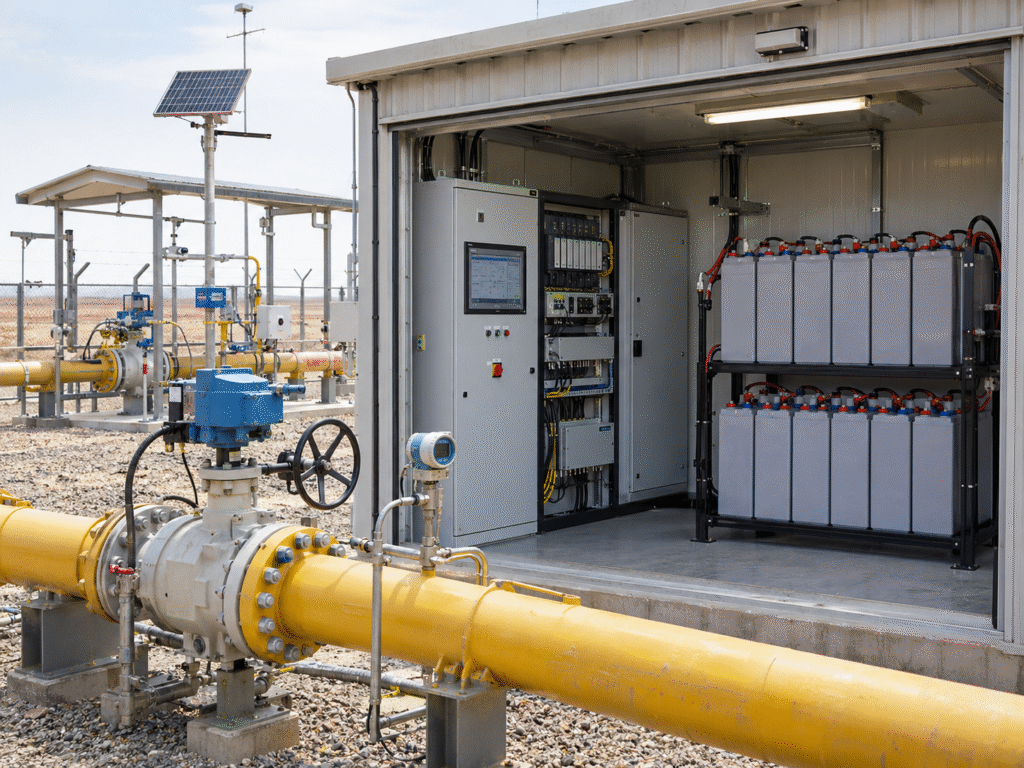
The Power Challenge Behind Remote Pipeline Monitoring
Oil and gas pipelines often extend for hundreds or thousands of kilometers, crossing deserts, mountains, agricultural areas and other locations where reliable utility electricity may not be available. Along these pipelines, operators install remote terminal units (RTUs), telemetry equipment, communication devices and monitoring instruments to collect operational information and communicate with central control systems.
Although individual monitoring stations may consume relatively little power, their electricity supply must be dependable. A station may need to operate continuously through long periods of poor weather or utility interruptions. At the same time, sending maintenance personnel to an isolated site can be expensive and time-consuming.
For this reason, battery selection becomes an important part of pipeline instrumentation and communication-system design. OPzV tubular GEL batteries are one option for stationary backup and off-grid energy storage at suitable remote monitoring installations.
Understanding the Electrical Loads at a Pipeline RTU Station
A typical remote pipeline monitoring station may include a programmable RTU, pressure and temperature transmitters, communication equipment, data loggers, sensors and associated DC power supplies. Depending on the project, the station may also contain equipment with occasional higher current demands. The loads do not necessarily operate in the same way.
Some devices consume electricity continuously, while others operate intermittently during measurement, communication or equipment activation. Therefore, a battery bank should not be selected solely from the power rating of the RTU. The total site load profile is the correct starting point. For example, an RTU may consume only a few watts, but communication equipment, protective electronics and auxiliary devices can increase the actual energy requirement. If the system includes motorized equipment or other substantial intermittent loads, those loads require separate evaluation. Such equipment should not automatically be assumed to operate from the same small telemetry battery.
Grid-Connected and Solar-Powered RTU Sites Have Different Battery Requirements
Grid-Connected Monitoring Stations
Where utility electricity is available, the battery may function primarily as standby power. During normal operation, a charger supports the DC load and maintains the battery. When the AC supply fails, the battery supports designated equipment until power returns or another energy source becomes available. The main design questions are the required backup duration, minimum equipment voltage and reliability of the charging system.
Solar-Powered Monitoring Stations
Remote pipeline installations may use solar panels when grid connection is impractical. In this case, the battery becomes part of a daily energy-storage system rather than a device that operates only during emergencies. Solar panels must generate enough energy to power the station and recharge the battery. The battery then supports loads during nighttime and periods of insufficient sunlight. This means a solar-powered RTU battery may experience frequent cycling, making the depth of discharge and energy balance particularly important.
A Practical Solar RTU Battery-Sizing Example
Consider a hypothetical remote monitoring station with an average electrical demand of 60W. The station operates continuously, so its daily energy consumption is: 60W × 24 hours = 1,440Wh per day
Suppose the project requires three days of autonomy without useful solar generation. The required delivered energy would then be: 1,440Wh × 3 days = 4,320Wh
For a nominal 24V battery system, this corresponds to a theoretical demand of: 4,320Wh ÷ 24V = 180Ah
However, 180Ah is not the final recommended battery capacity. This theoretical calculation does not include usable depth-of-discharge limits, battery aging, system losses, discharge characteristics or temperature-related capacity reduction. If the preliminary design assumes 50% usable depth of discharge and a combined 85% energy-delivery and reserve factor, the indicative capacity becomes: 180Ah ÷ (0.50 × 0.85) ≈ 424Ah
The engineer would then evaluate available battery sizes using the manufacturer’s discharge data and verify that the battery can supply the required load at the specified temperature and end voltage. The assumptions above are illustrative rather than universal engineering requirements. The solar array must also be designed to restore the consumed energy within the available charging window.
Why Reduced Maintenance Matters for Remote Pipeline Stations
Pipeline installations can be extremely difficult to access. A monitoring site may be located several hours from the nearest maintenance center, and service visits may require specialized transportation or access authorization. For a network containing hundreds of remote stations, maintenance cost can become a major operating expense.
OPzV batteries have a valve-regulated gel-electrolyte design that eliminates routine water topping-up. This can reduce one category of routine maintenance compared with flooded stationary batteries. However, periodic inspections remain necessary. Technicians should still check charging voltage, battery temperature, connections, physical condition and battery performance according to the maintenance plan. The value of OPzV in remote applications therefore comes from reduced maintenance requirements, not from the complete elimination of maintenance.
Desert Temperatures Can Change the Battery Economics
Many oil and gas projects are located in hot regions, including the Middle East and parts of Africa. An electrical enclosure exposed to intense sunlight may become considerably hotter than the surrounding air. This matters because elevated battery temperature accelerates lead-acid battery aging. A battery selected using laboratory capacity data at moderate temperature may not achieve its expected service life in a poorly ventilated field cabinet.
For remote pipeline projects, the buyer should specify the actual battery-compartment temperature range whenever possible. Shading, enclosure insulation, thermal management and appropriate charging-voltage compensation may be important parts of the design. A supplier should not promise a fixed battery lifespan based only on the country of installation or nominal battery capacity.
Solar Charge Controllers Must Match OPzV Charging Requirements
A solar RTU station often uses a DC charge controller rather than a conventional industrial rectifier. This creates an important compatibility question. The controller must support charging parameters appropriate for the selected OPzV battery. Incorrect absorption, float or temperature-compensation settings can contribute to premature battery aging.
A controller configured for another lead-acid technology should not automatically be considered suitable. For example, charging functions intended for certain flooded batteries may not be appropriate for a valve-regulated gel battery. Before ordering batteries, the project integrator should confirm that the charge controller allows the required voltage and temperature settings.
Explosion-Hazardous Areas Require Special Assessment
Oil and gas projects may include hazardous locations where flammable gas or vapor could be present. A conventional OPzV battery is not automatically suitable for installation inside a classified hazardous area. Battery enclosures, charging equipment, electrical protection and ventilation must be assessed under the applicable hazardous-area requirements.
Depending on the project, batteries may need to be installed outside the classified area or in a specifically engineered and approved installation. The battery’s ordinary CE or product documentation should not be treated as proof of ATEX, IECEx or other hazardous-location approval. International EPC contractors should therefore identify the hazardous-area classification before requesting a final battery quotation.
Communication Reliability Depends on the Complete DC System
A battery may have adequate capacity but still fail to keep a remote monitoring station operational if the DC distribution system is poorly designed. Undersized cables, high-resistance connectors and inappropriate protective devices can create excessive voltage drop. At low DC voltages, even a relatively small additional resistance can become important.
The system integrator should review cable distances, peak equipment current, fuse coordination and minimum equipment voltage. Where remote monitoring is available, battery-voltage and charger-status alarms can help identify problems before an outage occurs.
OPzV or OPzS for Oil and Gas Remote Installations?
Both technologies can be considered for suitable stationary applications, but their maintenance requirements differ. OPzS flooded tubular batteries require electrolyte inspection and water maintenance. They may be practical at staffed industrial sites where qualified maintenance teams are regularly available.
OPzV batteries are often more attractive at unmanned locations where reducing routine service visits is particularly valuable. The selection should also consider cycling frequency, temperature, required autonomy, available installation space and the project’s charging architecture. Neither technology eliminates the need for correct sizing and proper maintenance.
What Should Be Included in a Pipeline Battery RFQ?
International buyers can obtain more accurate technical proposals by providing:
- Site type: RTU, SCADA, telemetry or remote monitoring
- Nominal DC voltage and permissible operating range
- Average and peak electrical loads
- Required autonomy in hours or days
- Solar-panel capacity and charge-controller details
- Expected battery-compartment temperature
- Hazardous-area classification, if applicable
- Installation space, enclosure requirements and project quantity
- Required documentation, tests and destination country
This information enables the supplier to determine whether the requested battery capacity and technology are suitable.
Working with an OPzV Battery Manufacturer
Wuxi Huizhong Power supplies OPzV tubular GEL and OPzS flooded tubular batteries for industrial stationary energy-storage applications. For oil and gas infrastructure projects, we can review the battery voltage, expected energy demand, installation dimensions and operating conditions when preparing a quotation.
For distributors and EPC contractors handling multiple remote sites, consolidated project quantities and technical specifications are particularly useful for planning battery configurations, documentation and shipping. The final design must be checked against the relevant oil and gas installation requirements.
Conclusion
Reliable electricity at a remote pipeline monitoring station depends on the complete energy system, not just the battery’s advertised capacity. The RTU load, communication equipment, autonomy requirement, solar generation, charging strategy, temperature and maintenance accessibility all influence battery selection.
OPzV tubular GEL batteries may be a practical option for remote monitoring projects where reduced routine maintenance is desirable and the installation environment is suitable.
Sourcing batteries for pipeline RTU, SCADA or remote oil and gas monitoring projects?
Contact Wuxi Huizhong Power with your system voltage, daily energy demand, required autonomy, charging method and project quantity. Our team can evaluate a suitable OPzV battery configuration and provide a project-based quotation.
Website: www.huizhongpower.com
Email: felix@hujhon.com