
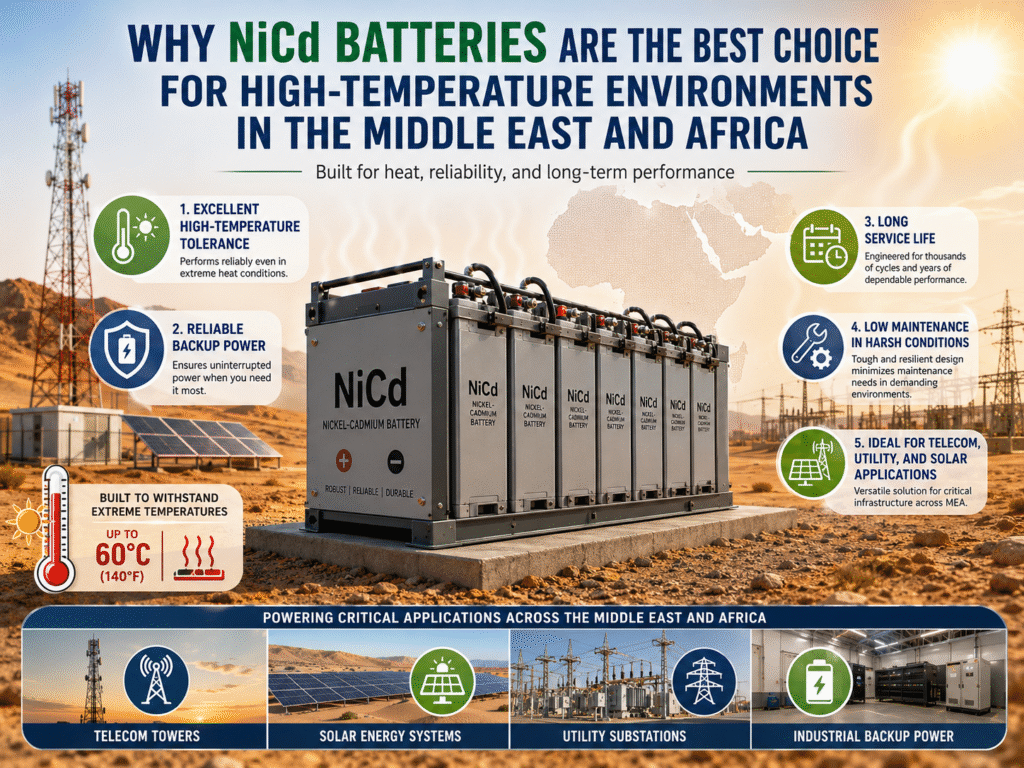
High ambient temperature is one of the biggest challenges facing industrial battery systems in the Middle East and Africa.
Countries such as:
- Saudi Arabia
- United Arab Emirates
- Oman
- Kuwait
- Iraq
- Qatar
- Nigeria
- Sudan
- Egypt
- Algeria
regularly experience summer temperatures above 45°C, while battery enclosures exposed to direct sunlight may exceed 60°C.
In these harsh environments, selecting the wrong battery technology can result in:
- Rapid capacity loss
- Frequent battery replacement
- Unexpected system failures
- Increased maintenance costs
This is why many utilities, oil & gas companies, telecom operators, and railway authorities continue to specify industrial nickel-cadmium (NiCd) batteries for mission-critical backup power systems.
Why High Temperature Is a Serious Challenge for Batteries
Every battery chemistry is affected by temperature.
However, the impact varies significantly.
High temperatures accelerate:
- Chemical aging
- Water loss
- Plate corrosion
- Internal resistance changes
- Capacity degradation
The result is shorter battery life and reduced reliability.
How NiCd Batteries Perform in Hot Climates
Industrial NiCd batteries are designed to withstand demanding environmental conditions.
Their advantages include:
Excellent Heat Resistance
NiCd batteries maintain stable performance in ambient temperatures exceeding 40°C.
This makes them ideal for:
- Desert substations
- Outdoor telecom cabinets
- Solar farms
- Oil & gas facilities
Reduced Capacity Degradation
Compared with conventional lead-acid batteries, NiCd batteries retain usable capacity more effectively at elevated temperatures.
This translates into more reliable backup power during emergencies.
Longer Service Life
In hot climates, NiCd batteries often outlast lead-acid batteries by several years, reducing replacement frequency and lowering lifecycle costs.
Why Middle Eastern Projects Prefer NiCd Batteries
Many countries in the Middle East have adopted NiCd batteries for critical infrastructure because of their ability to tolerate:
- High ambient temperatures
- Dust
- Sandstorms
- Irregular maintenance schedules
Typical applications include:
- Utility substations
- Oil & gas facilities
- Airports
- Military installations
- Telecom base stations
Why African Infrastructure Projects Choose NiCd Batteries
Across Africa, many industrial sites are located in remote regions where:
- Grid reliability is limited
- Maintenance resources are scarce
- Environmental conditions are challenging
NiCd batteries help reduce operational risk by providing:
- Long service life
- Low maintenance
- Excellent temperature tolerance
- High reliability
NiCd vs Lead Acid in Hot Climates
| Feature | NiCd Battery | Lead-Acid Battery |
|---|---|---|
| High-temperature performance | Excellent | Moderate |
| Service life in hot climates | 15–25 years | Often reduced significantly |
| Maintenance frequency | Lower | Higher |
| Deep discharge recovery | Excellent | Limited |
| Lifecycle cost | Lower | Higher |
Best Applications in the Middle East and Africa
Industrial NiCd batteries are particularly suitable for:
Electrical Substations
Reliable DC backup for protection relays and switchgear.
Oil & Gas Facilities
Emergency shutdown systems and communication equipment.
Railway Infrastructure
Signal control and level crossing systems.
Telecom Networks
Base stations located in remote or desert regions.
Solar Power Plants
Industrial backup for renewable energy installations.
Frequently Asked Questions
Can NiCd batteries operate at 50°C?
Yes. Industrial NiCd batteries are specifically designed for high-temperature operation.
Why do utilities in Saudi Arabia use NiCd batteries?
Because they offer excellent reliability and long service life under extreme heat.
Are NiCd batteries better than lead-acid batteries in Africa?
For many industrial applications, yes. Their durability and lower lifecycle costs make them an attractive choice.
Do high temperatures reduce NiCd battery life?
All batteries are affected by heat, but NiCd batteries tolerate elevated temperatures much better than many alternative chemistries.
Conclusion
For industrial projects in the Middle East and Africa, temperature is one of the most important factors when selecting a battery.
Industrial NiCd batteries provide:
- Superior heat resistance
- Longer operational life
- Lower maintenance requirements
- Reliable emergency performance
These characteristics make them one of the best choices for harsh climate applications.