
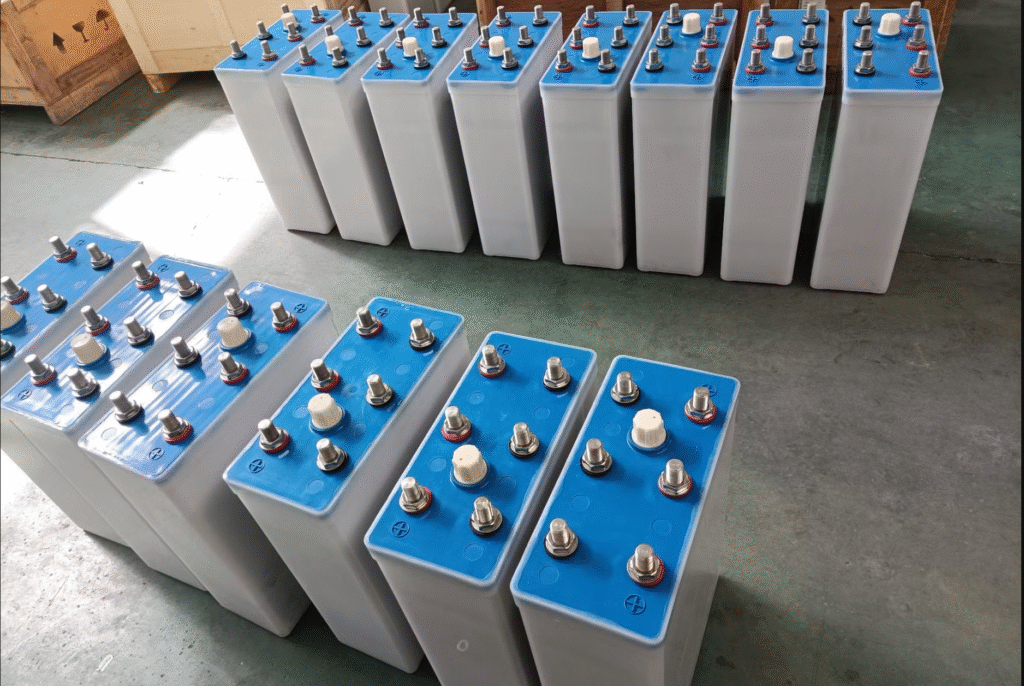
In industrial energy storage systems, two technologies are often compared:
- Nickel-cadmium (NiCd) batteries
- OPzV gel lead-acid batteries
Both are widely used in:
- Power plants
- Substations
- Telecom systems
- Renewable energy projects
- UPS backup systems
However, their performance characteristics are significantly different.
This article compares NiCd and OPzV batteries to help engineers and buyers select the right solution.
Overview of OPzV Batteries
OPzV batteries are:
- Valve-regulated lead-acid batteries
- Gel electrolyte type
- Designed for deep cycle applications
They are commonly used in:
- Solar energy storage
- Telecom backup systems
- UPS applications
Advantages:
- Lower cost than NiCd
- Good cycle life
- Maintenance-free design
Overview of NiCd Batteries
NiCd batteries are:
- Industrial alkaline batteries
- Designed for extreme reliability
- Suitable for harsh environments
They are commonly used in:
- Substations
- Power plants
- Railway systems
- Offshore platforms
Advantages:
- Extremely long lifespan
- High temperature resistance
- Strong reliability
- Deep discharge tolerance
Lifespan Comparison
| Battery Type | Lifespan |
|---|---|
| NiCd Battery | 15–25 years |
| OPzV Battery | 10–15 years |
NiCd batteries generally last significantly longer.
Temperature Performance
NiCd Battery
- Excellent high temperature performance
- Excellent low temperature performance
- Stable in extreme environments
OPzV Battery
- Moderate high temperature resistance
- Performance decreases in extreme heat
- Less suitable for harsh environments
Deep Discharge Performance
NiCd
- Excellent deep discharge tolerance
- Fast recovery
- Minimal degradation
OPzV
- Moderate deep discharge capability
- Sensitive to deep cycling
- Faster capacity loss under stress
Maintenance Requirements
NiCd
- Low maintenance
- Periodic inspection required
OPzV
- Maintenance-free
- But more sensitive to operating conditions
Cost Comparison
| Factor | NiCd | OPzV |
|---|---|---|
| Initial cost | Higher | Lower |
| Lifecycle cost | Lower | Higher |
| Replacement frequency | Low | Higher |
Application Suitability
NiCd Best For:
- Power plants
- Substations
- Railway systems
- Offshore platforms
- Harsh environments
OPzV Best For:
- Telecom systems
- Solar energy storage
- Budget-sensitive projects
- Stable environments
Reliability Comparison
NiCd batteries provide higher reliability in:
- Extreme temperatures
- Harsh industrial conditions
- Long-term standby operation
OPzV batteries perform well in stable environments but are less robust under extreme conditions.
FAQ
Which lasts longer, NiCd or OPzV batteries?
NiCd batteries generally have a longer service life.
Which battery is better for substations?
NiCd batteries are preferred for critical utility applications.
Are OPzV batteries cheaper than NiCd?
Yes, OPzV batteries have lower initial cost.
Which is better for high temperature environments?
NiCd batteries perform better in high heat conditions.
Can OPzV replace NiCd batteries?
Only in non-critical or stable environmental applications.
Conclusion
Both NiCd and OPzV batteries have their own advantages.
However, for critical industrial applications requiring:
- High reliability
- Long service life
- Harsh environment performance
NiCd batteries remain the preferred choice.
OPzV batteries are suitable for cost-sensitive and stable operating environments.