
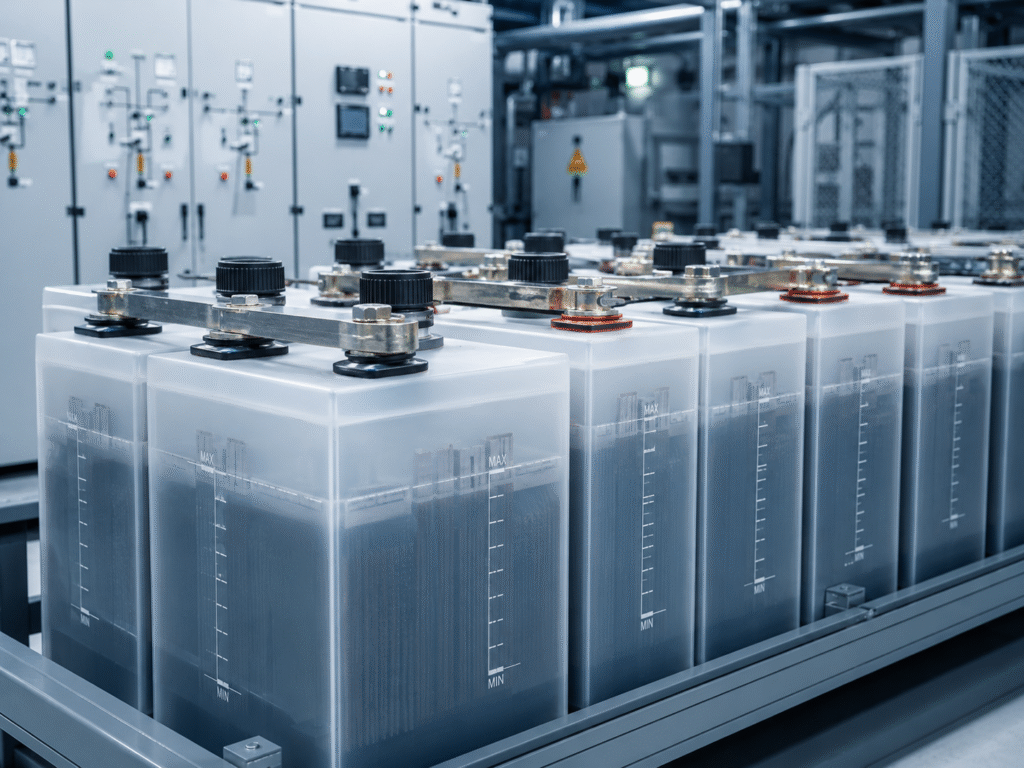
A nickel-cadmium battery is a rechargeable alkaline battery that uses:
- Nickel hydroxide as the positive active material
- Cadmium as the negative active material
- Potassium hydroxide (KOH) as the electrolyte
Unlike lead-acid batteries, NiCd batteries do not rely on sulfuric acid.
This alkaline chemistry provides several important benefits:
- Wide operating temperature range
- High resistance to overcharge
- Excellent deep discharge recovery
- Long service life
- Stable electrical performance
Industrial NiCd batteries are fundamentally different from the small consumer NiCd batteries that were once used in cordless tools and household electronics.
Industrial batteries are engineered specifically for stationary backup power systems requiring decades of reliable operation.
Main Types of Industrial NiCd Batteries
Industrial NiCd batteries are generally divided into two major categories.
Pocket Plate Batteries
Pocket plate batteries use perforated steel pockets to contain active materials.
Advantages include:
- Long service life
- Excellent mechanical strength
- High reliability
- Outstanding float charging performance
Typical applications:
- Utility substations
- Railway signaling
- Power plants
- Telecom systems
- Offshore facilities
Pocket plate technology is the dominant choice for stationary industrial backup systems.
Sintered Plate Batteries
Sintered plate batteries use a porous metallic substrate to support active materials.
Advantages include:
- High-rate discharge capability
- Excellent low-temperature performance
- Fast charging response
Typical applications:
- Aircraft starting
- Aerospace systems
- Military equipment
- Emergency engine starting
Although highly capable, sintered plate batteries are generally more expensive and are used in specialized applications.
Why Industrial NiCd Batteries Are Different from Consumer NiCd Batteries
Many people associate NiCd batteries with:
- Old cordless drills
- Portable radios
- Rechargeable flashlights
These consumer products differ significantly from industrial systems.
Industrial NiCd batteries feature:
| Feature | Consumer NiCd | Industrial NiCd |
|---|---|---|
| Service Life | 2–5 Years | 15–25 Years |
| Cell Capacity | Small | Large |
| Applications | Portable Devices | Critical Infrastructure |
| Maintenance | Minimal | Planned Industrial Maintenance |
| Reliability | Moderate | Extremely High |
Understanding this distinction helps eliminate many misconceptions about industrial NiCd technology.