
To understand why NiCd batteries are so reliable, it helps to examine their operating principles.
During charging and discharging, chemical reactions occur between the positive and negative electrodes.
Unlike lead-acid batteries, the electrolyte does not participate directly in the energy storage reaction.
This provides several advantages:
- Stable electrolyte composition
- Better deep discharge recovery
- Longer service life
- Greater tolerance to abuse conditions
Battery Construction
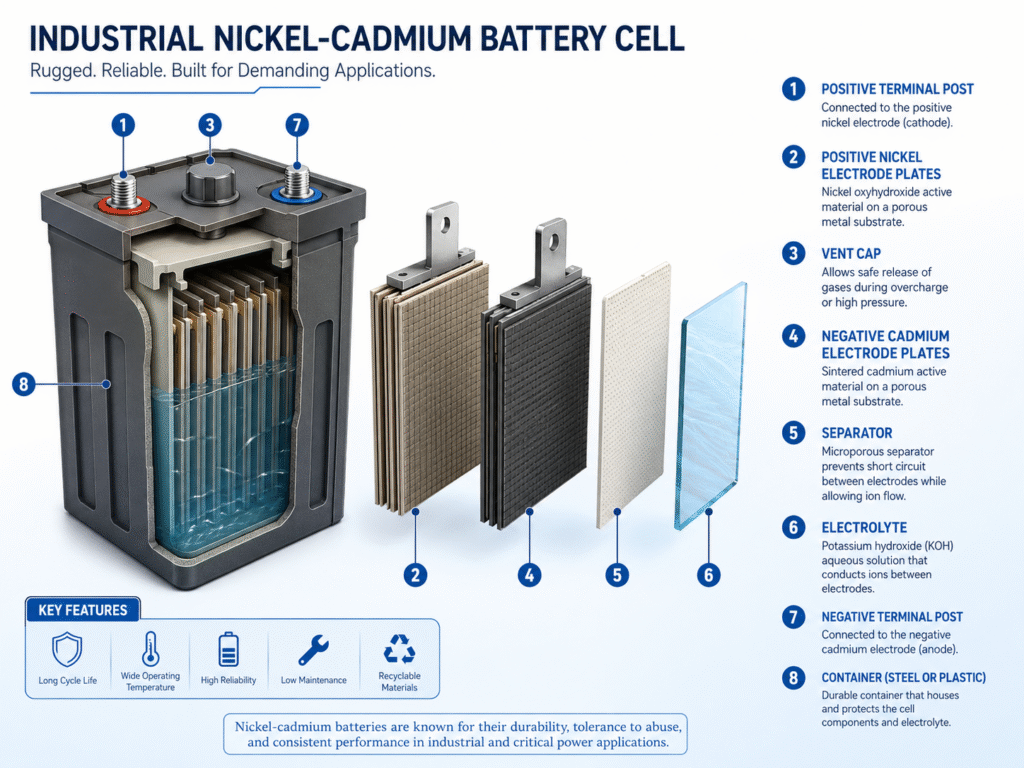
A typical industrial NiCd battery consists of:
- Positive electrode plates
- Negative electrode plates
- Separator materials
- Electrolyte (KOH)
- Steel cell container
- Vent cap
- Inter-cell connectors
Each component is designed for decades of industrial operation.
Charge Process
During charging:
- Electrical energy is converted into chemical energy.
- Active materials are restored to their charged state.
- Oxygen recombination minimizes electrolyte loss.
Industrial chargers typically operate using:
- Float charging
- Boost charging
- Equalization charging
depending on system requirements.
Discharge Process
When the external power supply fails:
- Chemical energy converts back into electrical energy.
- The battery immediately supplies the connected load.
- Voltage remains stable throughout most of the discharge cycle.
This rapid response makes NiCd batteries ideal for emergency backup systems.
Why NiCd Batteries Recover So Well After Deep Discharge
One major advantage of NiCd chemistry is its ability to recover after severe discharge events.
Unlike many battery technologies, NiCd batteries:
- Resist permanent sulfation
- Recover capacity effectively
- Tolerate repeated deep discharges
This characteristic is particularly valuable in utility and railway applications.