
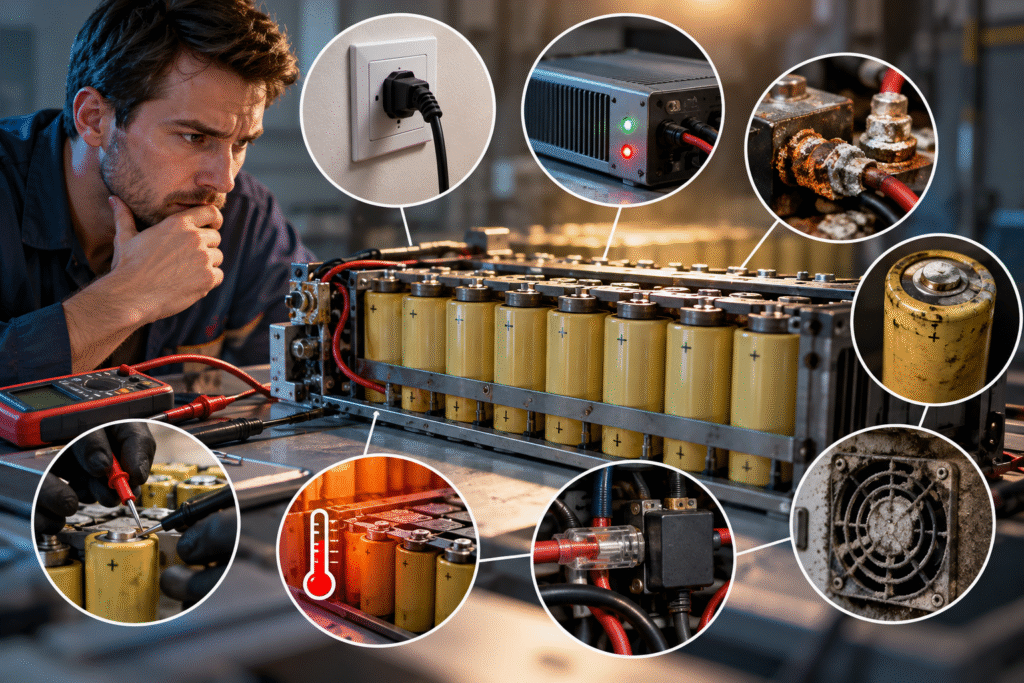
1. Incorrect Battery Charger Voltage Settings
One of the most common reasons an industrial NiCd battery fails to reach its expected charged condition is an unsuitable charger voltage setting.
Unlike lead-acid batteries, nickel-cadmium batteries have different electrochemical characteristics and charging requirements. Applying lead-acid charging parameters to a NiCd battery bank can result in inadequate charging or excessive electrolyte consumption.
For industrial vented NiCd batteries, float and boost charging voltages depend on the battery construction, manufacturer recommendations, ambient temperature, and intended operating conditions.
Some industrial NiCd designs use float charging settings around 1.40–1.45 V per cell, while boost charging may require a higher voltage. These values are illustrative rather than universal specifications, and the applicable manufacturer’s charging instructions must take priority.
What Should Operators Check?
Maintenance engineers should compare the actual charger output with the recommended charging parameters for the installed battery model. They should also verify whether the charger is operating in float mode, boost mode, or a current-limited charging stage.
A charger may display its programmed output voltage correctly while the voltage measured directly at the battery terminals is lower because of cable resistance, connections, or load conditions.
2. Insufficient Charging Time After Deep Discharge
Industrial NiCd batteries are frequently installed in standby applications where they remain on float charge for extended periods and occasionally experience deep discharge during a power interruption.
Following a significant discharge, the battery may require several hours or longer to recover, depending on the depth of discharge, available charging current, and approved charging procedure.
A common misunderstanding is that reaching the charger voltage setpoint automatically means the battery has recovered its full capacity.
In reality, battery voltage alone cannot reliably indicate the state of charge of a nickel-cadmium battery.
Example: Substation Backup Battery
Consider a substation using a 110V-class NiCd battery bank to supply protection relays and circuit breaker operating mechanisms.
After an extended power outage, the DC charger resumes operation. The charger voltage returns to its programmed value, but the battery may still require additional charging before it can deliver its specified backup duration.
If operators perform a discharge test too soon, the battery may appear to have insufficient capacity even though the problem is incomplete recharge.
3. Battery Temperature Is Outside the Recommended Charging Range
Temperature affects charging efficiency, cell voltage behavior, and battery performance.
Industrial NiCd batteries are valued for their ability to operate in demanding environments, including installations exposed to low or high ambient temperatures. Nevertheless, wide operating temperature capability does not mean that identical charging parameters are appropriate under every condition.
At low temperatures, charging acceptance may decrease and the battery may require a modified charging procedure. At high temperatures, inappropriate charging voltage can increase gas generation and water consumption.
For installations in Saudi Arabia, the United Arab Emirates, Nigeria, Kenya, or other regions where battery rooms may experience elevated temperatures, charger settings and ventilation deserve particular attention.
Recommended Actions
Operators should measure the actual battery temperature rather than relying only on the outdoor ambient temperature. They should also confirm whether temperature compensation is required or supported for the particular NiCd battery design.
If the installation uses a temperature sensor, its placement and accuracy should be checked during routine maintenance.
4. One or More Cells Have Abnormally Low Voltage
An industrial NiCd battery bank consists of multiple cells connected in series to provide the required DC system voltage.
When one cell develops an internal abnormality, the overall battery voltage may not immediately reveal the problem.
For example, a battery bank containing 90 cells can show an apparently acceptable total voltage while one or more cells behave differently from the rest.
Possible causes include internal deterioration, extended undercharging, connection problems, or differences in cell condition.
How to Identify the Problem
Technicians should record individual cell voltages under consistent operating conditions and compare them with previous maintenance records.
A single low-voltage reading is not always sufficient to confirm a defective cell, especially during charging or shortly after a change in operating mode. Repeated measurements and manufacturer-approved diagnostic procedures provide a more reliable assessment.
If a particular cell repeatedly exhibits abnormal voltage or temperature behavior, additional testing may be necessary.
5. Excessive Voltage Drop in Battery Cables and Connections
Sometimes the battery itself is operating normally, but the charging system cannot deliver the expected voltage at the battery terminals.
This situation can occur when cables are undersized, connections become loose, or corrosion increases contact resistance.
The voltage drop between the charger and battery is especially important in large industrial DC installations where long cable runs or high charging currents are involved.
For example, if the charger measures voltage at its own output terminals rather than directly at the battery bank, cable losses may prevent the battery from receiving the intended charging voltage.
Maintenance personnel should inspect cable terminations, measure voltage drop under load, and verify that connection resistance remains within acceptable limits.
6. Electrolyte Level or Maintenance Problems
Vented industrial NiCd batteries use an alkaline electrolyte, generally based on potassium hydroxide.
During normal service, water may be consumed through gas generation, particularly under charging conditions. If the electrolyte level falls below the manufacturer’s specified minimum, battery operation and service life may be affected.
It is important to understand that routine electrolyte maintenance normally involves replenishing water according to the manufacturer’s instructions, rather than adding acid or arbitrarily replacing the alkaline electrolyte.
The electrolyte level should be checked under the conditions specified by the manufacturer, because the apparent level can change with the battery’s state of charge.
7. Battery Aging and Loss of Usable Capacity
Although industrial nickel-cadmium batteries can provide long service life, they are not immune to aging.
After years of operation, battery performance may decline because of internal degradation, operating conditions, maintenance history, or repeated exposure to unsuitable charging conditions.
An aging battery may still reach its expected terminal voltage while delivering significantly less discharge capacity than required.
This is why a controlled capacity test, conducted according to the manufacturer’s procedure and applicable standards, is often more meaningful than voltage measurements alone.
Troubleshooting Checklist for Industrial NiCd Battery Banks
| Observed Problem | Possible Cause | Recommended Inspection |
|---|---|---|
| Low battery voltage | Incorrect charger setting | Check charger output and battery terminal voltage |
| Slow capacity recovery | Insufficient recharge time | Review charging current and duration |
| Excessive water consumption | High temperature or overcharging | Check charging voltage and temperature |
| One abnormal cell | Cell deterioration or connection issue | Measure and trend individual cell voltages |
| Voltage difference between charger and battery | Cable or terminal resistance | Measure voltage drop under charging current |
| Normal voltage but short backup time | Capacity loss or incomplete recharge | Conduct an approved capacity test |
Frequently Asked Questions
Can a NiCd battery show normal voltage but still have low capacity?
Yes. Terminal voltage alone is not a reliable measure of available capacity. A battery can display an apparently normal voltage while failing to deliver its rated discharge duration.
Can I use a lead-acid battery charger for a NiCd battery?
Only if the charger supports the charging profile required by the specific NiCd battery. A charger configured exclusively for lead-acid batteries should not be assumed compatible.
Should I replace the entire NiCd battery bank if one cell has low voltage?
Not necessarily. The abnormal cell should first be investigated. Any replacement must follow the manufacturer’s compatibility, maintenance, and commissioning requirements.
How often should an industrial NiCd battery be tested?
Inspection and testing intervals depend on the installation’s criticality, manufacturer recommendations, operating conditions, and applicable maintenance standards.
Conclusion
When an industrial NiCd battery is not charging fully, the most effective approach is to investigate the complete charging system before deciding that the battery must be replaced.
Charger voltage, recharge time, ambient temperature, cable resistance, electrolyte condition, and individual cell performance should all be considered.
For substations, power generation facilities, and other critical applications, identifying these problems early can reduce unexpected downtime and unnecessary maintenance costs.
Looking for industrial nickel-cadmium batteries for a new project or battery replacement?
WUXI HUIZHONG POWER CO., LTD. supplies industrial NiCd battery solutions for power utilities, railway systems, telecommunications facilities, and industrial backup power applications.
Visit www.huizhongpower.com to discuss your project requirements, including DC system voltage, required backup duration, and battery capacity.