
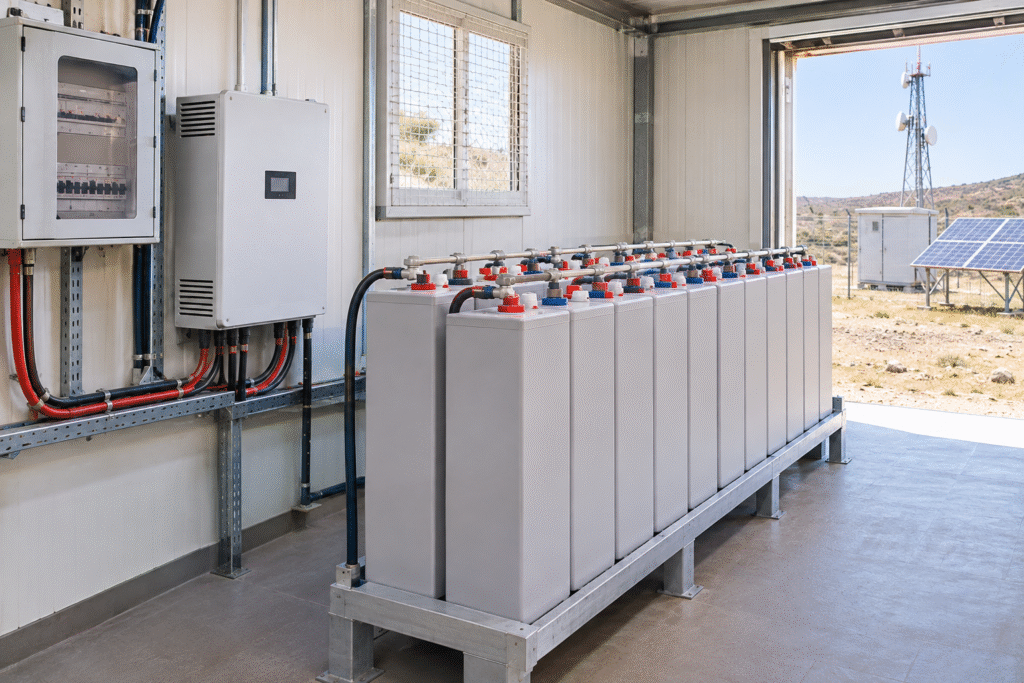
Why Remote Telecom Sites Need a Different Battery Strategy
Battery backup for a city telecom room and battery backup for a remote base station may look similar on a technical drawing, but their operating conditions can be completely different.
A remote telecom site may experience unstable utility power, several outages per day, limited maintenance access, long travel distances for service teams and high ambient temperatures. In some regions of Africa, the Middle East, Southeast Asia and Latin America, the battery bank may also operate together with solar panels and a diesel generator.
Under these conditions, battery selection cannot be based only on nominal voltage and ampere-hour capacity. The battery must be evaluated as part of the complete power system. This is one reason 2V OPzV tubular GEL batteries continue to be used in many stationary telecom applications where long service life, deep-cycle capability and reduced routine maintenance are important.
Where OPzV Batteries Fit in a Telecom Power System
A typical telecom site may contain rectifiers, a DC distribution unit, batteries, radio equipment, transmission equipment, cooling equipment and sometimes solar or generator power. Many telecom DC systems operate around a nominal 48V battery bus. A battery bank using 2V cells can therefore be configured according to the required system voltage and charger characteristics.
During normal operation, the rectifier supplies the telecom load while maintaining the battery on charge. When AC power disappears, the battery immediately supports the DC load without requiring a mechanical transfer process. At hybrid sites, the operating sequence may be more complicated. Solar energy may support the load during the day, batteries may cover short power interruptions or nighttime operation, and a diesel generator may start only when battery capacity reaches a defined threshold. In this type of project, the battery is not simply an emergency device. It becomes an active part of the site’s energy-management strategy.
Why OPzV Is Attractive for Hard-to-Reach Sites
OPzV batteries use tubular positive plates combined with an immobilized gel electrolyte. Compared with conventional flooded stationary batteries, they do not require routine water topping-up. That difference can become economically important at remote telecom sites.
Imagine a network operator with hundreds of towers located several hours away from the nearest city. Sending a technician to inspect electrolyte levels involves transportation, labor, fuel and sometimes security costs. Reducing routine battery maintenance can therefore affect the total operating cost of the entire network.
OPzV technology can be particularly attractive where maintenance visits are difficult, but it is important not to interpret “maintenance-free” as “inspection-free.” Operators should still monitor terminal condition, charging voltage, battery temperature, cell voltage consistency and physical condition.
Runtime Should Be Calculated from the Real DC Load
One of the most common mistakes in telecom battery procurement is starting with a requested battery capacity before confirming the actual site load. For example, suppose a 48V telecom system has an average DC current of 20A and the operator wants approximately eight hours of backup.
The theoretical capacity requirement starts at: 20A × 8 hours = 160Ah
However, specifying a 160Ah battery simply because the calculation produces 160Ah would usually be too simplistic. A practical design should also consider allowable depth of discharge, battery aging, site temperature, future load expansion, discharge rate, cable losses and the required reserve at the end of the design life.
For this reason, a telecom EPC or network operator may finally select a noticeably larger battery than the theoretical minimum. When requesting a quotation, providing the actual DC load and required autonomy is much more useful than simply asking, “Please quote a 48V 300Ah telecom battery.”
Frequent Outages Change the Battery Requirement
Two sites can both require eight hours of backup but operate very differently. Site A experiences one major outage every few months. Site B experiences three or four grid interruptions almost every day. The second site puts significantly more cycling stress on the battery.
In areas with unreliable electricity, buyers should therefore tell the battery manufacturer how often outages occur and how deeply the batteries are normally discharged. This information affects battery sizing and charging strategy. A battery that is suitable for standby service is not automatically the best choice for a site experiencing frequent partial or deep cycles.
Recharge Time Is Often More Important Than Buyers Expect
Backup duration receives most of the attention during battery selection, but recharge capability can be equally important. Consider a remote site with six hours of grid availability followed by a long outage. If the charger cannot restore the energy removed during the previous discharge before the next outage occurs, the battery gradually operates at a lower state of charge.
The result may look like insufficient battery capacity even though the real problem is inadequate charging opportunity. For a hybrid telecom project, the EPC should therefore evaluate the battery bank together with rectifier capacity, generator operating strategy and available solar charging power. The key engineering question is not only: “How long can the battery discharge?”
It is also: “Can the system fully or sufficiently recharge the battery before the next expected outage?”
Temperature Deserves Special Attention in Outdoor Telecom Sites
Remote telecom shelters can become very hot, especially when cooling systems are small or poorly maintained. High battery temperature accelerates lead-acid battery aging. Low temperature, on the other hand, can reduce the available discharge capacity.
This means a battery selected only according to the room-temperature catalogue capacity may not provide the expected runtime at the actual installation site. Before finalizing an OPzV telecom battery bank, buyers should communicate the expected minimum and maximum ambient temperatures to the supplier. The charging system should also use charging parameters appropriate for the selected battery model and operating temperature.
OPzV Battery Racks and Site Layout Matter
For large-capacity telecom systems, 2V cells can create a substantial battery bank. Rack dimensions, cable routing, floor loading and maintenance clearance should therefore be considered during the quotation stage rather than after the batteries arrive. For overseas projects, this becomes even more important because changing battery-room dimensions after shipment can be expensive.
A professional supplier should be able to provide battery dimensions, weight, rack arrangement drawings, inter-cell connector information and recommended installation configuration before production. For containerized telecom shelters, overall installation space may determine whether a single-row, multi-tier or alternative rack arrangement is required.
What Telecom Importers Should Include in an RFQ
A useful telecom battery RFQ should identify the DC system voltage, actual continuous load, required backup time, grid-outage frequency, expected temperature range, installation location, preferred OPzV capacity, available charging current and quantity of sites. For replacement projects, buyers should also provide photographs of the existing battery bank, battery model, rack dimensions and charger nameplate. This information allows the manufacturer to evaluate whether the requested battery is genuinely suitable instead of simply quoting the nearest catalogue model.
Should You Use One Large String or Parallel Battery Strings?
Large telecom loads sometimes require multiple battery strings connected in parallel. Parallel strings can provide additional capacity and redundancy, but they also require careful attention to cable length, conductor resistance, connection symmetry and battery matching. New and old battery strings should not be mixed casually. If parallel operation is planned, the supplier should know this during the design stage so that the battery arrangement, connectors and capacity can be reviewed as one system.
OPzV vs AGM for Remote Telecom Applications
AGM batteries remain common in telecom because they are compact, widely available and economical for many standby installations. OPzV batteries become particularly interesting when the project places greater emphasis on long-duration discharge, repeated cycling, tubular-plate durability and long-term stationary operation.
The lowest purchase price therefore should not automatically determine battery technology. For network operators managing many remote sites, replacement frequency, maintenance visits and site accessibility may have a greater influence on total cost than the initial battery price.
Purchasing OPzV Batteries for an Overseas Telecom Project
International buyers should evaluate more than capacity and price. Documentation, manufacturing consistency, export packaging, connector quality, rack compatibility and factory testing all affect project execution. This is particularly important for distributors and EPC contractors because a battery problem after installation can create costs far beyond the value of the battery itself.
Wuxi Huizhong Power manufactures stationary lead-acid batteries including OPzV, OPzS, GEL and AGM series for telecom, utility, renewable-energy and industrial backup applications. For project quotations, battery capacity can be evaluated according to the required DC voltage, load current, backup duration, operating temperature and installation arrangement.
Conclusion
OPzV batteries can be a practical solution for remote telecom towers where maintenance access is limited and reliable long-duration backup is required. However, a successful telecom battery project begins with the site operating profile rather than a catalogue capacity.
Load current, autonomy, outage frequency, recharge opportunity, temperature, charger capacity and installation layout should all be considered before the final battery bank is selected.
If you are sourcing OPzV batteries for a telecom network, BTS project or remote communication site, send us your DC voltage, site load, required backup hours, temperature range and project quantity. Wuxi Huizhong Power can help evaluate a suitable battery capacity and provide a project quotation.