
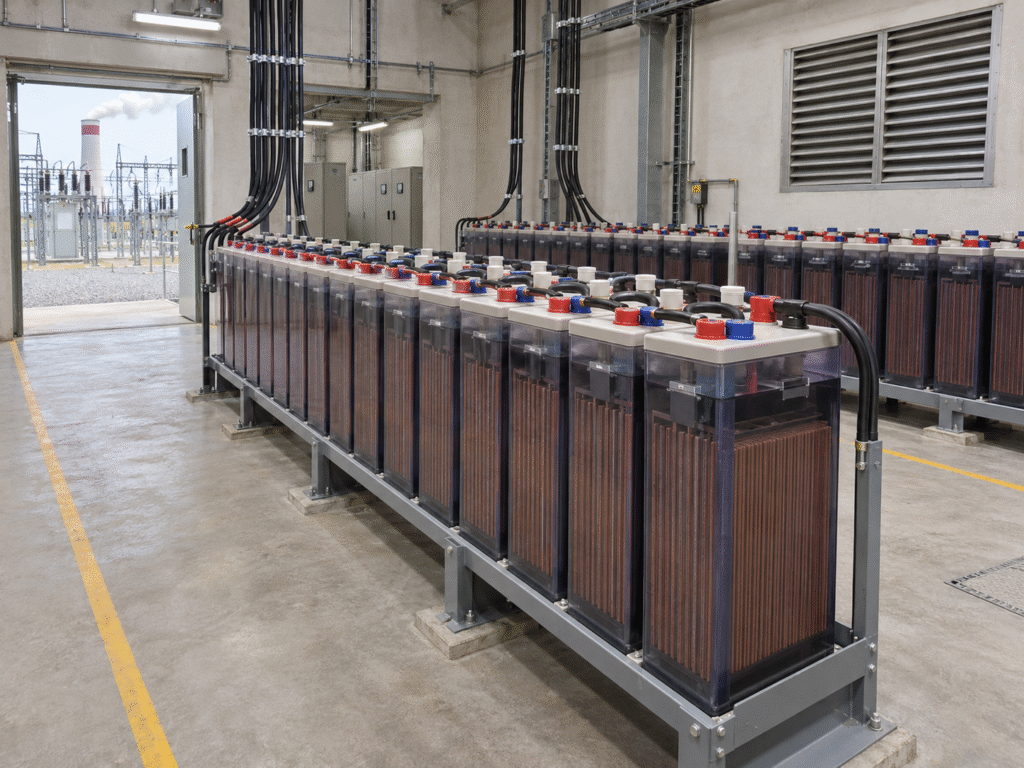
Why Substations Still Depend on Dedicated DC Battery Systems
A power substation can lose its AC auxiliary supply at exactly the moment when reliable control power is most important. Protection relays, circuit-breaker trip and close coils, control circuits, alarms, emergency lighting, communication equipment and automation systems may all depend on the station DC system.
For this reason, utilities commonly use a dedicated stationary battery bank connected to a charger or rectifier. Among the technologies used for these systems, OPzS tubular flooded lead-acid batteries remain relevant for projects that value long stationary service life, proven technology, large-capacity availability and the ability to inspect and maintain the electrolyte system. Unlike a small commercial UPS battery, a substation battery should be selected according to the complete duty cycle.
A Substation Battery Has More Than One Type of Load
One of the most important differences between a station battery and many other standby batteries is the combination of continuous and momentary loads. Continuous DC loads may include protection relays, control equipment, indication systems, communication devices and monitoring equipment.
At the same time, the battery may need to supply short-duration high-current loads when circuit breakers operate. Therefore, selecting an OPzS battery using only average continuous current can lead to an inadequate design. A proper calculation needs to consider both the required energy over the specified backup period and the battery’s ability to maintain acceptable voltage during high-current events. This is particularly important when several breakers may need to operate during the same emergency.
110V and 220V DC Systems Need More Than a Simple Cell-Count Calculation
Substation projects frequently specify nominal DC system voltages such as 110V DC or 220V DC. However, the correct number of 2V cells should not be determined simply by dividing the nominal DC system voltage by two. The design must account for charger settings, float voltage, boost or equalization requirements where applicable, maximum equipment voltage, minimum permissible load voltage, cable voltage drop and discharge end voltage.
Different utilities may also use different design philosophies. For this reason, when an EPC contractor requests a quotation for a 110V or 220V OPzS battery system, the supplier should review the required cell quantity together with the project’s charger and DC bus specifications. Simply supplying a standard number of cells without reviewing the system voltage range can create problems during commissioning.
Why OPzS Batteries Are Used in Utility DC Applications
OPzS batteries use tubular positive plates and flooded electrolyte. The tubular construction is well suited to long-duration stationary applications because the positive active material is retained within tubular gauntlets rather than relying on a conventional flat pasted positive plate.
The flooded design also allows technicians to inspect electrolyte level and perform routine maintenance throughout the service life. This characteristic is sometimes viewed as a disadvantage because maintenance is required. In many utility applications, however, regular preventive maintenance is already part of standard operating procedures. For a staffed substation or power plant with trained maintenance personnel, the ability to inspect the battery physically may be considered acceptable or even desirable.
Capacity Should Be Based on the Duty Cycle
Suppose a project specification requests several hours of emergency DC operation followed by multiple breaker operations. It would be incorrect to size the battery from one simple Ah calculation without considering when each load occurs. Utility battery sizing is normally based on a load profile or duty cycle. The engineer identifies the loads operating immediately after AC failure, the loads continuing throughout the outage and any momentary loads occurring at defined times. The battery must then support the entire sequence while maintaining the required minimum DC bus voltage.
This is why two substations with the same 110V DC bus may require very different battery capacities. One project might use a relatively small battery because the continuous load is low. Another may need substantially more capacity because of additional protection, communication, automation and emergency loads.
Breaker Tripping Can Expose a Weak Battery Bank
A station battery can appear normal during float operation while still being unable to support a demanding breaker operation. When the battery is continuously connected to a charger, the DC bus may show a normal voltage even when battery capacity has deteriorated. A real emergency is different.
If the AC supply disappears and a breaker trip command occurs, the battery must deliver the required current while maintaining sufficient voltage at the breaker coil. Excessive voltage drop may be caused not only by the battery cells but also by loose connectors, undersized cables, high-resistance joints or long cable runs. This is why factory capacity testing and site inspection should be considered together.
Charger Compatibility Is Part of Battery Selection
OPzS batteries and station chargers operate as one system. A charger with unsuitable voltage settings can shorten battery life or prevent the battery from reaching the required state of charge. Temperature, charging current and the manufacturer’s recommended float and boost parameters should therefore be considered during commissioning.
For replacement projects, the existing charger should not automatically be assumed to be suitable simply because it worked with the old battery bank. Before ordering replacement OPzS cells, buyers should check the charger output range, current rating and operating mode. If the new battery capacity is significantly different from the previous bank, recharge time should also be reviewed.
Maintenance Access Must Be Designed Before Installation
Because OPzS is a flooded battery, technicians need safe access for electrolyte inspection and other routine maintenance. Battery racks should therefore not be designed only to fit the maximum number of cells into the smallest possible space. Adequate clearance is needed to inspect cell condition, measure voltage, work on connectors and safely perform maintenance.
Large OPzS cells can also be extremely heavy. Rack loading, floor loading and lifting access therefore need consideration before shipment. For international projects, providing the supplier with a battery-room drawing or available rack dimensions can prevent significant installation problems later.
Transparent Containers Can Help Maintenance Teams
Many stationary flooded batteries use translucent containers that allow the electrolyte level to be visually inspected. For utility maintenance teams, this makes routine inspection easier. However, visual inspection is only one part of maintenance.
Operators should also record cell voltage, battery temperature, electrolyte condition where applicable, connector condition and any unusual signs such as corrosion or abnormal heating. Maintenance records are particularly valuable because they reveal gradual changes that may not be obvious during a single inspection.
New Cells Should Not Be Added to an Aging String Without Evaluation
Utilities sometimes ask whether one failed OPzS cell can simply be replaced while the rest of the bank remains in operation. Technically, individual-cell replacement may be possible in some situations, but the age and condition of the remaining cells must be considered.
Installing one new cell into a heavily aged string can create imbalance because the new cell and old cells may have substantially different capacity and internal characteristics. The decision should therefore be based on test results and the overall condition of the bank rather than the failed cell alone. For critical substations, reliability should take priority over the lowest immediate repair cost.
Information an EPC Should Send Before Requesting an OPzS Quotation
For accurate project selection, a manufacturer should receive more than a request such as “OPzS 2V 1000Ah, please quote.” The most useful technical information includes the nominal DC system voltage, required autonomy, continuous load, short-time loads, discharge end voltage, expected ambient temperature, required cell quantity or existing configuration, charger specifications and installation dimensions.
For tenders, the applicable technical standard and required tests should also be provided. If the project is replacing an existing battery bank, photographs and nameplate data from the current cells and charger can help identify potential compatibility issues.
OPzS Battery Supply for International Utility Projects
Large substation and power-plant projects often require more than battery cells. The complete supply scope may include battery racks, inter-cell connectors, terminal hardware, protective covers, installation drawings, technical datasheets, test reports and packing documentation.
For overseas EPC contractors, complete documentation can be almost as important as the battery itself because approvals and commissioning often depend on technical submissions. Wuxi Huizhong Power supplies OPzS stationary lead-acid batteries in multiple capacities for electrical utilities, substations, power stations, renewable-energy systems and industrial DC applications. Project-specific battery arrangements and racks can be evaluated according to the technical specification.
Conclusion
An OPzS battery bank in a substation is not simply an energy-storage device. It is part of the protection and control system that may be required to operate during one of the most critical moments in the life of the electrical installation. Correct sizing therefore requires evaluation of continuous loads, momentary breaker loads, autonomy, voltage limits, charger compatibility, temperature and installation conditions.
For an upcoming 110V DC, 220V DC, substation or power-plant battery project, send Wuxi Huizhong Power your single-line diagram, load schedule or technical specification. We can review the application and recommend a suitable OPzS battery configuration for quotation.