
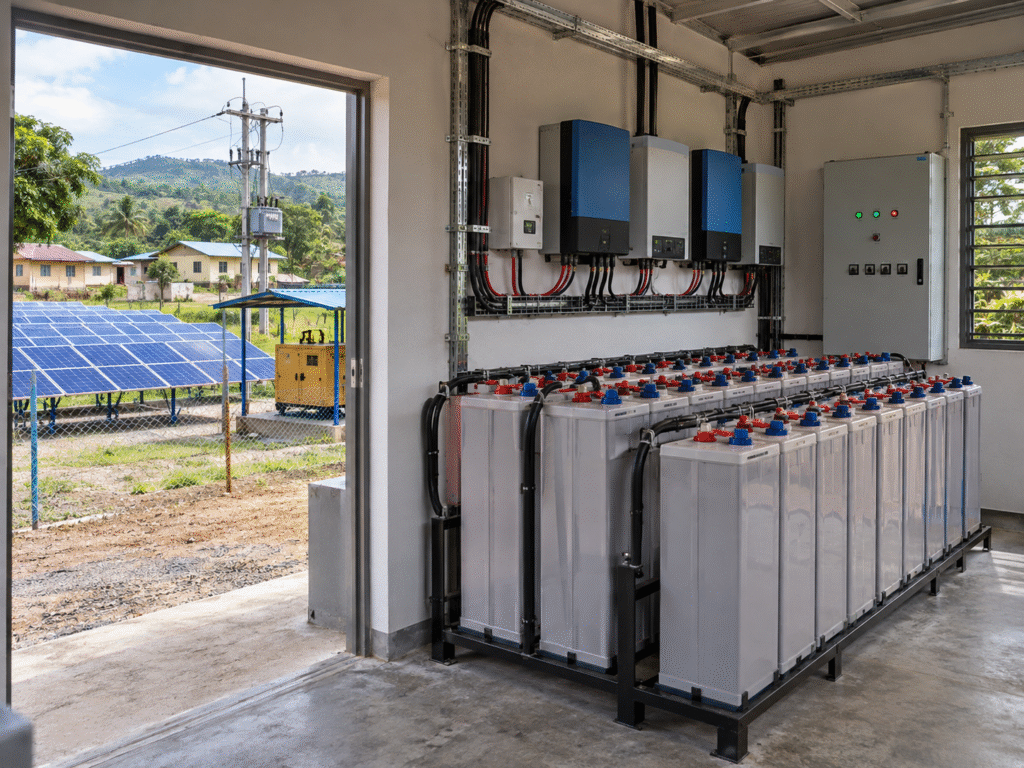
Lead-Acid Batteries Still Have a Role in Off-Grid Energy Storage
Lithium batteries now receive much of the attention in modern energy-storage projects, but tubular lead-acid batteries continue to be specified in many off-grid and hybrid power systems. This is particularly true where project owners prioritize mature technology, predictable procurement cost, local service capability and the ability to use conventional charging equipment.
OPzV and OPzS are two technologies frequently considered for large stationary solar battery banks. Both use tubular positive plates, but their electrolyte systems and maintenance requirements are different. The correct decision therefore depends less on the question “Which battery is better?” and more on “How will this particular site actually operate?”
Typical Applications for Tubular Solar Battery Banks
Large 2V tubular batteries are frequently considered for village mini-grids, remote schools, clinics, agricultural systems, telecom-energy sites, island power systems and industrial facilities without reliable utility electricity. Many of these systems combine several energy sources.
Solar PV may provide most daytime energy. Batteries support the load after sunset. A diesel generator may operate during extended cloudy periods or unusually high demand. Some projects also have limited grid power available for only part of the day. This operating profile makes the charging strategy much more complicated than a normal standby battery installation. The battery may cycle every day rather than remain on float for months.
OPzV and OPzS Solve Different Operational Problems
OPzV batteries use gelled electrolyte and a valve-regulated design. Their main attraction in remote solar applications is reduced routine electrolyte maintenance. There is normally no requirement for regular water topping-up. OPzS batteries are flooded tubular batteries. They require electrolyte monitoring and periodic addition of appropriate water according to operating conditions and the manufacturer’s instructions.
At first glance, OPzV therefore appears to be the obvious choice for every remote installation. In reality, the decision is more nuanced. If a project has qualified maintenance personnel, an established maintenance schedule and suitable battery-room ventilation, OPzS can remain a practical solution for heavily cycled stationary systems. If the site is difficult or expensive to visit, the reduced maintenance requirement of OPzV can become a major advantage.
Start with Daily Energy Consumption, Not Battery Capacity
Many solar-system inquiries begin with a statement such as: “We need a 1000Ah battery bank.” The problem is that Ah capacity alone tells the supplier very little about the application. A better starting point is the site’s daily energy consumption. Suppose a remote installation consumes 12kWh per day. If the DC battery system is 48V nominal, the theoretical daily ampere-hour demand is approximately: 12,000Wh ÷ 48V = 250Ah
But this does not mean the project simply needs a 250Ah battery bank. The engineer must consider desired depth of discharge, number of autonomy days, battery aging, temperature, system losses and future load growth. If the project requires two days of autonomy and the design intentionally avoids very deep discharge during normal operation, the required installed battery capacity can become several times the theoretical one-day Ah consumption. This is why professional battery sizing begins with the load profile.
“Three Days of Autonomy” Can Create a Very Large Battery Bank
Autonomy requirements strongly affect the cost of an off-grid project. A system designed for one night of battery operation may have a manageable battery bank. A system required to operate for three cloudy days without solar generation may need dramatically more capacity. Before accepting a large autonomy requirement, EPC contractors should determine whether a backup generator is available.
In some projects, designing a smaller battery bank plus controlled generator operation can be more economical than installing enough batteries to cover every possible weather condition. The optimum solution depends on fuel cost, maintenance availability, solar resource, required reliability and project budget. Battery sizing should therefore be part of a system-level economic decision.
Solar Charging Must Restore Yesterday’s Energy
A large battery bank is useful only if the available PV system can recharge it. This is one of the most frequently overlooked issues in off-grid design. Suppose the batteries supply a significant amount of energy overnight. The next day, the solar array must simultaneously supply daytime loads and replace energy removed from the battery.
If the PV array is too small, the battery may never return to a sufficiently high state of charge. After several days, the system may appear to suffer from “low battery capacity,” while the real problem is chronic undercharging. Persistent partial-state-of-charge operation can be especially damaging to lead-acid batteries. For this reason, battery capacity and PV capacity should never be selected independently.
OPzV May Be Better Where Maintenance Visits Are Expensive
Consider a solar-powered communications or monitoring site located several hundred kilometers from a service center. The monetary value of distilled or demineralized water itself is insignificant. The expensive part is sending a technician to the site.
Transportation, labor, accommodation and lost working time can make a simple maintenance visit surprisingly costly. In such installations, OPzV batteries can reduce the need for electrolyte-related maintenance and simplify long-term site management. This is particularly relevant for projects involving many geographically dispersed sites. A distributor or project developer should therefore compare lifetime service costs rather than battery purchase price alone.
OPzS Can Be Practical at Staffed Energy Sites
Now consider a village power station or industrial mini-grid with permanent technical staff. The site already performs routine generator, inverter and electrical maintenance. In this environment, maintaining a flooded OPzS battery bank may not create a significant additional logistical burden.
Technicians can inspect electrolyte levels and battery condition as part of the normal preventive-maintenance program. For projects where the maintenance infrastructure already exists, OPzS can therefore remain commercially attractive. This illustrates why battery technology should be matched to the operating organization as well as the electrical load.
Hot Climates Require More Than a “Tropical Battery” Label
Many solar projects are installed in high-temperature regions. Buyers sometimes ask for a “battery suitable for Africa” or “battery for Middle East temperature.” However, no battery technology is unaffected by temperature.
High temperature accelerates the aging processes of lead-acid batteries. Battery-room design, ventilation, shading, charging-voltage compensation and actual cell temperature therefore remain important. A battery installed inside a ventilated equipment room may experience very different conditions from one installed in an outdoor metal cabinet exposed to direct sunlight. When requesting a quotation, project owners should provide realistic site temperatures rather than only the country name.
Deep Discharge Should Not Become Normal Operation
OPzV and OPzS batteries are designed for deep-cycle applications, but “deep-cycle battery” does not mean the system should intentionally discharge the batteries to their extreme limit every day. A design that repeatedly uses nearly all available battery capacity leaves little reserve for aging, weather variation or unexpected load growth.
More conservative depth-of-discharge operation generally provides greater design margin and can improve long-term performance. For solar EPC companies, the target depth of discharge should therefore be established during system sizing rather than left entirely to the inverter’s default setting.
Generator Integration Can Extend System Reliability
In hybrid solar systems, a generator should not be viewed only as an emergency device. It can also be used strategically to prevent prolonged low-state-of-charge operation during extended poor weather.
For example, the controller may start the generator when battery voltage or state of charge reaches a defined level and stop it after sufficient recharge. This strategy can reduce the battery capacity required for extreme weather events while maintaining high system reliability. The charger or inverter-charger must still provide suitable charging parameters for the selected OPzV or OPzS battery.
Replacement Projects Need Additional Investigation
Replacing an old battery bank is not always as simple as installing the same Ah capacity. The original solar array may have degraded. Loads may have increased. Inverters may have been replaced. Additional equipment may have been installed.
As a result, the operating conditions that existed when the system was designed may no longer exist. Before quoting replacement batteries, an EPC contractor or distributor should verify current daily consumption, PV generation, charger settings and existing battery arrangement. Otherwise, the new battery may inherit a system-design problem from the old installation.
What Overseas Buyers Should Send to a Battery Manufacturer
A useful off-grid project inquiry should include system voltage, daily energy consumption or load profile, required autonomy, expected depth of discharge, solar-array size, inverter or charge-controller information, maximum and minimum temperature, generator availability and installation environment. Photographs and drawings are particularly useful for replacement projects. With these details, the manufacturer can discuss a technically appropriate capacity rather than simply quoting a catalogue battery.
Choosing Between OPzV and OPzS
For a remote site with minimal maintenance access, OPzV often deserves stronger consideration. For a staffed installation with established maintenance procedures and adequate ventilation, OPzS may remain an attractive option.
However, neither technology can compensate for an undersized solar array, incorrect charging parameters or unrealistic autonomy requirements. The best battery is therefore the battery that matches the complete system design and long-term maintenance strategy.
Sourcing Tubular Batteries for Solar and Hybrid Projects
Wuxi Huizhong Power manufactures OPzV and OPzS stationary lead-acid batteries for renewable-energy storage, telecom, utilities and industrial backup systems.
Battery capacities, racks, connectors and project configurations can be supplied according to different DC voltage and installation requirements. For distributors and EPC companies, we can evaluate project information before quotation so that the proposed battery capacity is matched more closely to the actual application.
Conclusion
OPzV and OPzS batteries can both be used successfully in off-grid solar and hybrid power systems, but they should not be selected by price or Ah rating alone. Daily load, autonomy, solar recharge capability, depth of discharge, temperature, site accessibility and maintenance resources all influence the final decision.
If you are preparing an off-grid solar system, hybrid mini-grid or remote energy-storage project, send us the system voltage, daily kWh consumption, required backup time, solar capacity, installation temperature and project quantity. Wuxi Huizhong Power can recommend a suitable OPzV or OPzS configuration and prepare a project quotation.