
Emergency Power in Industrial Facilities Is Not Just About Keeping the Lights On
When an industrial facility loses its normal electricity supply, the immediate priority is not always maintaining production. In many installations, the more important requirement is preserving essential control functions, supporting alarm and communication equipment, and allowing designated systems to reach or maintain a safe condition.
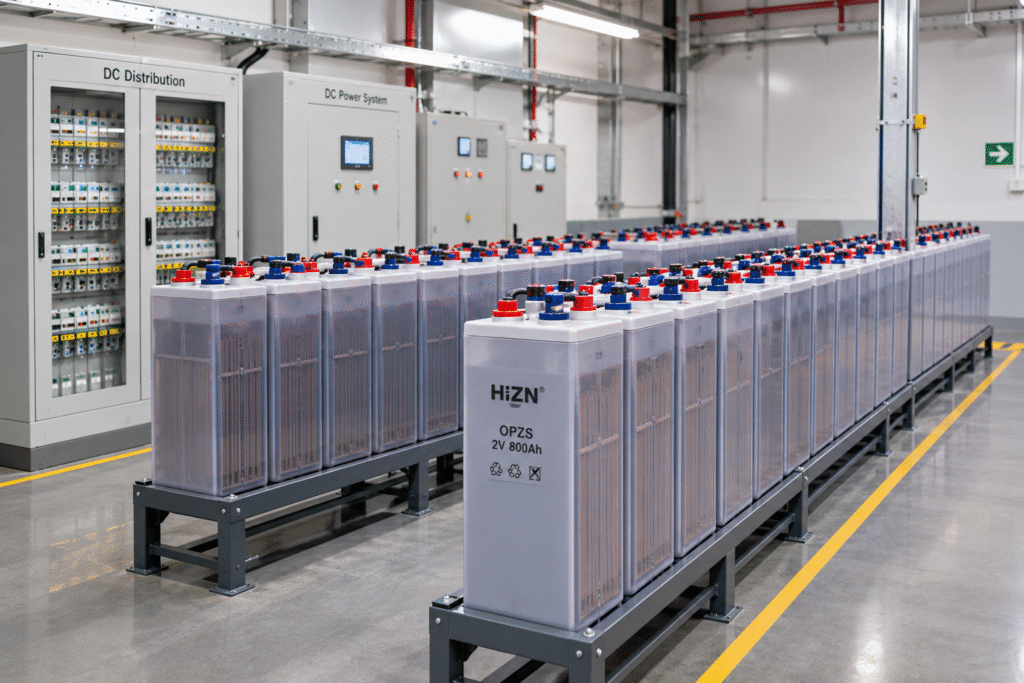
Factories, oil and gas facilities, utility installations and large industrial infrastructure projects may use dedicated DC battery systems to support selected critical loads during an AC power failure. OPzS and OPzV tubular lead-acid batteries are among the technologies that can be evaluated for suitable stationary DC backup applications. However, an industrial emergency battery system must be designed around the actual equipment requirements, applicable regulations and required operating sequence. A battery selected only by nominal voltage and ampere-hour rating may not provide the necessary performance during an emergency.
Which Industrial Emergency Systems May Require Battery Backup?
Industrial facilities can have several independent categories of critical electrical loads.
Control and Monitoring Equipment
Process-control systems, monitoring equipment and communication devices may require continuous power for a specified period after a utility failure. In some facilities, the battery supports the DC power system directly. In others, an inverter or UPS converts battery energy into the required AC supply. These arrangements have different electrical characteristics and battery requirements.
Emergency Shutdown Support Equipment
Certain industrial shutdown systems require reliable electrical power to operate protective logic or associated equipment during an abnormal event. The backup power design must consider both the continuous load and any short-duration demands during the shutdown sequence. The relevant functional-safety requirements and approved system architecture determine whether a particular battery technology can be used.
Fire-Related Auxiliary Power Systems
Some industrial facilities have dedicated power arrangements for fire alarms, monitoring equipment or emergency auxiliary functions. However, a conventional stationary OPzS or OPzV battery bank should not be assumed to satisfy the requirements of a certified fire alarm or life-safety power supply. Such applications may require dedicated listed equipment, approved battery types, supervision functions and specific standby and alarm-duration calculations. For this reason, battery selection must follow the applicable fire-system standards and approval requirements.
Industrial Emergency Lighting and Communication
Certain large industrial installations use centralized battery systems for designated emergency lighting or communication loads. Whether tubular lead-acid cells are appropriate depends on the required operating duration, charger configuration, discharge profile, installation conditions and local certification requirements. These systems should be evaluated separately from general-purpose backup power.
Continuous Loads and Momentary Loads Must Be Calculated Separately
One of the most common mistakes in industrial battery sizing is calculating only the continuous load. Consider an emergency DC system that supports monitoring and control equipment for several hours. During normal battery discharge, the continuous current may be relatively low.
However, if an emergency operation activates additional equipment, the current demand may increase significantly for a short period. The battery must maintain sufficient voltage throughout the entire duty cycle. For this reason, industrial battery calculations should include the timing and duration of individual loads, not merely the total Ah consumption. The final capacity must be verified against the selected battery’s discharge performance and the minimum voltage permitted by the connected equipment.
Example: Sizing a Stationary Battery for Industrial Control Backup
Consider a hypothetical industrial DC system with a nominal battery voltage of 110V. The continuous load is 15A, and the required standby duration is four hours. The basic continuous-load demand is: 15A × 4 hours = 60Ah
Suppose the system must also supply a short-duration additional load of 80A during an emergency sequence. It would be incorrect to simply add 80Ah to the continuous-load calculation. The additional load is measured in amperes and operates for a limited duration. Its energy demand depends on how long it operates, while its high current also creates an important voltage-performance requirement.
For example, an additional 80A lasting ten seconds consumes only approximately 0.22Ah, but the battery must still be capable of supplying the combined instantaneous current without the DC voltage falling below the required limit. A correct sizing assessment should therefore evaluate the continuous discharge period and the high-current duty cycle separately. The final battery capacity may also need allowances for temperature, aging, design margin and discharge end voltage. This is why industrial DC battery sizing should not be reduced to a simple arithmetic formula.
OPzS or OPzV: Which Technology Fits the Facility?
The two technologies share tubular positive-plate construction but have different electrolyte systems. OPzS uses flooded electrolyte and requires routine inspection of electrolyte level and appropriate water maintenance. OPzV uses a gelled electrolyte with a valve-regulated construction and does not normally require routine water topping-up. At a staffed industrial facility with an established battery maintenance program, OPzS can be an attractive solution.
Where reducing electrolyte-related maintenance is important, OPzV may offer practical advantages. However, neither option should be selected solely according to maintenance requirements. Operating temperature, required discharge performance, charger compatibility, available space and applicable approval requirements are equally important.
Battery Rooms and Industrial Safety Requirements
Stationary lead-acid battery systems introduce electrical, chemical and gas-related hazards that must be addressed in the installation design. Battery rooms or enclosures should provide suitable ventilation, electrical protection, access clearance and environmental control. Flooded OPzS batteries can release hydrogen during charging. Valve-regulated OPzV batteries can also release gas under certain operating or fault conditions.
Therefore, selecting OPzV does not automatically eliminate ventilation requirements. The necessary protective measures depend on the installed battery capacity, charging conditions, room characteristics and relevant standards. Industrial projects should evaluate installation safety using applicable requirements such as IEC 62485-2, together with local electrical and fire regulations.
Charger Failure Can Compromise Emergency Readiness
A stationary battery is often kept on charge for long periods before being required to operate. During this time, the charger plays a critical role in maintaining battery readiness. An unsuitable charger setting can cause undercharging, accelerated aging or excessive charging stress.
In some systems, the DC bus may continue to operate normally while the battery gradually loses usable capacity. This means a normal DC bus voltage does not necessarily prove that the battery can support the required emergency load. A reliable maintenance program should evaluate both the charger and the battery. Where required by the system design, charger-failure alarms, battery monitoring and periodic performance testing should be included.
Why Emergency Battery Replacement Is More Complicated Than Matching Ah
Industrial facilities often replace battery banks after many years of service. A buyer may request the same voltage and capacity as the original installation. However, the equipment connected to the DC system may have changed since the initial commissioning. Additional instruments, control devices, communication systems or protective equipment may have increased the total load.
The charger may also have deteriorated or been modified. Before replacement, the engineering team should compare the current duty cycle with the original design assumptions. If the existing battery experienced premature failure, the cause should be investigated before ordering a new bank. Simply installing a replacement with the same Ah rating may leave the underlying problem unresolved.
Designing for Maintainability and Future Replacement
Large 2V battery banks can contain dozens or even more than one hundred individual cells, depending on system voltage and configuration. Installation planning should consider more than the initial available space. Technicians need access to terminals, connectors and inspection points. Heavy cells require suitable handling procedures and load-bearing structures.
For flooded batteries, maintenance staff must also be able to inspect and service the electrolyte system safely. Replacement logistics matter as well. If a battery room has a narrow entrance or restricted lifting access, transporting large cells into the installation may become difficult. These issues should be identified before the supplier finalizes battery dimensions and rack drawings.
Procurement Documents Should Define the Complete Supply Scope
Industrial EPC contractors frequently work with detailed technical specifications. A complete battery RFQ should identify the required DC voltage, operating voltage limits, battery duty cycle, autonomy, installation temperature, charger information and relevant project standards.
The procurement scope should also clarify whether the battery supplier is responsible for racks, inter-cell connectors, terminal hardware, installation drawings, technical documentation and factory tests. For international projects, the destination country, shipping requirements and acceptance procedures should be discussed early. The technical specification should take priority over a generic product catalogue.
Avoiding Common Mistakes in Emergency Battery Procurement
Several recurring purchasing mistakes can create unnecessary technical and commercial risk. The first is selecting a battery from a simple Ah calculation without reviewing the full duty cycle. The second is retaining an old charger without confirming compatibility with the replacement battery. The third is ignoring actual battery-room temperature when evaluating expected service life.
Another mistake is assuming that a battery described as industrial, long-life or maintenance-free is automatically approved for every emergency or life-safety application. Proper documentation and application verification are essential. For distributors, these checks also help reduce after-sales disputes and costly replacement claims.
How an Experienced Supplier Supports Industrial DC Projects
Wuxi Huizhong Power manufactures OPzS, OPzV, AGM and GEL stationary lead-acid batteries for industrial energy-storage and backup applications. For project inquiries, technical evaluation can include battery voltage, required capacity, installation dimensions, terminal arrangement and application conditions.
For large industrial EPC projects, early communication about racks, documentation, factory testing and shipping arrangements can help avoid delays during technical approval and equipment procurement. Where the application is safety-critical or subject to specific equipment approvals, final suitability must be established through the appropriate engineering and certification process.
Conclusion
Industrial emergency DC systems are designed to support important electrical functions when normal power is unavailable. Their reliability depends on much more than the battery capacity printed on the label.
Continuous loads, short-duration current demands, voltage limits, charger performance, operating temperature, battery-room design and maintenance procedures must all be considered.
OPzS and OPzV tubular batteries can be evaluated for suitable industrial stationary backup systems, provided the selected technology meets the project’s operating and approval requirements.
Looking for OPzS or OPzV batteries for an industrial emergency DC system?
Send Wuxi Huizhong Power your technical specification, nominal DC voltage, load schedule, required autonomy, charger details and project quantity.
We can review the requested configuration and prepare an application-based quotation.
Website: www.huizhongpower.com
Email: felix@hujhon.com