

Introduction
A nickel-cadmium battery bank may contain dozens or even more than one hundred individual cells connected in series to provide the DC voltage required by industrial equipment.
These battery systems are commonly used in power substations, generating stations, railway signaling facilities, and emergency shutdown systems where reliable backup power is essential.
One of the more difficult maintenance problems is identifying a weak cell before it causes the battery bank to fail during discharge.
The overall battery voltage may appear normal, and the charger may show no obvious alarm. Nevertheless, an individual cell can have significantly lower usable capacity than the rest of the battery bank.
When the system is required to provide emergency power, that weak cell may reach its discharge limit earlier than the others, reducing the available backup duration.
Understanding how to detect and evaluate cell voltage imbalance is therefore an important part of industrial NiCd battery maintenance.
1. What Is Cell Voltage Imbalance in a NiCd Battery Bank?
Cell voltage imbalance occurs when individual cells within a battery bank display different voltage characteristics under comparable operating conditions.
In a series-connected battery bank, every cell carries the same charging or discharging current. However, differences in internal condition, capacity, temperature, and maintenance history can cause individual cell voltages to behave differently.
Small voltage differences are not necessarily abnormal.
The concern arises when one or more cells consistently deviate from the expected behavior of the battery bank, particularly during controlled discharge testing.
A weak cell may reach a low voltage earlier than neighboring cells even though the overall battery bank has not yet reached its specified discharge endpoint.
2. Why Can a Weak Cell Remain Undetected During Float Charging?
During normal standby operation, an industrial NiCd battery bank is often connected to a charger that maintains the DC bus voltage.
Under these conditions, the total battery voltage is primarily influenced by the charger and the charging characteristics of the cells.
This means that the overall bank voltage does not necessarily provide a reliable indication of the usable capacity of every individual cell.
Example: 110V-Class Industrial DC System
Consider a nominal 110V-class battery system using 92 nickel-cadmium cells connected in series.
Even if the total bank voltage appears acceptable, an individual cell can limit discharge performance.
If one cell has deteriorated, the remaining cells may still allow the overall battery voltage to remain close to the expected value during charging.
However, during a discharge event, the weak cell may lose voltage more rapidly than the others.
The result can be premature termination of the discharge test or insufficient backup time during an actual power failure.
3. Common Causes of Weak Cells in Industrial NiCd Batteries
Uneven Cell Aging
Although all cells in a battery bank may have been installed at the same time, their aging characteristics are not necessarily identical.
Small differences in manufacturing, operating temperature, and service conditions can accumulate over many years.
As a result, one cell may experience a greater reduction in usable capacity than the rest of the battery bank.
Incomplete Charging
A cell that has not reached an appropriate charged condition may show reduced performance during discharge.
This can occur because of unsuitable charger settings, insufficient charging time, or other operating conditions.
Before classifying a cell as defective, operators should verify that the battery bank has been charged according to the manufacturer’s approved procedure.
Electrolyte Problems
Low electrolyte level, contamination, or electrolyte leakage can affect cell performance.
In vented NiCd batteries, routine maintenance should include checking electrolyte levels and inspecting cell containers and vent assemblies.
Abnormal electrolyte conditions should be investigated before conducting further testing.
High Connection Resistance
Loose or corroded intercell connectors can produce voltage drop and localized heating.
A voltage measurement taken across both a cell and its connection may therefore be misleading.
To distinguish cell performance from connection resistance, technicians should use consistent measurement points and separately evaluate the voltage drop across intercell connections.
4. How to Identify a Weak NiCd Cell
The most reliable approach combines operating records, individual cell measurements, and controlled testing.
Step 1: Record the Overall Battery Voltage
Measure the total battery voltage at the battery terminals and compare it with the expected value for the current charging or discharging condition.
Record the charger operating mode, charging current, battery temperature, and measurement time.
Step 2: Measure Individual Cell Voltages
Measure the voltage of each cell using an appropriate instrument and consistent test points.
For meaningful comparison, readings should be taken under similar conditions.
A single reading outside the average range does not automatically confirm cell failure. However, a cell that repeatedly behaves differently from neighboring cells should be investigated.
Step 3: Inspect Cell Temperature and Physical Condition
Check for abnormal heating, damaged containers, electrolyte leakage, and unusual deposits.
A cell that exhibits both abnormal voltage behavior and elevated temperature requires particular attention.
Any damaged or leaking cell should be handled according to the manufacturer’s safety procedures.
Step 4: Conduct an Approved Capacity Test
A controlled discharge test is an important method of determining whether the battery bank can deliver its required capacity.
During testing, technicians should monitor both the total battery voltage and individual cell behavior.
The discharge current, endpoint voltage, temperature correction, and acceptance criteria must follow the applicable battery specification and testing procedure.
The test should be performed by qualified personnel using suitable equipment, with arrangements to maintain critical DC loads.
5. Understanding Voltage Behavior During Discharge
Nickel-cadmium batteries have a relatively flat discharge voltage characteristic over much of their usable capacity.
This characteristic is beneficial for industrial applications because it helps maintain a stable DC supply during discharge.
However, it also means that voltage alone is not a precise indicator of remaining capacity.
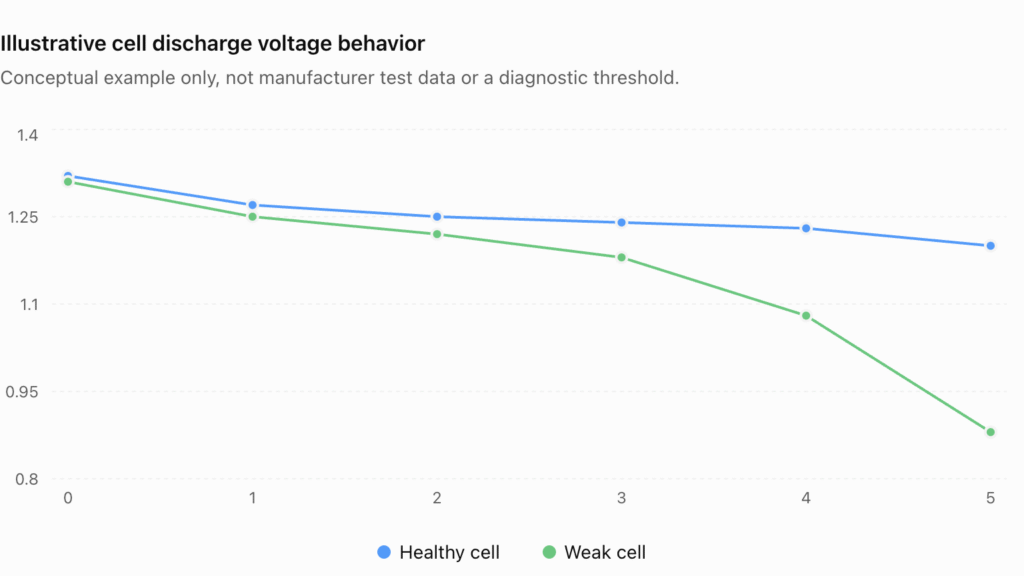
A healthy cell generally maintains a relatively stable voltage before approaching the end of its discharge period.
A weak cell may experience a more rapid voltage decline and reach its discharge limit earlier.
The exact voltage profile depends on discharge rate, temperature, cell construction, and state of charge. Therefore, the curves above should not be used as field acceptance criteria.
6. Should You Replace One Weak Cell or the Entire Battery Bank?
This is a common question for maintenance contractors and industrial battery distributors.
Replacing a single cell may be technically possible in some industrial NiCd battery systems, but the decision should not be based solely on the price of a replacement cell.
The new cell must be compatible with the existing battery bank in terms of design, capacity, charging characteristics, and other manufacturer-specified requirements.
The condition and age of the remaining cells must also be considered.
If a battery bank has been operating for many years and several cells exhibit reduced capacity, replacing only one cell may not provide a long-term solution.
For critical applications, a complete battery bank assessment is recommended before deciding between individual cell replacement and full battery replacement.
7. Preventing Cell Imbalance in Industrial Battery Installations
A preventive maintenance program should focus on identifying changes before they affect the availability of the DC backup system.
| Maintenance Activity | Purpose |
|---|---|
| Record individual cell voltages | Identify developing abnormalities |
| Monitor battery temperature | Detect unusual operating conditions |
| Inspect electrolyte levels | Prevent electrolyte-related problems |
| Check intercell connections | Reduce resistance and localized heating |
| Verify charger settings | Maintain appropriate charging conditions |
| Perform capacity testing | Confirm actual backup capability |
| Maintain historical records | Identify long-term performance trends |
Maintenance frequency should follow the battery manufacturer’s recommendations, site operating requirements, and applicable standards.
8. Special Considerations for Battery Distributors and Replacement Projects
For overseas distributors and engineering contractors, weak-cell complaints often occur in battery banks that have already been operating for several years.
Before requesting replacement cells from a manufacturer, it is useful to collect the following information:
- Battery model, nominal capacity, and installation date.
- Number of cells connected in series.
- Charger float and boost voltage settings.
- Individual cell voltage measurements.
- Operating temperature and electrolyte maintenance history.
- Available discharge test reports and fault records.
This information allows the battery supplier to evaluate the application more accurately and determine whether individual cell replacement or a new battery bank is more appropriate.
For large industrial projects, providing complete technical information can also reduce quotation errors and prevent compatibility problems during installation.
Frequently Asked Questions
Can one weak NiCd cell affect the entire battery bank?
Yes. In a series-connected battery bank, a weak cell may reach its discharge limit earlier than the others and reduce the usable backup duration of the complete system.
Does a low cell voltage always indicate a defective cell?
No. Cell voltage depends on charging conditions, temperature, measurement timing, and other factors. Further investigation is required before confirming cell failure.
Can NiCd battery cells be replaced individually?
Individual cell replacement may be possible when approved by the manufacturer and when the replacement cell is compatible with the existing system.
Is a capacity test necessary if the battery voltage looks normal?
For critical backup systems, capacity testing is important because normal terminal voltage does not guarantee that the battery can deliver its required discharge duration.
Conclusion
Cell voltage imbalance is an important maintenance concern in industrial nickel-cadmium battery systems, especially where the battery bank supports critical DC equipment.
A weak cell may remain unnoticed during normal float charging but become a serious limitation during an emergency discharge.
Regular individual cell measurements, electrolyte inspections, charger verification, and capacity testing can help identify developing problems before they cause unexpected power interruptions.
WUXI HUIZHONG POWER CO., LTD. supplies industrial nickel-cadmium batteries for substations, power plants, railway systems, and other demanding backup power applications.
For battery replacement projects or new DC power system installations, visit www.huizhongpower.com to request technical information and discuss your required battery capacity, discharge performance, and installation conditions.