
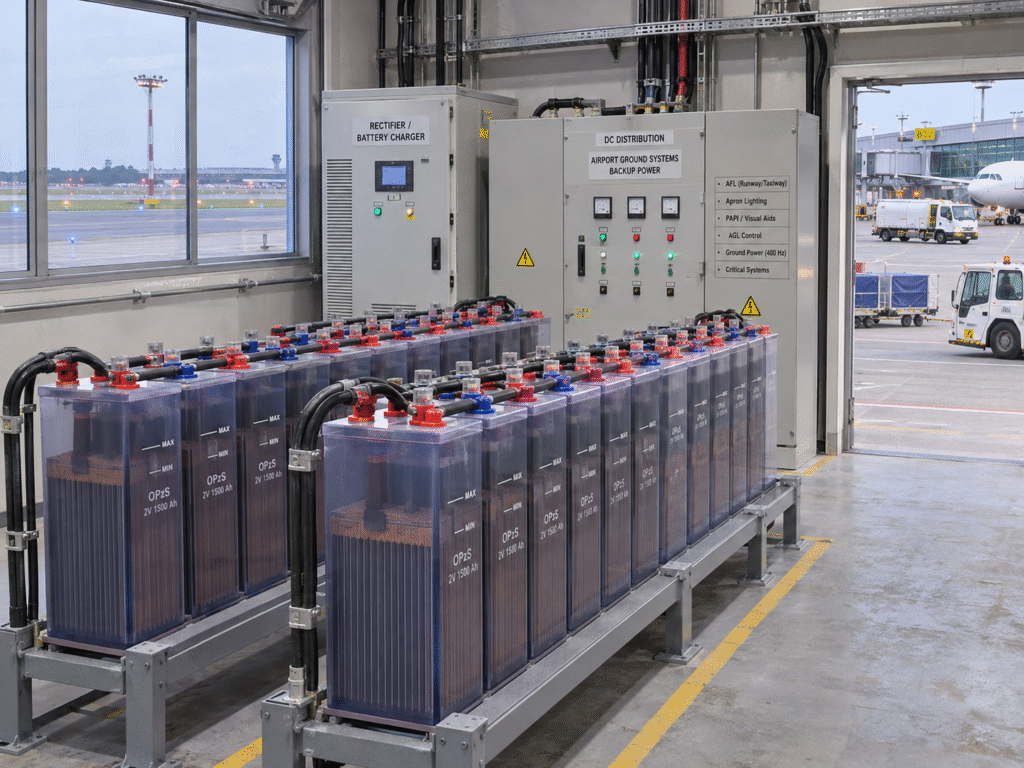
What Happens When an Airport Ground Facility Loses Power?
An airport contains numerous electrical systems with different operational priorities. Terminal buildings, communication facilities, monitoring stations, electrical substations and ground-based navigation infrastructure may all depend on dedicated backup power arrangements. During a utility interruption, some systems require immediate transfer to an alternative electricity source. Others may operate from batteries while generators start or until normal power is restored.
A well-designed backup system must maintain the required equipment functions within the voltage and operating limits established by the airport’s engineering specifications. Stationary OPzS and OPzV batteries can be considered for certain airport auxiliary DC and backup applications where the approved system architecture permits their use. However, airports are highly regulated environments. Battery suitability must be established for each specific application rather than assumed from the battery’s general industrial performance.
Airport Backup Power Is Not One Single System
A major airport may operate several independent electrical backup systems.
Ground Communication Facilities
Fixed communication facilities may need backup power for radio equipment, transmission devices, monitoring electronics and associated DC distribution. The required battery capacity depends on the actual equipment load and specified autonomy. Some installations may use a centralized DC battery bank, while others rely on equipment-specific UPS systems.
Ground-Based Navigation Support Facilities
Certain fixed ground-based navigation installations require highly reliable electricity. The approved power-supply architecture may include batteries, UPS systems, generators or other redundant sources.
If stationary OPzS or OPzV batteries are considered, the project engineer must verify that the technology, performance and monitoring arrangements meet the relevant equipment and aviation-authority requirements. A generic industrial battery should not be presented as automatically approved for aviation navigation equipment.
Airport Electrical Substations
Airport substations can have station DC systems supporting designated switchgear control, protection and monitoring equipment. These applications have engineering similarities to industrial and utility DC battery systems. The load schedule may contain continuous control loads and short-duration breaker-operation currents. OPzS or OPzV battery selection should therefore be based on a duty-cycle calculation rather than nominal Ah alone.
Remote Monitoring Installations
Large airports may have remotely located monitoring cabinets, weather-related instrumentation or communications equipment. Where such equipment requires independent DC power, an appropriately designed stationary battery installation may be considered. For low-power equipment, a compact battery solution could be more suitable than large 2V tubular cells.
Three Questions Before Choosing an Airport Battery
Before selecting OPzS or OPzV, the EPC contractor should resolve three engineering questions.
First: What equipment must remain operational?
The answer defines the battery load schedule and may identify different power-supply requirements for different equipment categories.
Second: How long must the equipment operate without normal electricity?
Some systems require relatively short bridging periods, while others may require extended backup.
Third: What approvals and technical standards apply?
A battery that meets ordinary stationary industrial requirements may not satisfy the approval requirements of a specific airport system. These questions should be answered before the supplier is asked to recommend a model.
Why Battery Duty Cycle Matters More Than Nominal Capacity
Consider a hypothetical airport auxiliary DC system with a continuous load of 20A and a required backup duration of four hours. Its initial continuous-load demand is: 20A × 4 hours = 80Ah
If the system also includes short-duration switchgear loads, those loads must be added to the duty-cycle assessment. The battery must support the required current without allowing the equipment voltage to fall below the specified minimum.
For this reason, selecting an 80Ah battery merely because the continuous-load calculation produces 80Ah would not be a reliable engineering decision. The final design must consider battery aging, temperature, discharge characteristics, minimum DC voltage, cable losses and appropriate design margins. Manufacturer discharge tables should be used to verify the final capacity.
OPzS and OPzV Have Different Maintenance Requirements
OPzS batteries use flooded electrolyte and tubular positive plates. They require appropriate electrolyte inspection, water maintenance and monitoring. For an airport facility with permanent electrical maintenance staff, these requirements may be manageable within established maintenance procedures.
OPzV batteries use a gelled electrolyte and valve-regulated construction. Routine water replenishment is normally unnecessary, which may be attractive for selected remote installations with limited maintenance access. However, both technologies require charging-system compatibility, periodic inspection and suitable installation conditions. Neither technology is automatically superior for every airport application.
Charger Compatibility and DC Bus Voltage
Airport infrastructure may use different DC voltage levels depending on the equipment and electrical design. A 2V cell battery bank must be configured according to the permissible charging and discharging voltage range. The number of cells should not be chosen solely by dividing the nominal DC bus voltage by two.
The engineer should also review charger float voltage, any permitted boost or equalization functions, maximum equipment voltage and minimum voltage during discharge. For replacement projects, the existing charger must be evaluated before a different battery model or technology is installed. An unsuitable charger may shorten battery life or leave the battery insufficiently charged when backup power is required.
Battery Monitoring and Preventive Maintenance
Airport facility operators may require the electrical backup system to report abnormalities before an actual power failure. Depending on the project, monitoring may include battery voltage, charger status, battery temperature and alarms. For large stationary banks, individual-cell monitoring or periodic cell measurements can help identify developing problems.
However, monitoring alone cannot prove that a battery will deliver its rated backup duration. Performance testing and periodic maintenance remain important. The appropriate testing procedure should follow the battery manufacturer’s instructions and the applicable project standards.
Battery Rooms and Installation Safety
Large stationary batteries require suitable installation arrangements. Battery-room design should consider ventilation, electrical protection, access clearance, floor loading and safe maintenance procedures. Flooded OPzS batteries require particular attention to electrolyte handling and water maintenance.
Valve-regulated OPzV batteries also require appropriate ventilation because gas release can occur under certain charging or fault conditions. The airport facility’s electrical safety requirements, applicable battery installation standards and local regulations should be incorporated into the design. For equipment installed near sensitive electronic systems, cable routing, grounding arrangements and associated electrical protection must be considered within the complete system design.
What About Equipment Certification?
This is a particularly important issue for airport procurement. A product described as an industrial battery is not necessarily qualified for aviation-related service. The project may require compliance with particular aviation authority specifications, electrical standards, environmental tests or equipment approval procedures.
General manufacturer documentation, ordinary CE declarations or transport certificates do not automatically demonstrate suitability for every airport application. Therefore, the EPC contractor should provide the complete technical specification and identify any mandatory certifications before requesting the final quotation. The battery manufacturer should confirm which documents and tests can actually be supplied.
Replacing Existing Airport Battery Banks
Battery replacement at an operating airport may involve strict maintenance windows and installation procedures. The new battery’s dimensions, weight, terminal arrangement and connector configuration should be reviewed against the existing installation.
For an OPzS or OPzV replacement, the project should verify the present load schedule and charger parameters. If the previous battery bank experienced abnormal deterioration, possible causes such as temperature, charging conditions or connection resistance should be investigated. A replacement project should not rely only on the capacity shown on the old battery nameplate.
RFQ Checklist for Airport Infrastructure Contractors
An effective technical inquiry should include the following information:
| Information | Why It Matters |
|---|---|
| Application and equipment type | Defines the operating and approval requirements |
| Nominal DC voltage | Establishes the initial battery configuration |
| Continuous and intermittent loads | Supports duty-cycle calculations |
| Required backup duration | Determines the energy requirement |
| Minimum permissible DC voltage | Defines discharge performance limits |
| Charger specifications | Confirms charging compatibility |
| Installation temperature | Affects capacity and aging |
| Battery dimensions and rack layout | Supports installation planning |
| Mandatory standards and certifications | Determines project eligibility |
| Quantity and destination | Supports commercial quotation |
Providing this information at the beginning of procurement can reduce technical clarification cycles and avoid offering a battery that does not meet the actual system requirement.
Working with a Stationary Battery Manufacturer
Wuxi Huizhong Power manufactures OPzS flooded tubular, OPzV tubular GEL and other stationary lead-acid batteries for industrial energy-storage and backup applications.
For suitable airport auxiliary DC and infrastructure projects, we can review the electrical requirements, installation dimensions, requested battery capacity and supporting documentation. International EPC contractors and industrial battery distributors can submit technical specifications for evaluation before requesting final pricing. Any aviation-specific qualification or application approval must be separately confirmed.
Conclusion
Airport ground infrastructure includes multiple electrical systems with different reliability and approval requirements. A suitable backup battery solution must be selected according to the actual load, required autonomy, voltage limits, charging architecture and installation environment.
OPzS and OPzV stationary batteries may be considered for selected airport auxiliary DC applications where their use is permitted by the project specification.
Preparing an airport electrical infrastructure, ground communication or auxiliary DC battery project?
Send Wuxi Huizhong Power your technical specification, DC voltage, duty cycle, required backup time, charger details and project quantity.
Our team can review suitable OPzS or OPzV configurations and prepare a project-based quotation.
Website: www.huizhongpower.com