
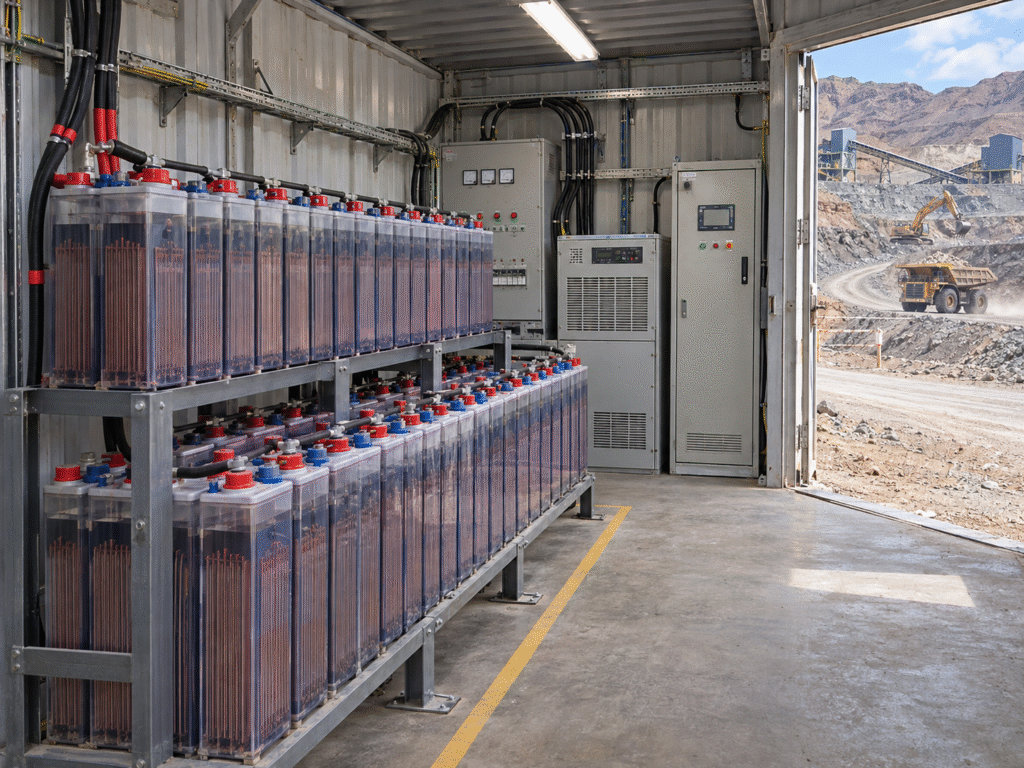
Mining Projects Often Operate Beyond Reliable Electrical Infrastructure
Mining operations frequently take place in remote areas where utility electricity is limited, unstable or unavailable. Open-pit mines, mineral processing facilities, exploration camps and remote monitoring stations may depend on generators, solar power or hybrid electrical systems.
For these facilities, backup electricity is not always about keeping the entire mining operation running. In many cases, the immediate requirement is to maintain communications, monitoring, instrumentation and designated control functions when the primary power source fails. Stationary OPzV and OPzS tubular lead-acid batteries can be considered for these industrial backup applications. The challenge for engineering contractors is selecting the right battery architecture for the specific site, rather than applying the same energy-storage configuration to every mining installation.
Different Mining Facilities Require Different Backup Strategies
Remote Mining Communication Stations
Large mining operations may operate radio networks, communication towers, repeaters and data-transmission equipment across extensive areas. These systems help coordinate personnel, vehicles and operations.
At remote communication sites, batteries may support designated DC loads during generator shutdowns or grid interruptions. OPzV batteries can be particularly relevant where maintenance visits are difficult and reduced routine electrolyte maintenance is desirable. The required backup capacity depends on continuous equipment current, operating voltage, expected outage duration and charging availability.
Environmental and Geotechnical Monitoring Stations
Remote mining operations may install equipment to monitor environmental conditions, water levels, equipment status or other site parameters. Such monitoring stations may be supplied by solar panels and small DC battery systems.
The battery must support the equipment overnight and during periods of insufficient solar energy. For larger fixed monitoring installations, OPzV batteries may be considered where their capacity, physical dimensions and cycling characteristics match the application. Small monitoring devices may instead be better served by compact battery formats.
Mineral Processing and Industrial Control Rooms
Processing facilities may need backup power for selected PLCs, industrial communication systems, alarms and process-monitoring equipment. These loads can be supported through a suitable DC battery system or an industrial UPS architecture.
However, large motors, crushers, conveyors and pumping systems normally require separate power-system engineering. A stationary tubular lead-acid battery bank intended for control backup should not automatically be treated as a power source for major industrial machinery.
The Difference Between Backup Power and Daily Energy Storage
A mining communication station operating on reliable utility power may require a battery only during occasional interruptions. A remote station running on solar and generator power may discharge its battery every day. Although the electrical loads may be similar, these two operating patterns place different demands on battery performance.
Standby applications emphasize readiness after long periods on charge. Hybrid applications introduce more frequent cycling, variable charging opportunities and possible operation at partial state of charge. The engineering team should therefore communicate the expected discharge frequency to the manufacturer. A battery that performs well in standby service may not deliver the expected lifetime if subjected to a much more demanding cycling schedule.
Example: Battery Backup for a Mining Communication Site
Consider a hypothetical remote mining communication installation operating at 48V DC. The site has an average continuous DC current of 25A and requires eight hours of backup. The theoretical energy demand in ampere-hours is: 25A × 8 hours = 200Ah
This value is only the starting point. The selected battery must be capable of delivering the required current over eight hours while maintaining acceptable system voltage. Capacity allowance may also be needed for battery aging, temperature, future equipment expansion and the desired remaining reserve.
Unlike a simple multiplication of current and time, final battery selection should be based on the manufacturer’s discharge tables at the applicable discharge duration and end voltage. If additional equipment operates intermittently, the duty cycle must include those loads as well. For projects with multiple parallel strings, cable arrangement and current sharing must be evaluated carefully.
High Temperature Can Significantly Affect Mining Battery Life
Many remote mining installations are located in hot, dry regions. Battery compartments can experience even higher temperatures than the surrounding outdoor environment, especially inside small metal shelters or poorly ventilated cabinets. Higher operating temperatures accelerate the aging of lead-acid batteries.
Dust, corrosion and vibration may also affect the surrounding electrical installation. The battery room or enclosure should provide appropriate thermal conditions, electrical protection, ventilation and maintenance access. A battery described as suitable for mining is not automatically qualified for every temperature, vibration or environmental condition encountered at a mine. Actual site conditions must be assessed before equipment selection.
OPzV Versus OPzS for Mining Infrastructure
Both technologies use tubular positive plates but differ in electrolyte construction and maintenance requirements. OPzV uses gelled electrolyte and a valve-regulated design. Routine water replenishment is normally unnecessary. This can make OPzV attractive for unmanned mining communication or monitoring stations where regular maintenance visits are costly.
OPzS uses flooded electrolyte and requires periodic electrolyte inspection and maintenance. At a large, staffed processing facility with qualified maintenance personnel, OPzS may be a commercially practical solution. The decision should reflect operating frequency, maintenance accessibility, charging conditions, environmental temperature and lifecycle cost. Selecting only the lowest initial battery price may lead to higher operating costs later.
Generator-Battery Hybrid Systems Need a Recharge Strategy
Mining sites often operate diesel generators for part of the day. If the battery must support communication and monitoring equipment while the generator is off, the charging period becomes a critical design factor. The charger must have enough available capacity and operating time to replace the energy removed during the previous discharge.
However, installing a larger charger does not automatically solve every problem. Lead-acid batteries have charging-current limits, and charge acceptance changes as they approach full charge. A battery bank that is repeatedly discharged and only partially recharged can deteriorate faster than expected. For hybrid mining power systems, the generator schedule, charger capacity, battery capacity and discharge profile should be considered together.
Hazardous Mining Locations Require Separate Approval
Mining facilities may contain hazardous atmospheres, combustible dust or other specialized environmental risks. Certain underground mines also impose strict requirements on electrical equipment, ventilation and battery installations. A conventional OPzV or OPzS battery is not automatically suitable for these locations.
If the project involves underground coal mining, explosive atmospheres or other classified hazardous areas, the complete battery system must be evaluated against the applicable mining and electrical safety requirements. The manufacturer’s general product certificates should not be interpreted as approval for hazardous-area installation. For this reason, buyers should identify the actual installation classification in their RFQ.
Battery Replacement at Remote Mining Sites
Replacing an aging battery bank at a remote mining facility can involve significant transport and installation expenses. Battery weight, physical dimensions, rack compatibility and handling arrangements should be confirmed before shipping. For overseas projects, even a small dimensional difference can create problems if the original battery rack cannot accommodate the replacement cells.
The existing charger should also be checked for compatibility. If the old battery bank failed prematurely, the project engineer should investigate charging behavior, temperature and actual load conditions before ordering a replacement. Otherwise, the same system problem may affect the new batteries.
What Mining EPC Contractors Should Include in an RFQ
An effective project inquiry should identify the mining application, installation location, nominal DC voltage, load profile and required backup duration. It should also include the charging source, expected discharge frequency, battery temperature range, installation dimensions and environmental conditions.
For projects requiring hazardous-area approvals or specific mining standards, those requirements should be clearly stated. Where the project involves several remote facilities, buyers should provide the total site quantity and whether the electrical requirements are identical across locations. This helps the supplier evaluate standardized battery configurations and project logistics.
OPzV and OPzS Battery Supply for Mining Projects
Wuxi Huizhong Power manufactures OPzV tubular GEL, OPzS flooded tubular and other stationary lead-acid batteries for industrial backup and renewable-energy applications. For mining communication systems, remote monitoring stations and industrial auxiliary power, we can review the battery capacity, DC voltage, installation requirements and operating profile when preparing quotations. For overseas mining EPC contractors and battery distributors, technical specifications, project quantities and destination details can be evaluated together to support procurement planning.
Conclusion
Reliable battery backup in a mining project begins with understanding the actual electrical loads and operating environment. Communications equipment, remote monitoring stations and industrial control systems can have very different power requirements from mining machinery.
OPzV batteries may be suitable for selected unmanned stationary installations where reduced routine maintenance is valuable, while OPzS can remain practical at staffed industrial facilities with established maintenance procedures.
Sourcing stationary lead-acid batteries for a mining communication network, remote monitoring station or industrial auxiliary power project?
Contact Wuxi Huizhong Power with your system voltage, load schedule, required autonomy, expected temperature, installation arrangement and project quantity.
Our team can evaluate a suitable OPzV or OPzS configuration and prepare a project-based quotation.
Website: www.huizhongpower.com