
Introduction
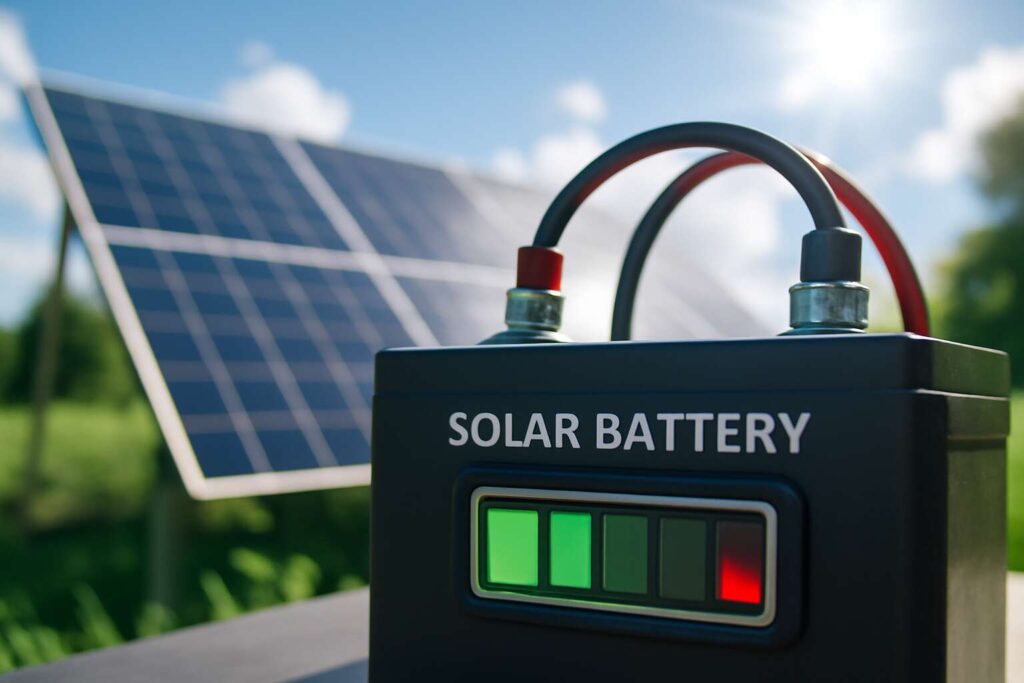
A common problem in off-grid and hybrid solar systems is that the lead-acid battery bank begins charging every morning but does not reach a confirmed full-charge condition before sunset.
The solar charge controller may remain in bulk or absorption mode for most of the day. In other systems, the controller briefly shows float, but the battery still provides shorter-than-expected runtime during the night.
This problem is often caused by an imbalance between:
- Daily energy consumption
- Available solar energy
- Battery-bank capacity
- Charging-current limits
- Absorption time
- Weather conditions
- System losses
A lead-acid battery requires more than reaching a target voltage for a few minutes. It must also remain at the correct absorption voltage long enough for charging current to decline to an appropriate level.
Morningstar explains that the bulk stage supplies the maximum available current and commonly restores approximately 80%–90% of the battery’s state of charge. The remaining charging process takes place mainly during absorption, so a system that reaches the absorption voltage late in the afternoon may not have enough sunlight left to complete the charge.
What Does “Fully Charged” Actually Mean?
A lead-acid battery should not be considered fully charged only because:
- The controller displays a high voltage.
- The charge indicator shows several bars.
- The controller briefly enters absorption.
- The controller changes to float.
- The battery voltage looks normal immediately after charging.
A reliable full-charge assessment normally considers several conditions:
- The correct absorption voltage was reached.
- The battery remained in absorption for sufficient time.
- Charging current declined appropriately.
- Battery temperature remained normal.
- Individual battery voltages were reasonably consistent.
- Flooded-cell specific gravity stabilized where measurement is possible.
- The battery delivered expected capacity during a later discharge test.
The exact full-charge criteria depend on the battery manufacturer, battery type, charger design, and system configuration.
Reason 1: The Solar Array Produces Less Daily Energy Than the Loads Consume
The most fundamental cause is an energy deficit.
If the loads consume more energy each day than the solar array returns to the battery, the battery bank will gradually operate at a lower state of charge.
A system may appear correctly designed based on the solar panel nameplate rating, but actual daily production is affected by:
- Peak sun hours
- Cloud cover
- Seasonal solar conditions
- Panel temperature
- Dust
- Shading
- Panel orientation
- Controller efficiency
- Wiring losses
- Battery-charging losses
For example, a nominal 3kW solar array does not continuously produce 3kW from sunrise to sunset.
If the array produces 10kWh of usable daily energy but the loads and system losses consume 12kWh, the battery bank experiences an approximate 2kWh daily deficit.
The batteries may still charge during the middle of the day, but they will not fully recover the energy removed during the previous night.
Reason 2: Daytime Loads Are Using Most of the Solar Power
The charge controller may show a high output current, but not all of that current necessarily enters the battery.
Suppose:
- Solar controller output: 60A
- Inverter and DC loads: 45A
- Net battery charging current: 15A
Although the controller reports 60A, the battery receives only approximately 15A.
This distinction is especially important in systems operating:
- Water pumps
- Refrigeration
- Air conditioning
- Telecom equipment
- Office equipment
- Workshop machinery
- Continuous security systems
Morningstar notes that when system loads exceed the available solar charging current, the controller may be unable to maintain the battery at its float set point.
A shunt-based battery monitor can help distinguish between:
- Solar-controller output current
- Load current
- Actual net battery current
Reason 3: The Solar Array Is Too Small for the Battery Bank
A large battery bank requires enough charging power to replace the energy removed during discharge and then complete the absorption stage.
Increasing battery capacity without increasing the solar array can create a system that has long theoretical backup time but never completes a full recharge.
For example, consider a 48V 800Ah battery bank.
If 40% of its nominal capacity is removed overnight:
48V × 800Ah × 40% = 15.36kWh of nominal DC energy removed
After charging losses and daytime loads are included, the solar system may need to produce considerably more than 15.36kWh to restore the bank fully.
If the site has only four effective peak sun hours, the required array power may be much greater than expected.
Battery-bank and PV-array sizing must therefore be performed together.
Reason 4: The System Reaches Absorption Too Late in the Day
Solar charging has a limited daily window.
If the battery reaches absorption at 4:00 p.m. and sunset occurs at 5:30 p.m., there may not be enough solar power or time to complete absorption.
This often occurs when:
- The previous night’s discharge was too deep.
- Morning loads are high.
- The PV array is undersized.
- Panels are shaded during the morning.
- The battery bank is too large.
- Charging current is limited.
- Weather conditions reduce production.
Repeatedly reaching absorption late in the day can leave the battery in a partial state of charge even though the voltage appears acceptable.
Partial-state-of-charge operation is a major concern in off-grid lead-acid systems because prolonged incomplete charging promotes sulfation and capacity loss. Morningstar identifies extended partial-state-of-charge operation as a common contributor to shortened lead-acid battery life in off-grid solar systems.
Reason 5: Absorption Time Is Too Short
Some solar controllers use a fixed absorption time. Others use adaptive algorithms based on battery voltage history, charging current, or the previous discharge.
If absorption time is too short, the controller may change to float before the battery has completed charging.
Possible causes include:
- Incorrect controller preset
- Battery capacity entered incorrectly
- Tail-current setting too high
- Absorption timer too short
- Controller reset during the day
- Battery voltage rising prematurely
- Another charger raising system voltage
- High battery internal resistance
The required absorption time depends on:
- Battery chemistry
- Depth of discharge
- Charging current
- Battery age
- Battery temperature
- Manufacturer recommendations
A large battery bank discharged deeply generally requires more charging time than a small bank discharged lightly.
Reason 6: The Charge Controller Uses the Wrong Battery Profile
Charge-controller settings should match the selected battery model.
Settings may differ between:
- Flooded lead-acid
- AGM
- GEL
- OPzV
- OPzS
- Lead-carbon batteries
Important settings include:
- Absorption voltage
- Absorption time
- Float voltage
- Equalization voltage
- Equalization frequency
- Charging-current limit
- Temperature compensation
- Float-exit conditions
Morningstar advises installers to configure absorption, float, and equalization settings according to the battery manufacturer rather than relying automatically on a generic controller preset.
Using a setting that is too low can cause chronic undercharging. A setting that is too high can cause gassing, water loss, venting, corrosion, and shortened battery life.
Reason 7: The Charge Controller Is Limiting Current
The controller may be operating correctly but unable to provide all the current available from the panels.
Possible causes include:
- Controller current rating is too low.
- Controller temperature derating is active.
- PV input voltage is outside the preferred operating range.
- Battery-charging current limit is programmed.
- The inverter or energy-management system imposes a current limit.
- The controller is protecting itself from overheating.
- Multiple controllers are not configured consistently.
For example, a 100A-capable solar array connected through a controller limited to 60A cannot provide more than the controller’s permitted output.
Clipping may be acceptable during occasional peak production, but frequent current limiting can reduce the daily charging energy available to the battery.
Reason 8: Solar Panels Are Shaded, Dirty, or Poorly Oriented
Partial shading can significantly reduce solar-array output.
Common sources of shading include:
- Trees
- Antennas
- Buildings
- Roof structures
- Utility poles
- Other rows of solar panels
- Dust accumulation
- Bird droppings
The effect may occur only during certain hours.
Morning shading is particularly important because it delays battery recovery after the overnight discharge. Afternoon shading can interrupt absorption before the battery reaches full charge.
Check solar production throughout the entire day rather than relying only on a midday reading.
Compare:
- Expected PV power
- Actual PV power
- PV voltage
- PV current
- Controller output
- Weather conditions
Reason 9: The Battery Bank Has High Internal Resistance
An aged or sulfated battery may reach the absorption voltage quickly without accepting much energy.
The controller sees the correct voltage and reduces current, but the battery remains at a low usable capacity.
Typical signs include:
- Battery voltage rises unusually quickly.
- Absorption begins earlier than expected.
- Charging current falls rapidly.
- The controller enters float.
- Battery runtime remains short.
- Voltage collapses under load.
This is different from an undersized solar array.
With an undersized array, the battery may struggle to reach absorption. With a high-resistance battery, it may reach absorption too quickly but fail to store adequate energy.
A controlled capacity test is required to distinguish between charging-system limitations and battery deterioration.
Reason 10: Cable Voltage Drop Causes Incorrect Regulation
The solar controller may measure the voltage at its own terminals rather than directly at the battery.
If the charging cables are too long, too small, loose, or corroded, the controller can see a higher voltage than the voltage actually present at the battery terminals.
For example:
- Controller output voltage: 57.6V
- Battery-terminal voltage: 56.4V
The controller may reduce current because it believes the absorption target has been reached, while the battery receives insufficient voltage.
Inspect:
- Controller-to-battery cable size
- Cable length
- Terminal torque
- Fuse holders
- Circuit breakers
- Busbars
- Cable-lug crimps
Measure voltage at both the controller and battery while substantial charging current is flowing.
Reason 11: Temperature Compensation Is Missing or Incorrect
Lead-acid charging voltage should be adjusted according to battery temperature.
If the battery is cold, an uncompensated charging voltage may be too low, leading to incomplete charging.
If the battery is hot, an uncompensated voltage may be too high, increasing the risk of overcharging.
Common errors include:
- No temperature sensor
- Sensor installed near the controller instead of the battery
- Sensor attached to a battery in a different temperature zone
- Incorrect compensation coefficient
- Damaged sensor wiring
- Several chargers using different temperature values
The temperature sensor should represent the battery bank’s actual operating temperature.
Reason 12: Several Chargers Are Not Coordinated
The battery may be connected to:
- Solar MPPT controllers
- An inverter/charger
- A generator charger
- A grid charger
- A wind controller
Another charger may raise the battery voltage, causing the solar controller to reduce output or display absorption or float even when solar energy is not providing the majority of the charge.
Morningstar notes that a controller may display a charging stage when another charging source is connected to the same battery bank, even when solar input is absent.
To understand the real charging process, measure:
- Current from each charger
- Net current entering the battery
- Battery voltage
- Active charger stage
- Time spent in absorption
Reason 13: The Battery Bank Is Frequently Discharged Too Deeply
A system may be technically capable of charging the battery after a shallow discharge but incapable of recovering from a deep daily discharge before sunset.
For example, an array may recharge 20% of battery capacity easily but fail to replace 60% every day.
This can occur after:
- New loads are added.
- Operating hours increase.
- The battery bank loses capacity.
- Seasonal sunlight decreases.
- Appliance efficiency declines.
- Users begin operating heavy loads at night.
The battery’s daily depth of discharge should be measured rather than estimated.
Reason 14: Seasonal Solar Production Has Changed
A system that charges fully during summer may remain undercharged during winter or a prolonged rainy season.
Seasonal changes affect:
- Day length
- Sun angle
- Peak sun hours
- Cloud cover
- Shading patterns
- Panel temperature
- Load demand
In hot regions, air-conditioning demand may increase during periods when high panel temperature reduces PV efficiency.
In rainy or monsoon regions, several consecutive low-production days can leave the battery bank at partial state of charge.
Battery and solar sizing should use the site’s worst relevant solar season, not only annual average production.
How to Calculate Whether the Array Can Recharge the Battery
A preliminary daily energy calculation can be made using:
Energy to Replace = Battery Voltage × Ah Removed
Then account for charging losses and daytime loads.
Example
Battery bank:
- 48V
- 400Ah
- 40% daily discharge
Energy removed:
48 × 400 × 0.40 = 7,680Wh
Assume approximately 85% overall battery-charging efficiency for a preliminary estimate:
7,680Wh ÷ 0.85 = approximately 9,035Wh
Daytime loads:
3,000Wh
Total daily solar energy required:
9,035Wh + 3,000Wh = approximately 12,035Wh
With four effective peak sun hours and an assumed 80% overall PV system yield:
Required PV power = 12,035 ÷ 4 ÷ 0.80
Required PV power = approximately 3,761W
A practical system would require additional design margin for weather, aging, temperature, and seasonal variation.
This is a preliminary calculation. Final sizing should use actual site irradiation data and equipment specifications.
Practical Troubleshooting Procedure
Step 1: Record the Nightly Discharge
Measure:
- Evening battery voltage
- Morning battery voltage
- Ah removed
- Nighttime energy consumption
- Lowest battery voltage
- Peak inverter current
Step 2: Record Daily Solar Production
Collect:
- PV energy in kWh
- Maximum PV power
- Controller output current
- Hours in bulk
- Hours in absorption
- Time entering float
Step 3: Measure Net Battery Current
Use a battery shunt to separate solar output from actual battery charging current.
Step 4: Compare Controller and Battery Voltage
Measure both values during high-current charging.
Step 5: Check Individual Batteries
Measure every battery in the series string during:
- Morning rest
- Bulk charging
- Absorption
- Evening discharge
Step 6: Inspect the Solar Array
Check:
- Shading
- Dust
- Damaged modules
- Loose MC4 connectors
- String fuses
- Combiner-box connections
- PV voltage
- PV current
Step 7: Verify Controller Settings
Compare every setting with the battery manufacturer’s data sheet.
Step 8: Test Battery Capacity
A battery bank with reduced capacity may show abnormal charge behavior even when the solar system is correctly sized.
Common Mistakes
Adding More Batteries Without Adding Solar Panels
This increases storage capacity but also increases the energy and time needed for charging.
Judging Full Charge from Voltage Alone
Voltage can rise before the battery has accepted full capacity.
Ignoring Daytime Loads
Solar power used by loads is not available for battery charging.
Using Annual Average Sun Hours
The battery must remain reliable during the lowest-production season.
Increasing Charging Voltage to Compensate for a Small Array
Higher voltage cannot create energy that the solar array does not produce.
Assuming Float Means the Battery Is Healthy
The controller may enter float because of timer logic, voltage rise, another charger, or high battery resistance.
Frequently Asked Questions
Why does the controller stay in bulk charge all day?
The battery may be deeply discharged, the PV array may be undersized, loads may consume most solar power, or available sunlight may be insufficient.
Why does the controller enter float but runtime is still short?
The absorption stage may be incomplete, the battery may have reduced capacity, or cable voltage drop may cause premature voltage regulation.
Should I add more solar panels or more batteries?
If the batteries cannot be fully recharged, adding more batteries may worsen the problem. First calculate the energy deficit and available charging power.
Can I use a generator to complete charging?
Yes, when the inverter/charger and generator are correctly sized and configured. The total charging current must remain within the battery manufacturer’s limit.
How often should a solar lead-acid battery reach full charge?
The required charging schedule depends on the battery design and manufacturer. However, chronic partial-state-of-charge operation should be avoided unless the battery is specifically designed for it.
Conclusion
A solar lead-acid battery bank that never reaches full charge before sunset is usually experiencing an energy-balance or charging-control problem.
The most common causes are:
- Insufficient PV energy
- Excessive daytime loads
- Oversized battery capacity
- Late absorption
- Incorrect charge-controller settings
- Short absorption time
- Shading or dirty panels
- Cable voltage drop
- High battery internal resistance
- Seasonal production changes
For an accurate system evaluation, provide the battery voltage and Ah capacity, battery type, PV-array wattage, charge-controller model, daily load consumption, peak sun hours, charging-stage history, cable sizes, and measured battery current.