
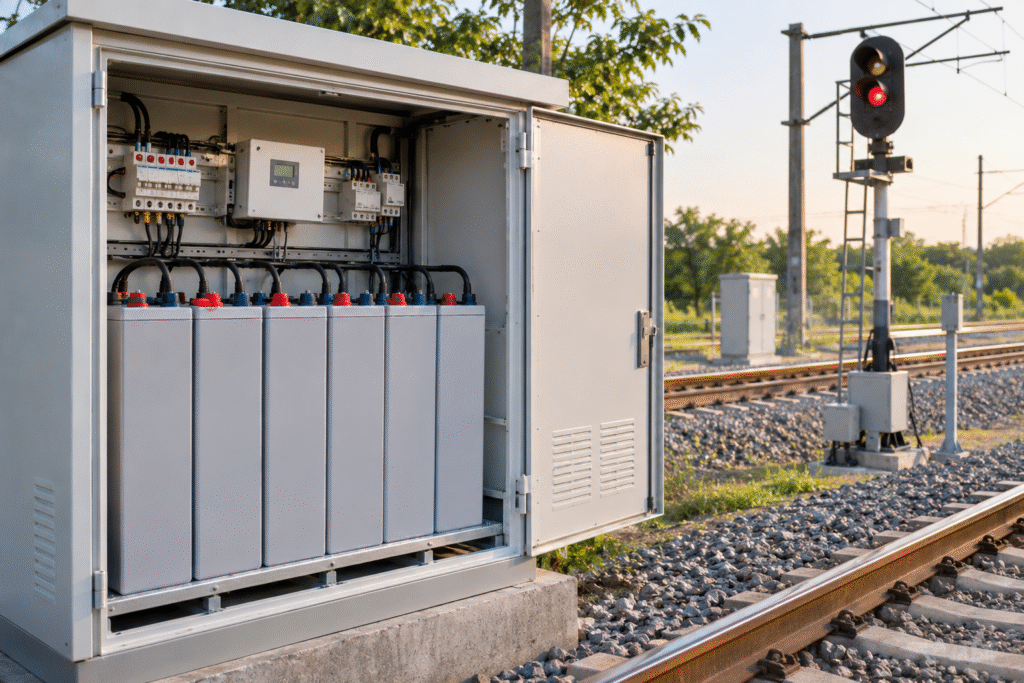
Railway Signaling Power Is Different from Ordinary Commercial Backup
Railway signaling systems depend on reliable power to support control, communication and monitoring equipment. Even a relatively small trackside installation may contain equipment that must remain operational or transition safely during a loss of utility electricity. Unlike an office UPS installation, railway equipment may be located in remote cabinets, unmanned equipment rooms, tunnels or stations with limited maintenance access. The electrical load can be modest, but the consequences of an unsuitable battery system can be significant.
For this reason, railway system integrators need to evaluate batteries according to the complete application rather than relying only on nominal voltage and ampere-hour capacity. OPzV tubular GEL batteries can be considered for selected stationary railway backup applications where long-duration DC support, reduced electrolyte maintenance and suitable environmental protection are required. However, battery suitability must always be verified against the railway operator’s technical specification and the applicable system safety requirements.
Which Railway Applications May Use OPzV Batteries?
Trackside Signaling Equipment Rooms
Trackside equipment rooms may contain signal controllers, communications equipment, monitoring devices and associated DC power supplies. When the normal AC supply fails, a stationary battery bank can support designated loads for a specified period, depending on the system architecture.
In remote regions, long distances between maintenance locations make battery reliability particularly important. A battery bank that requires frequent unscheduled site visits may increase the railway operator’s maintenance costs substantially.
Railway Communication and Monitoring Systems
Railway communication networks often extend across large geographical areas. Some sites may have unstable utility power or limited access during unfavorable weather. Stationary batteries may support communication cabinets, remote data-acquisition equipment and selected monitoring loads. Where system voltage and space permit, 2V OPzV cells can be configured into a larger battery bank to support the required DC voltage and backup duration.
Remote Level Crossings and Wayside Installations
Some wayside installations rely on local power systems rather than a continuously available utility supply. These systems may combine grid power, solar panels, chargers and batteries. However, the backup requirements and allowable battery technologies for level-crossing safety functions are highly application-specific. Any OPzV solution must be approved within the relevant railway safety design rather than treated as a generic replacement.
What Makes OPzV Relevant to Remote Railway Installations?
OPzV batteries use tubular positive plates with a gelled electrolyte in a valve-regulated construction. For projects where regular electrolyte maintenance is difficult, the absence of routine water topping-up can be an advantage. This does not mean the battery requires no monitoring. Terminal condition, charging parameters, cell voltage, temperature and overall battery condition still require appropriate inspection.
An operator managing many remote signaling sites should therefore evaluate the total lifetime maintenance burden, including travel expenses, technical labor and replacement downtime. A battery that is slightly more expensive to purchase may still offer an attractive operating-cost profile when routine maintenance access is particularly difficult.
How to Calculate Battery Capacity for Railway Backup
The first step is to identify which electrical loads must remain supplied during a power interruption. Some equipment may need continuous power, while other loads operate intermittently. The power system may also have short-duration current demands that are not represented by average consumption.
Consider a hypothetical DC installation with a continuous load of 12A and a required backup period of eight hours. The basic current-time calculation gives: 12A × 8 hours = 96Ah
This is only an initial energy-demand estimate, not the required battery nameplate capacity. The final battery selection must consider discharge-rate characteristics, permissible end voltage, battery aging, temperature, reserve margin and the equipment’s minimum operating voltage. If the system includes intermittent higher-current loads, these must be included in the duty-cycle calculation. The manufacturer’s discharge tables should then be used to establish whether the selected battery can meet the required discharge profile.
Battery Voltage Must Match the Railway DC Power Architecture
Railway equipment may use different DC voltage levels depending on the operator, signaling technology and equipment design. A supplier should not assume that all railway signaling applications operate at 48V or 110V. For a system using 2V cells, the required series-cell quantity depends on the full charging and operating voltage range, not simply the nominal voltage.
The engineer must review float charging, permissible maximum voltage, minimum load voltage, discharge end voltage and cable voltage drop. This becomes particularly important when replacing an existing battery bank while retaining the original charger. A nominally compatible battery may still create problems if its charging requirements or discharge behavior differ from those of the original installation.
Temperature and Outdoor Cabinet Conditions
Railway equipment can be exposed to widely varying environmental conditions. A trackside cabinet in a hot climate may experience elevated internal temperatures, particularly under direct sunlight. Equipment in colder regions may experience reduced available battery capacity during winter. Both conditions affect battery design.
Higher temperatures can accelerate aging, while low temperatures reduce discharge performance. The battery supplier should therefore receive the expected operating temperature range and, where possible, information about the actual battery enclosure. The enclosure must also provide suitable ventilation, environmental protection and maintenance access according to the battery design and applicable standards.
When Is a 2V OPzV Battery Bank Appropriate?
Large 2V tubular GEL cells are generally more attractive for stationary systems requiring substantial energy capacity or long-duration backup than for compact low-power cabinets. For example, a large signaling control room or communications shelter may justify a centralized 2V battery bank.
A small cabinet with only a few watts of continuous consumption may be more suitably served by a smaller battery format. Therefore, using a 2V OPzV battery simply because it is marketed as a long-life product does not automatically result in the best solution. Correct selection depends on physical space, power requirements, battery-system architecture and maintenance strategy.
Replacement Projects Need Special Attention
International suppliers frequently receive requests for replacement batteries based on photographs or existing model numbers. Although this information is useful, it does not confirm that the old system was correctly sized. Before replacing a railway battery bank, the EPC contractor should verify the existing DC load, charging voltage, condition of the charger, available installation space and the required backup duration.
The remaining electrical infrastructure should also be inspected for signs of overheating, corrosion or abnormal resistance. If the battery bank was experiencing premature failure, installing an identical replacement without investigating the charging system may reproduce the same problem.
What Railway EPC Contractors Should Include in an RFQ
A technically useful RFQ should provide:
- Railway application and equipment type
- Nominal DC voltage and acceptable voltage range
- Continuous and intermittent load requirements
- Required backup duration
- Minimum and maximum installation temperature
- Existing charger model and charging parameters
- Battery enclosure or rack dimensions
- Required technical standards and approval documents
- Project quantity and destination country
For railway safety-related applications, the EPC should additionally identify the operator’s approval process and any mandatory certification or validation requirements. A battery manufacturer’s ordinary product documentation cannot replace railway system-level safety verification.
Sourcing OPzV Batteries for International Railway Projects
Overseas railway projects often require coordinated technical submissions before equipment procurement. Battery dimensions, cell weights, terminal arrangements, inter-cell connectors, rack configuration, installation instructions and factory testing requirements should be reviewed before manufacturing.
Wuxi Huizhong Power manufactures OPzV tubular GEL and other stationary lead-acid batteries for industrial backup and infrastructure applications.
For railway-related projects, we can review the requested battery capacity, DC voltage, installation arrangement and available product documentation to determine whether a suitable battery configuration can be offered. Application suitability and any railway-specific approvals must be confirmed against the actual project requirements.
Conclusion
Reliable railway backup power requires more than choosing a battery with sufficient nominal capacity. The actual load profile, required autonomy, charger characteristics, temperature range, enclosure design and maintenance arrangements are all important.
OPzV tubular GEL batteries may provide a useful option for selected stationary railway signaling and communication power systems, especially where routine maintenance access is limited.
Planning a railway signaling, trackside communication or railway infrastructure battery project?
Send Wuxi Huizhong Power your DC voltage, load profile, backup duration, installation temperature and technical specification for an application-based OPzV battery quotation.
Website: www.huizhongpower.com
Email: felix@hujhon.com