
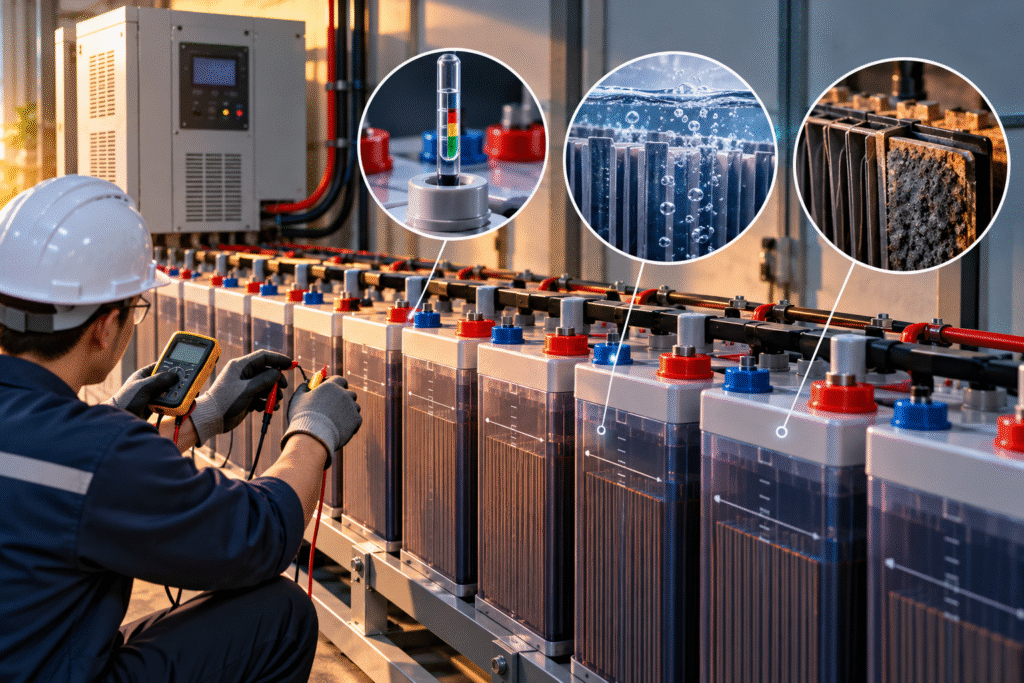
What Is an Equalization Charge?
During normal float operation, the battery remains at a controlled voltage intended to keep it fully charged.
Equalization uses a different charging condition to help bring cells back toward a more uniform state.
Depending on the manufacturer, this may involve:
- Higher controlled voltage
- Defined current
- Longer charging time
The exact values are product-specific.
Do not use one universal OPzS equalization voltage.
Equalization Is Different from Normal Float Charging
Float Charge
Purpose:
- Maintain full SOC
- Compensate self-discharge
- Support standby service
Equalization Charge
Purpose:
- Correct abnormal imbalance
- Restore full charge after certain adverse conditions
- Improve electrolyte mixing where appropriate
Equalization should therefore not become the normal everyday charging mode.
Situation 1: Large Individual Cell-Voltage Differences
One reason to consider equalization is persistent cell-voltage imbalance.
Example:
Most OPzS cells on float are relatively consistent.
Several cells remain noticeably below the rest even after adequate normal charging.
Before equalizing, first rule out:
- Measurement error
- Poor connector
- Low electrolyte level
- One defective cell
- Temperature difference
Equalization cannot repair an internal short or mechanically damaged battery.
Situation 2: Battery Was Deeply Discharged
An extended outage may discharge the OPzS bank much more deeply than normal.
If normal charging cannot restore uniform:
- Cell voltage
- Specific gravity
the manufacturer may prescribe a corrective or equalization charge.
However, the battery should not remain deeply discharged while technicians wait for the next maintenance visit.
Recharge should begin as soon as reasonably possible.
Situation 3: Repeated Inadequate Charging
This is common in remote hybrid systems.
Examples:
- Generator runs too briefly
- Solar array is undersized
- Charger voltage is too low
- Daily loads prevent full recharge
The OPzS battery spends repeated cycles at partial SOC.
Consequences may include:
- Sulfation
- SG imbalance
- Stratification
- Declining capacity
Equalization may help correct part of the condition—but it does not solve the underlying energy deficit.
If the solar system cannot fully recharge the battery, repeated equalization will not fix the system design.
Situation 4: Specific-Gravity Differences Persist
OPzS offers one major diagnostic advantage:
specific gravity can be measured directly.
If temperature-corrected SG remains significantly different between cells after proper charging, equalization may be considered according to manufacturer instructions.
Before doing so, confirm:
- Electrolyte levels
- Temperature correction
- Recent water addition
- Hydrometer accuracy
Do not equalize because one hydrometer reading was taken immediately after adding water.
Situation 5: Electrolyte Stratification
In tall flooded cells, denser electrolyte may settle toward the bottom while lighter electrolyte remains near the top.
Symptoms can include:
- Low upper-layer SG
- Reduced apparent capacity
- Uneven acid concentration
Controlled gassing during appropriate charging can help mix the electrolyte.
Equalization may therefore be useful in some stratification conditions.
But again:
identify the problem first.
Equalization Should Not Be Used to Hide a Weak Cell
Suppose one OPzS cell has:
- Very low capacity
- High self-discharge
- Internal short
Repeated equalization may temporarily change its voltage but will not correct the underlying failure.
If the same cell becomes abnormal after every charge, perform:
- Capacity evaluation
- Self-discharge test
- Physical inspection
rather than endlessly increasing charge voltage.
Check the DC Load Before Raising Battery Voltage
This is one of the most important engineering considerations.
During equalization, total battery voltage can rise well above normal float voltage.
In a 110V or 220V DC system, connected equipment may not tolerate this higher voltage.
Before equalizing, determine whether:
- Loads can remain connected
- Loads must be transferred
- Charger output must be limited
OPzS manufacturer guidance specifically warns that permitted load voltage may be exceeded during equalization and that this should be checked before the process begins.
Calculate the Maximum DC Bus Voltage
If: Equalization voltage = Ueq per cell
and: Number of cells = N
then: Maximum DC bus voltage ≈ Ueq × N
Compare that value with:
- Relay limits
- PLC input limits
- Communication equipment
- Inverter DC limits
- Lighting circuits
This is particularly important in long substation strings.
Battery Temperature Must Be Monitored
Equalization increases:
- Charging activity
- Gassing
- Heat generation
Therefore, battery/electrolyte temperature should be recorded during the process.
If temperature rises excessively:
- Reduce current
- Interrupt charging
- Return to float
according to the manufacturer’s procedure.
Do not continue equalization simply because the programmed timer has not finished.
Individual Cell Voltage Should Be Measured
Before equalization, record every cell.
During charging, watch:
- Highest-voltage cell
- Lowest-voltage cell
- Temperature outliers
After equalization, record them again.
The purpose is to answer:
Did the voltage distribution actually improve?
Without before/after measurements, technicians cannot know whether the procedure achieved anything.
Measure Specific Gravity Before and After
For OPzS, record:
- SG
- Electrolyte temperature
before equalization.
Then repeat after the battery has completed the approved process and stabilized sufficiently.
A useful table:
| Cell | SG Before | SG After | Voltage Before | Voltage After | Temp. |
|---|---|---|---|---|---|
| 01 | |||||
| 02 | |||||
| 03 |
This turns equalization from guesswork into a documented maintenance action.
Expect More Gassing
Higher charging voltage usually produces more gassing in flooded lead-acid cells.
Therefore:
- Ventilation is important.
- Ignition sources must be controlled.
- Water consumption can increase.
The battery room should already be designed for the applicable gas-emission conditions.
Check Electrolyte Level
Equalization can increase water loss.
Check electrolyte level according to the battery manual.
Avoid filling every cell to maximum immediately before a strong equalization charge unless the manufacturer’s procedure specifically requires it.
Electrolyte expansion and gassing can contribute to overflow if the cell has been overfilled.
Use the Correct Water
If topping-up is required after the procedure, use the manufacturer-specified:
- Distilled water
- Demineralized water
Do not routinely add acid to compensate for water loss.
Equalization and Water Consumption Must Be Viewed Together
Suppose a customer reports:
“Our OPzS batteries need water every month.”
Then you discover the charger automatically equalizes every week.
The problem may not be battery quality.
The charging strategy may be unnecessarily aggressive.
Review:
- Equalization frequency
- Voltage
- Duration
- Battery temperature
before changing the maintenance schedule.
Equalization Is Not a Substitute for Correct Float Voltage
A battery chronically undercharged on float will repeatedly become imbalanced. Technicians equalize it. The battery temporarily improves. Then the problem returns. The real cause remains:
incorrect float charging.
Before equalization, verify:
- Float voltage
- Temperature compensation
- Charger calibration
Equalization Is Not a Substitute for Adequate Charging Energy
In an off-grid solar system:
Night load: large
Daily PV surplus: too small
The battery never reaches full charge.
Increasing equalization frequency may actually increase:
- Water loss
- Heat
- Generator runtime
without fixing the energy balance.
The project may need:
- More PV
- Longer generator charging
- Lower load
- Larger charger
Do Not Apply OPzS Equalization Settings to OPzV
This distinction is critical.
OPzS: flooded electrolyte
OPzV: GEL VRLA
Both can be tubular 2V batteries, but their charging behavior differs. Do not take an OPzS high-voltage equalization procedure and apply it to OPzV. OPzV manufacturers may permit corrective charging under specific circumstances, but the settings and limits must follow the OPzV manual.
A Practical Decision Process
Step 1 — Identify the Problem
Is the issue:
- Voltage imbalance?
- Low SG?
- Deep discharge?
- Stratification?
- Incomplete charging?
Step 2 — Correct Basic Causes First
Check:
- Float voltage
- Charger operation
- Electrolyte level
- Temperature
Step 3 — Record Baseline Data
Measure:
- Cell voltage
- SG
- Temperature
Step 4 — Confirm Load Voltage Compatibility
Can the connected DC equipment tolerate the equalization voltage?
Step 5 — Apply Manufacturer-Approved Procedure
Use the specified:
- Voltage
- Current
- Duration
- Temperature limit
Step 6 — Monitor Continuously
Watch:
- Cell voltage
- Temperature
- Gassing
Step 7 — Determine the End Point
Use manufacturer criteria rather than simply “charge for 24 hours.”
Step 8 — Recheck the Battery
Compare:
- Voltage spread
- SG spread
- Temperature
Step 9 — Investigate Cells That Remain Abnormal
A cell that does not respond may require deeper testing.
Signs the Equalization Worked
Possible positive results include:
- Reduced cell-voltage spread
- More uniform SG
- Improved charge state
- Better discharge behavior
Document the data.
Signs the Problem Is More Serious
Further investigation is needed when:
- One cell remains low
- One cell becomes excessively hot
- SG does not recover
- Self-discharge remains high
- Capacity remains poor
At this point, repeatedly equalizing may create more stress without meaningful benefit.
Example: OPzS Bank After Generator Failure
A remote site experiences a long outage. The battery is deeply discharged. Generator repair takes several days.
After normal charging:
- Most cells recover.
- Several cells remain lower in voltage and SG.
A sensible process is:
- Confirm normal charge has completed.
- Correct electrolyte level if required.
- Record SG and voltage.
- Apply the manufacturer’s corrective equalization procedure.
- Monitor temperature.
- Recheck SG.
- Capacity-test if runtime remains poor.
This is more reliable than immediately replacing several cells.
Example: Weekly Equalization in a Standby Substation
A standby OPzS battery rarely discharges. The charger performs automatic high-voltage equalization every week.
The site reports:
- Heavy gassing
- Frequent watering
- Terminal corrosion
This should trigger a review of the charging program. Equalization should have a technical reason. More charging is not always better charging.
Equalization Maintenance Record
Record:
- Date
- Reason for equalization
- Initial voltage
- Initial SG
- Electrolyte level
- Equalization voltage
- Current
- Start time
- End time
- Maximum temperature
- Final SG
- Final cell voltages
This is particularly useful for warranty and long-term maintenance.
Common Mistakes
Equalizing on a Fixed Calendar Without Checking Battery Condition
Can increase unnecessary stress.
Raising Voltage to “Repair” Capacity Loss
Equalization cannot reverse every aging mechanism.
Ignoring Load Voltage Limits
Connected electronics may see excessive DC voltage.
Ignoring Temperature
Battery heating can become excessive.
Adding Acid After Every Equalization
Normal water loss should not be corrected with routine acid addition.
Copying Another Brand’s Voltage
OPzS settings are manufacturer-specific.
Applying OPzS Settings to OPzV
These technologies require different charging control.
Frequently Asked Questions
Does every OPzS battery need regular equalization?
Not necessarily. Equalization should follow the battery manufacturer’s instructions and actual battery condition.
Can equalization correct low specific gravity?
It may help when incomplete charging or stratification is responsible, but low SG has several possible causes.
Does equalization consume more water?
It can because higher charging voltage generally increases gassing.
Can the load remain connected during equalization?
Only if the connected equipment can tolerate the higher DC bus voltage.
Can equalization recover a sulfated OPzS battery?
It may help certain undercharged/sulfated conditions, but it cannot repair severe permanent plate damage.
Can the same procedure be used for OPzV?
No. Follow the OPzV manufacturer’s specific charging instructions.
Conclusion
OPzS equalization should be treated as a controlled corrective procedure, not a routine button to press whenever the battery appears weak.
The correct sequence is:
diagnose → measure → equalize when justified → monitor → measure again.
The most important parameters are:
individual cell voltage + specific gravity + temperature + charging current + total bus voltage.
Used correctly, equalization can help restore a more uniform battery condition.
Used unnecessarily or incorrectly, it can increase:
- Water consumption
- Gassing
- Temperature
- Corrosion
- Maintenance cost
For large OPzS solar, telecom, UPS and substation systems, keeping a documented equalization history also makes future battery-condition assessment much easier.